CATHOLIC ORTHODOXY
AND
ANGLO-CATHOLICISM,
A WORD ABOUT INTERCOMMUNION BETWEEN THE ENGLISH
AND THE ORTHODOX CHURCHES.
BY
J.J.
OVERBECK
And
he said unto me, Son of man, can these bones live?
And I answered, O Lord God, thou knowest."--Ezek. xxxvii. 3.
LONDON
TRÜBNER
1866.
|
PREFACE.
THERE is a
kind of constraining power and agency inherent in Truth; "for we cannot
but speak the things which we have seen and heard" (Acts iv. 20). Some
may deem it wise not to startle the minds of settled persons by what
they term a revolution in Religion. Some may deem it preposterous to
oppose the rocky wall of the Church to the wild waves of a certain
school of human science and researches. Some may deem it harsh and
cruel to hurt the; feelings of friends, whose most sacred convictions
we attack unreservedly. Oh! it is painful, I know, to disagree with
those who are dear to our heart. But Truth is uppermost, and permits no
bartering, no deference to circumstances whatever.
I found the Orthodox Church to
be the only true Catholic Church, and, consequently, try to bring about
a Reunion of the other Christian Churches (chiefly of the English
Church) with the Orthodox. About a year ago I wrote a German book ("Die
orthodoxe katholische Anschauung, &c," Halle, 1865) on this
subject, and had the satisfaction to hear that it was directly
circulated in two Russian translations. A Russian gentleman of high
standing and profound theological learning wrote me a letter in which
he states: "Mon coeur a été touché par cette
franche et loyale confession de vos sentiments vraiment orthodoxies
..... Vous avez su parfaitement bien deviner les seuls moyens
possibles pour l'union tant desirée entre l'Orient et
l'Occident, et on PEUT ACCEPTER DE FACTO TOUTES LES CONDITIONS QUE VOUS
[iii/iv] AVEZ PROPOSÉES." And another Orthodox, who is at the
same time a well known theological author of great merit, wrote: "Ihre
Ideen sind praktisch ausführbar, und desto kräftiger
konnen sie auf die Gemüther der Freunde der Wahrheit wirken. Ihr
Buch hat besonders in Petersburg und Moskau eine warme Aufnahme im
Publikum gefunden."
Critical reviews came in,
pleasant and unpleasant, as it usually happens in such cases. I only
pick out two, one of the Protestant "Theologisches Literaturblatt von
Dr. K. Zimmermann" [Darmstadt], which is a pattern of benevolent and
gentlemanly dealing; and one of the Roman-Catholic
"Chilianeum," whose anonymous author hides himself, as it were, "under
the water," reminding me of the Ovidian frogs:
Quanquam sint sub aqua, sub aqua maledicere tentant.
The present book was, while I
was writing it, simultaneously translated into Russ by kind and
actively sympathizing hands.
I trust the English public will
be indulgent to my feeble attempt to express myself in their language,
and excuse a foreigner to meddle in their affairs. However, Religion
is, I think, a common property of mankind, and nationalities may not
form a bar in heavenly things, but are connected by a bond of
solidarity comprising the whole Catholic world. To re-introduce
the English Church into this Catholic Commonwealth was my aim in
writing this book, and I hope God will bless my endeavours.
CATHOLIC
ORTHODOXY.
The Catholic truth has been preserved by the Orthodox
Catholic Church, whilst Roman Catholicism introduced innovations both
in doctrine and discipline into the old common deposit of truth. "No
Popery" was a cry raised in the East five centuries before the
Reformation propagated it to the West. "No Popery! No Protestantism!"
is ourthe Church which Christ founded and not man.
cry, and we hope to awake all who seek after truth based on a solid
foundation, based on
The Church has many branches. There is an
Eastern Orthodox Catholic Church, and there is a Western Orthodox
Catholic Church (although now disfigured by Romish errors, but to be
purified and restored by God's help). Within the Eastern Church there
is a Greek, a Russian Church. Within the restored Orthodox Catholic
Church of the West there will be an Italian, a Gallican, a Germanic, an
Anglican Church. Every nationality will have its Catholic Orthodox
Church according to its [1/2] national usages, but based on the common
Catholic doctrine and holy canons.
Without the full truth there can be no claim
to Catholicity. He who accepts one truth and denies the other, or
sticks to one truth as being fundamental, and dispenses with others as
being accessory, or unimportant, or doubtful, or even injurious to
sound belief--such a one is no Catholic.
Without undoubted Apostolical Succession and
lawful priesthood there can be no claim to Catholicity. Christ charged
his Apostles to teach and to administer the Sacraments. The Apostles
consecrated Bishops to do the same. The Bishops ordained Priests and
Deacons to assist them in this their work. No others were ever
considered by the Church as competent to fulfil this task. Sacerdotal
power is from God, not from man. If any one holds all the doctrines of
the Church, but depends on an unlawful and invalid Episcopate, his
belief cannot supply nor make good the invalidity of Ordination. There
will be no Consecration of the Eucharist, no Absolution, &c, since
the pretended priest is nothing but a layman.
These general principles will be found correct by every
so called Anglo-Catholic. Let us now go a step farther and examine,
whether Catholic Unity can subsist without FORMAL Intercommunion
between the branches of the Church.
An invisible Intercommunion amounts, in its
significance, exactly to an invisible Church. But [2/3]
inasmuch as a visible Church has been founded by Christ, a visible
Intercommunion is so materially necessary to the Catholic Commonwealth,
that an attempt to deny or destroy it would be tantamount to apostasy
from Catholicity. Even the wish to have Intercommunion established, but
refusing to adopt the proper means, would be an imperfect velleity and
sinful indifference.
Let us impress this truth as deeply as possible on our
minds, that Insulation is Death, that a limb not connected with
the body, not taking part in its functions, not co-operating with the
whole, is lifeless. You do not delay with gangrene--a moment lost,
perhaps all is lost. With the immortal soul on the brink of eternity
there is a periculum in mora. If the bulk of the Catholic
Church denies you admittance, there must be some strong reason not to
be slighted.
Let us now view the Anglican Church, and
examine whether an Intercommunion between the same and the Orthodox
Catholic Church is possible and practicable.
First of all, what is the Anglican Church? The
definition is more than difficult. For if I say, it is that Christian
Denomination, the basis of which is the Bible, the Prayer-book, and the
Thirty-nine Articles, at once the Evangelical party will rise
and cry: "The Bible, and the Bible only is our foundation. We
disapprove a great deal of what the Prayer-book retained from Popery.
No Ritualism, no [3/4] Sacerdotalism! No sham of Apostolical
Succession! We all are priests. There is no Hierarchy divino jure,
clergymen and laymen are not essentially different, there is only a
distinction for order's sake. Our Intercommunion extends to Christendom
at large, and needs no formal verdict." Now the Evangelicals form the
majority of the English Church; and they neither miss nor want a formal
Intercommunion with the Orthodox Catholic Church.
Another party in the
English Church, almost as strong as the Evangelicals, and daily gaining
a greater ascendency, are the Broad-Churchmen. Their belief is
like the rainbow, many-coloured, hazy, shaded, clouded, changing
according to the temporary taste and fashion. While the Evangelicals
are trampling on the Mitre and Crosier, attacking Baptismal
Regeneration, Confession, and Real Presence, but fighting for the Bible
and its Plenary Inspiration, the Broad-Churchmen pitifully smile at the
Evangelical war against Popish trifles, concentrate their force against
the Bible, and do not accept but a few " truths sifted from amongst a
heap of rubbish hitherto considered as sacred relics." But, in the end,
Broad-Churchism evaporates in Pilate's saying: "What is truth?!" Well,
what is truth? I ask you. They shrug their shoulders and point to the
light of Scientific Researches, shining forth from Preadamite human
skeletons, from the vertebral knot of an ape's skull, from the extent
of physical and ethnographical studies. Well then let us live [4/5] to
see Christianity crumbling down under the hammer of such powerful
miners! They have already, by their watery arguments, quenched " the
fire that never shall be quenched," changing eternal punishment into
temporal correction. Judas Iscariot, nay, Satan (provided they admit
his real existence), will be saved one day. They will be able, I
expect, to wield the Cyclopean hammer, forging thunders more effectual
than those of the Vatican, in order to smash the Church to pieces. They
will be able, I expect, to climb and force, with Titanic bravery, the
pinnacles of heaven in order to dethrone the good old Christian God,
and to replace him by their weak sentimental phantom of a Deity moulded
out of goodness without holiness and justice, a Deity encompassed by a Magna
Charta of human rights, versus divine usurpations, a Deity of
"limited liability." Broad-Churchism strikes at the very root of
Christianity. And do you think, after this, that Broad-Churchmen really
care a bit for Intercommunion between the Orthodox and English
Churches? They like to be left alone; they have no wish to be bothered
in their state of perfect ease and comfort; and if they do wish for any
Intercommunion at all, it is not with Christians only, not with Jews
and Mahommedans only, but with Parsees, Hindoos, and Zulu-Kaffers (as
soon as properly educated). Why should we intrude upon Churchmen who
consider it the greatest glory of the English Church, that she is so
spacious as to accommodate all shades of religious opinions; that she
is not so narrow-minded as to exclude any [5/6] newcomer, or to ask him
after his Christian credentials. This forcibly reminds me of the large
barrack-like Parisian "Cités" which accommodate hundreds of
families without any other mutual bond but the bare walls of the
building.
There is, however, a grand and
prominent feature in Broad-Churchism, the undoubted merits of which
claim our just appreciation. The Broad-Churchmen are the only
consistent Protestants as opposed to the Evangelicals. They alone
can boast of standing on the genuine ground of the Reformation,
sticking fearlessly to the right of Private Judgment, which Luther so
emphatically claimed for himself, but denied to others.
Si fractus illabatur orbia,
Impavidum ferient ruinæ.
Never mind the ruins
they make; the ruins are but the necessary process of dissolution.
Bishop Colenso speaks out what he thinks, and he may do so, for
Protestantism has no lawful authority to restrain Private Judgment. The
Evangelicals lament the awful mischief which this modern school of
unbelief produces. And so do we. They invite us to combat our common
enemy. And so do we. They call their opponents traitors to the
Protestant cause. And we do not, for Broad-Churchmen arc the only true
Protestants. They bewail the decline of belief, but glory in
Protestantism. We bewail the decline of belief, but still more bewail
Protestantism as being the real parent of this unbelief. They pray God
to protect and uphold Protestantism. We consider such prayer a
blasphemy, [6/7] and pray for the destruction of Protestantism. We hail
Broad-Churchmen as the destroying angels of Protestantism. We
congratulate them on every breach they make in the Protestant
stronghold, not for their sapping the Christian belief, but for
bringing the malady of Protestantism to a wholesome crisis. Dr. Strauss
and Dr. Schenkel fling contemptuous inconsistency into the face of
their Evangelical opponents. The Evangelicals produce the Bible, but
their adversaries challenge them to demonstrate its genuineness,
authenticity, and inspiration, but they cannot, on Protestant ground,
stand the force of their opponents' arguments, they resort to the
Church and its Traditions, call History to their assistance, viz.
Church-witnesses. The Broad-Churchmen reply: "That is foul play! Don't
apply to the Church, the pillars of which the Samsons of the
Reformation have effectually shaken and upset!" Thus the Evangelicals
dwindle away into nothingness, execrate the enemy with unctuous
animosity and stubborn fanaticism. Voila tout! Arguments they have not
on Protestant ground, but holy indignation, prophetic thunders, and
cheap sneers.
Difficile est, satiram non scribere.
The Evangelicals float in
the air without any solid ground to rest upon. The Bible they have
purloined from the Church. Therefore it is a lifeless and deadly letter
in their hands, a letter which they twist according to their moderate
measure of understanding or misunderstanding. Not two Evangelicals
together understand the most important [7/8] passages of the Bible in
the same way. They slide over precipices, unwilling to expose
themselves in sounding the depths. And then they swear the clearness
and sufficiency of the book, which they have overclouded by a mist of
human effusions. The mist they like, it is true, because they cannot
reach the ground under their feet. Visionary prophecies and sublime
hallucinations about them fill their souls, but the true ground they
lose sight of.
This true ground is
the Church, the one Catholic and Apostolic Church which historically
continued since Pentecost. From this Church Protestantism snatched the
Bible, but lost (together with the Church) its legitimation and the key
to its understanding.
Our sympathy is with neither of the parties, but if
Consistency is a plea for preference, we decide in favour of the
Broad-Churchmen. Although the Evangelicals are believers and hold a
great many more truths in common with the Catholic Church (chiefly the
truth of Christ the God-Man and his Atonement), than the
Broad-Churchmen, those truths are either enveloped in a cloud of
incorrect notions, or partly altered and falsified, and, in the end,
the whole structure rests upon as wrong a basis as the Broad Church;
with the exception, that a sect of fanatic believers is much less
accessible to truth and resipiscence than a sect of scanty belief and
broad rationalism. The Broad Church is a blank, a tabula rasa;
the Evangelical Low Church [8/9] is a prolific, luxurious field covered
with lianas and weeds, stifling the few flowers and fruits which
occasionally may be produced.
And now, what are our hopes
and expectations from these two parties of the English Church?
The Evangelicals scarcely will
yield by themselves to any plan of Orthodox Intercommunion. Their
inveterate self-conceit can only be broken, as it were, by a wonder.
They display great activity, have a fervent love for the Bible, and a
fervent hatred of all that contradicts their opinions. They do not love
the Bible, but their Bible. After having infused into
the Bible their misconceptions, they like this their subjective Bible,
cherishing in the Bible nothing but their own conceited self,
fondling their biblicized Calvin. They read the Bible, are fond of the
Bible, as being their home-made book, not as the God-sent
Church-book. I call this an egotistical worship; I call this--Bibliolatria.
They love Christ, and Dr. Pusey forgives them a great many errors on
account of their love of Christ. But " if any man shall say unto you,
Lo, here is Christ, or there; believe it not; for there shall arise
false Christs." I openly confess that I dislike a Calvinistic Christ,
and that I do not " go forth into the desert to see him." I only like the
true, historical Christ of the Church, not the heretical phantom of
Christ, preaching Calvin's doctrines--and awful doctrines they
are--subverting the very foundation of all Catholic truth, haunting
poor mankind and [9/10] hunting them into despair for three centuries
past. Such a Christ Aras not crucified for us; he cannot atone us,
because he sprang from the brains of Calvin, but did not descend from
heaven. "But they intend at least to love the real Christ, and their
good intention will save them." I hope so myself, however the idolater
also intends to worship the real God, not the brass or ivory idol, but
the hidden God, represented by those images, and still nobody doubts
his idolatry. I will not carry this momentous question any farther, but
content myself with hinting how deeply Protestantism has uprooted the
Christian truth.
The Broad-Churchmen are quite
bewildered, frightened out of their wits, haunted by our "portentous"
notion of an "infallible Church." And how could they catch the
idea, after having lost the Personality of the Holy Ghost?
Church-infallibility is, therefore, in their eyes associated with
priestcraft on the one hand, and with outright folly on the other hand.
They write on the Church doors:
Per me si va nella città dolonte:
Per me si va nell' eterno dolore:
Lasciate ogni speranza voi, che 'ntrate.
Still they cannot refrain
from staring at this imposing fabric of astounding consistency. "Consistency"
is the spell which charms these men and introduces them into the study
of the Catholic Church. They study, grow more and more interested in
the matter, and finish by finding the commensurability of our notions,
their rationality, their cogency. How many earnest Rationalists have
[10/11] joined the Church, even some of their most desperate leaders,
e. g. Daumer! Others are paving the way to the Church, e. g. Bruno
Bauer. In this question experience can only show on which side there is
a greater hope for the Church; and I think, experience points to those
wanderers, poor in belief, whose lives are spent in seeking the truth,
not in enjoying the riches of self-made truths. The honest Rationalists
are nearer the truth than the boastful Evangelicals, who do not search
the Scriptures but for finding supports of their own tenets; and when
Scripture clashes with their preconceived notions, Scripture must yield
to the most painful contortions. The Evangelical is the rich and pious
Pharisee, the Broad-Churchman is the poor, needful, doomed Publican in
our Saviour's parable. Hence you will scarcely see a determined
Evangelical join the Catholic Church, but he rather associates with the
Irvingites or the Plymouth Brethren or any other mystical sect, tired
even of the easy shackles of the English Church.
One finds, however, among
Evangelicals a band of truly humble souls, poor in spirit, without
bitterness and animosity, not spasmodically clinging to a sectarian
creed, but open to the light from above. These are dear to our heart,
and we pray that, as they already implicitè belong to
the Catholic fold, God in his mercy may soon lead them to the visible
communion with our Church.
On the contrary, there is
a large class of Broad-Churchmen, chiefly consisting of young worldly
people of loose morals or superficial scientific [11/12] pursuits, who
use or rather abuse religion as a cloak which one needs in good
society; or who use Religion as a butt for their abortive wits and
loathsome sneers. There is no human hope for these, but the heavy hand
of God's merciful providence may, in due season, find its way to the
heart of those whom we consider now to be castaways.
Summing up the result of the preceding pages we find:
1. That neither the Evangelicals nor the Broad-Churchmen have
a proper notion of "the Church" in the Catholic meaning of the
word;
2. That both parties do not recognize an obligatory
Church-authority;
3. That they do neither wish nor want an Intercommunion of
the English and Orthodox Churches;
4. That the Orthodox Church must declare them to be heretics,
with whom an Intercommunion would not only be impossible, but
positively sinful, since by such Intercommunion heresy and schism would
creep into the Orthodox Church, and would make her Heterodox, depriving
her of all farther claim to Catholicity.
The third party of the English
Church is called High-Church. They form, so to say, the Conservative
body of the Church, whereas the Evangelicals may be termed to a
certain extent the Liberals, and [12/13] the Broad-Churchmen
the Radicals. These High-Churchmen lay a stress upon the
Church, connect the Bible with the Church, respect the old
Church-observances, e. g. the vigils, the feast and fast days, which
have fallen into utter desuetude with the other parties of the Church.
They like to style their clergymen " Priests," and themselves to be
considered a branch of the Catholic Church. The Church is their
aristocratic pride, and they contribute large sums for building,
beautifying, restoring, endowing churches. Hooker's Church Polity is
their standard work. You will find on the shelves of those among them
who profess theological learning, the works of their Bishops Andrewes,
Laud, Beveridge, Bramhall, Overall, Nicholson, Wilson, Cosin, Bull,
&c. The Dissenters and their Chapels they disdain, and feel sorely
grieved at the Evangelical dissent creeping into the Church. Of the
Broad Church they are ashamed, and feel deeply the defect of the
English Church in not being able to excommunicate them. They love both
the Prayer Book and the Thirty-nine Articles, either not perceiving the
deep gulf between both, or bridging it by interpreting the Articles by
the Prayer Book, as the Evangelicals interpret the Prayer Book by the
Articles. No wonder that both parties, although building on the same
substruction, come to a very different result. The chief glory of the
High-Churchmen is the boasted Apostolical Succession of their Bishops.
They profess not to entertain the least doubt about the same. Still
neither the Romish nor the [13/14] Orthodox Church recognize it, and
the Protestants do not care for it. Thus the English Church remains insulated.
Again, Insulation naturally creates uneasiness, doubt,
peevishness. How is it that such an immense number of books are written
about the Validity of English Ordinations? If the matter is so evident,
as you say, it is but time and labour lost to write ever and anon on
the same subject. And dangerous it is too to speak so much about a
matter till one begins to doubt, who never thought before of doubting.
Is it not the same with a defendant who asserts his innocence but
cannot come to an end in asserting it? At last people begin to think
there must be a hitch in the business, he cannot feel re-assured
himself, else he would not continue re-assuring others. It is a sad
thing to be insulated, without relations, friends, or acquaintances. In
fact, it is so uncommon that one feels obliged to ask, why is it so?
The Protestants alone are the only persons who offer their friendship
and intercommunion, but you refuse for fear of embarking in an affair
by which you might lose your Catholic claims. Thus all the Catholic
world refuse Intercommunion with you, re-ordain your priests who join
their Church, and have continued doing so for the last three centuries?
A long time indeed! Is it not hoping against hope to flatter oneself
with finally obtaining a favourable decision in a controversy pending
so long, a controversy which in its practical bearing has been
decided in the negative? For how could the Catholics re-ordain your
priests unconditionally, if they entertained even [14/15] the
remotest doubts about the Invalidity of your Ordinations, or if they
did not consider the question as finally and peremptorily settled?
However, you have one small friend, the Moravian Episcopal Church.
You recognize each other, consequently you adopt the full
Protestant creed of the Augsburg Confession, on which the Moravians
rest. Now we want another Newman to show the harmony of the Thirty-nine
Articles and the Augsburg Confession. It would not be difficult, I am
sure; at least not so difficult as that clever feat to harmonize the
Thirty-nine Articles and the Tridentine Confession. At all events it
would be worth while trying to reconcile the Augsburg with the
Tridentine Confession by the instrumentality and mediation of the
Thirty-nine Articles. Romanism and Protestantism, fire and water
reconciled!
There exists a Caricature
representing an elderly, sleepy bishop on the box of an omnibus,
driving on slowly, very slowly. On the opposite side you see the
Baptist Spurgeon, riding on the steam-engine of an express-train, with
flying hair, riding and preaching all along. It is not very pleasant,
indeed, to be joked at, but as long as the joke is not a mere calumny,
there is some truth at the bottom which one ought to mind.
Ridendo dicere verum.
Lord Palmerston had a very
fine collection of his caricatures, and, no doubt, he had improved by
them, the legitimate legatees of the prince's jesters. Let us now
inquire into the truth of the picture. The Baptists, the most active,
restless, turbulent [15/16] Dissenters, essentially akin to the
Evangelicals within the pale of the English Church, represent the
stirring element in the religious world, stirring, ever stirring,
without settling. It is interesting to see a high-spirited youth
rushing out to conquer the world. By his noise he arouses people from
sleep; by his endless talk he molests quiet men and compels them to
lift their voices; by his importune questioning he drives one mad, but
in the end you answer his questions, in order to be relieved from the
inquisitive young man. His voluble tongue utters a great deal of trash,
of florid nonsense, it is true, but among the rubbish you will find
sometimes a hidden pearl, a word which strikes home, arousing the
heedless sleeper from a dangerous security. The young man rides off on
the steam-engine, but your sleep is gone, you feel uneasy, unsettled,
doubts have entered your mind. .... That is the Providential
Mission of the Dissenters and their Evangelical friends in the
English Church, to awaken their brethren from a sound, but dangerous
sleep. They rested on the downy pillow of an unattackable,
unconquerable Church, providing for them plenty of food, both spiritual
and corporeal, plenty of truth, plenty of salvation --and all this at
the cheapest prices, i. e. with the least trouble and exertion.--Once
the English Church was a spell--now this spell is broken--it is like a
rich man who in the midst of his riches feels poor and troubled in the
very hall of his mediaeval palace, surrounded by his glorious ancestors
gazing from the gilt-framed pictures!
[17] The watchword of the
Conservative High-Churchman is: "Rest and be thankful!" An
infallible Church and strong Church-authority would be just the thing
for them. Unfortunately this authority is invested in a king or queen
who may possibly follow Broad-Church advice or listen to Evangelical
schemes. This authority is limited or rather exercised by the
Parliament, full of hostile elements, eager to weaken or destroy the
Church. The soul of the Parliament is the weather-cock called "Public
Opinion," a rather inconstant regulator of divine things. But is
there not the National Church Council "Convocation" discussing Church
affairs? Yes, it is discussing--that is all. Binding resolutions it
cannot issue, save by act of Parliament. And in this Convocation Low,
Broad, and High-Churchmen are sitting and debating, truly a most
unpromising mixtum compositum of heterogeneous principles.--Let
us pass by this ominous flaw in the Church-fabric!
There was a time when the
English Church possessed a strange, unenvied power, viz. the "Vis
inertiæ," slumbering on into broad daylight. The Dissenters
were moving and stirring--infidelity, indifference, immorality
revelling--Wesley crying and pulling his mother-church, till she awoke;
but more than one third of the Church was gone. She awoke imbued with
new life, ever since keeping up with the times--but this life was, like
sectarian life, merely individual. However, this High Church displays a
show of Church-life, which points at least to a want of real Church-life.
The High Church [17/18] combats manlily heretical teaching in the teeth
of Low Church (Gorham case), Broad Church (Essays and Reviews, Bishop
Colenso), and Parliament; and although defeated, repeatedly defeated,
legally defeated, she glories in her defeat for Christ's sake. Alas, it
is the Constitution of their Church which allowed them to be defeated
by heresy. Do you not see that you are fighting against your own
Church, which has become a refuge of heresy? Or is there any safeguard
of sound belief within the Church? Can you disown the heretical
Churchmen sitting at your side in the Council of the Church, preaching
from your pulpits, teaching your children, thus instilling the venom of
heresy into the hearts of the rising generation in whose hands lies the
destiny of times to come? These heretical Churchmen are protected by
the law; they live on your loaves and fishes, and would laugh at your
attempt to excommunicate them. Again, let us pass by this ominous flaw
in the Church-fabric!
Within the High Church there is a party who see "the
abomination of desolation stand in the holy place," who lift up their
eyes and look out for comfort and help, for strength and power, for
rest and peace. They open the Catholic annals of old, consult the
fathers of the Church, meditate in the Lives of the Saints. A new light
dawns upon them. Happy hours are spent with S. Basil, Chrysostom,
Augustine. "Well, let us again [18/19] infuse their life into our
Church!" A fuller belief is wrought out, scanty articles filled with
substantial truth, long-forgotten sacraments re-introduced, ascetic
life resuscitated. Excellent men they are these earnest High-Churchmen.
Would all the High Church were of the same stamp, but a good number of
its members are nothing but mere Conservatives, and do not take the
trouble to go beyond their actual church, whilst others, in premature
haste, precipitate beyond the mark, delight in trifles, decorations,
pompous garments, trimming up of churches, minute observances. They
ransack Romsey and Bona, and astonish their people by their abstruse
ritualistic learning rather than edify the same. They think to have our
sympathy, since their innovations are but old Catholic usages gleaned
in the East and chiefly in the West. But on the Catholic ground
these usages are significant, instructive, wholesome, having
historically grown up in their genuine soil. On the contrary,
transplanted into a cold, heterogeneous soil, they die away or grow
into superstition. These Ritualists play at ceremonies like children,
forgetting that the soul is more than the body, and both more than the
dress. It is a common mistake to take this class of Churchmen as
representatives of the High Church. They are, not inappropriately,
termed in a certain paper "Altitudinarians," as opposed to the "Latitudinarians"
(Broad-Churchmen) and "Platitudinarians" (Evangelical
Low-Churchmen). These ALP are indeed "der Alp" (the incubus) of
the English Church. Against those Attitudinarians [19/20] Archdeacon
Denison is the able exponent of High-Church principles. In the Norwich
Church Congress ("the Churchman," Oct. 12, 1865, p. 1184) he said: "he
did feel that in this country they were in a dangerous position on
account of a disposition to introduce too much of ultra ritualism--of
observances which, after all, were only the exponents of a high state
of doctrine which had been painfully arrived at, and which
could never be put in the place of the teaching of the doctrine. No
greater mistake could be made than for a man to say, 'I am going to
teach my people doctrine by wearing certain vestments and using certain
forms.' It would be a happy thing to go through the land and be able to
see no clergyman vested in any way but in that to which all eyes had
been accustomed. He had the utmost regard and respect for many of those
who differed from him on the subject, because he knew that among them
there were many of the most painstaking and hard-working of God's
Ministers, and therefore he desired to deal with the subject tenderly.
At the same time, he could not doubt that they were committing a
great mistake."
The real head of the most respectable High-Churchmen is
Dr. Pusey, whose profound learning and deep Christian
humility, together with his unflinching courage amidst persecutions and
sneers, deserve our admiration and sympathy. He has such a truly
Catholic turn in his mode of thinking that we wonder how he docs not
feel uneasy in a [20/21] Church beset with so many obstacles, open to
heresy, devastated within, broken up from without. It must be, no
doubt, on the one hand the force of habit which keeps him in a Church,
in which he was born and educated. On the other hand, he must foster an
idea of his Church, which idea is far from real, but which the love of
his mother-church realizes to his heart. Do we not see thousands of
affectionate children who cannot see (and if they could, they may not
see) the defects of their mother which everybody else sees? Dr. Pusey
is the father of the so-called Anglo-Catholics, sometimes
styled Puseyites, though by this by-name are generally
understood those High-Churchmen who revel in decorative tom-fooleries
and stylish ceremonies. He was, though not the originator, still a
mighty support of the Tractarian movement. He quieted the
passions of the young hot-brained Tractarians, smoothed down the
Romanizing tendencies, and was always an upright friend of the Eastern
Church, which he considered to be in unison with his own. Still he
remained a Western Churchman, guided by the true idea that both
Churches are fully entitled to have their own way and subsistence, only
linked by the bond of common Catholic truth and Catholic Constitution.
He would be quite right, provided his Church were a true branch of the
Western Catholic Church. The same is the case with Dr. Neale's most
excellent lecture, "The Bible, and the Bible only, the religion of
Protestants," which is quite unexceptionable if you substitute
"Catholic Church" for "English Church." Dr. [21/22] Neale's ideal
English Church is equally opposed to Popery and Protestantism. Would it
were so in the real English Church. Let a Broad-Churchman of
very advanced principles approach Dr. Neale's communion-table--will he
be able, lawfully, to refuse him the communion? Let the Bishop of
London enter his chapel and see his half Eastern, half Western
sarcerdotal garments--what do you think would be his episcopal verdict?
Now let us inquire into the claim of the Anglo-Catholics to
be members of the Catholic Church.
I.
Do the Anglo-Catholics possess the full Catholic
belief?
If we must decide in the
negative, it will be sufficient to prove that some of the
fundamental Catholic truths are not held by the
Anglo-Catholics, without entering into an examination of the other
unsound doctrines.
In acceding to Archbishop
Manning's charge, that "the Church of England rejects much Christian
truth," we specify this charge by singling out the most advanced
believing party of the English Church, showing that even those cannot
claim Catholicity of belief.
1. What is the relation between the Bible and the
Church?
In order to simplify this
question, let me propose the respective Orthodox Catholic view.
[23] Jesus Christ taught his
Apostles, during his lifetime and from his Resurrection to his
Ascension, all the Catholic truth, founded the Church, to be
guided infallibly by the indwelling Holy Ghost, "upon the foundation of
the apostles and prophets, Jesus Christ himself being the chief
corner-stone." THIS CHURCH IS "THE PILLAR AND GROUND OF THE
TRUTH,"--and I add most emphatically--the only pillar and ground of the
truth. The Apostles deposited this truth in their several Churches,
consecrated bishops to be their successors and preservers of the truth
deposited. Of this "depositum fidei" part was occasionally
written, part orally transmitted (2 Thess. ii. 15), but both the
written and unwritten word of God formed but one and the same faith,
the faith of the Church. This One Word of God, as contained in
Bible and Tradition, cannot be torn asunder without making the Bible a
storehouse of deadly weapons, a refuge of heresy, a hand-book for the
use of Satan (St. Matt. iv. 6). The Bible is neither the complete
nor sufficient source of Christian truth, but explicitly points to
the contrary. To the apostles Jesus Christ "shewed himself alive after
his passion by many infallible proofs, being seen of them forty days,
and speaking of the things pertaining to the kingdom of God" (Acts i.
3). What did he speak during those forty days? "About the
things pertaining to the kingdom of God," i. e. about the Constitution
of the Church and Church-doctrine. And quite natural it
was, for the foundation of the Church was close at hand. Of this
teaching we find fragments scattered about in the Epistles, [23/24] as
occasion required it, but nowhere is written down the complete account
of the preparatory instruction which Christ gave his Apostles in the
days between his Resurrection and Ascension. Still the Church rests on
this instruction, completing what we do not find in the Bible. For
instance, nobody can satisfactorily settle the important question of
the Baptism of infants from the Bible. Without the teaching of my
Church I certainly should be in this point a Baptist. Again, according
to Catholic Church teaching, the seven Sacraments are
instituted by Christ himself; but, in the Bible, you can only find two
sacraments instituted by Christ. Therefore you make the heterodox
distinction of two essentially different classes of sacraments, viz.
the two real sacraments, Baptism and the Lord's Supper, and five
sacramental rites of minor importance. Consistently you can attach to
the latter class only an "operatio ex opere operantis," and if
you still assert an "operatio ex opere operato," it is but one
of the many inconsistencies which overcloud Anglo-Catholicism vibrating
between Church and Bible. We have the Church including the
Bible, both forming but one Unity. You have the Bible and the
Church, forming a Duality disparaging either of the two. Now
as you hold the genuine Protestant belief of the self-subsistence of
the Bible, not considering the Bible as a fruit of the Church in the
full Catholic meaning of the word, exclusively belonging to the
Church, to be interpreted only by the Church--you cannot find
the proper position of the Church, but place her under the control of
the Bible. I [24/25] say, you do not fully consider the Bible as a
fruit of the Church, which fruit, as soon as ripe, i.e. canonically
completed and universally recognized, was detached from the tree, became
self-supporting and sovereign, though not
directly hostile to the tree which retains the office of keeping the
Bible's Pedigree, after having been superseded by the Bible in all its
other primitive functions. Before the Bible was ready, the Church was
acknowledged to have been an absolute monarch; since the Bible is
ready, the Church became (in the opinion of Protestants) a
constitutional prince, lodged in a splendid palace, but bereaved of all
rights, even of the right of Veto. The real power lies with the Magna
Charta of the Bible, which every one twists as it pleases him. It is
true, the Church is a most convenient armoury for the
Anglo-Catholics to find weapons for defending themselves and combating
Protestantism, but they forget that the primitive position of the
Church is materially altered, since the Bible ceased to be the
Church's helpmate, both (Church and Bible) being but one and the same
organ of the Holy Ghost. Since the Reformation the Bible has to watch
over the Church, and has to dictate the sound belief to the Church. Now
I call this Protestant table-turning. Such a Church beside
the Bible (instead of the Bible within the Church) may be
useful, handy, comfortable, but she is not necessary, merely
"un article de luxe." Wherefore the greater bulk of consistent
Protestants exploded the antiquated idea of the Church as being both
cumbrous and injurious to pure Bible-belief.
[26] The English Church teaches
on this point in the 6th and 20th of the 39 Articles: "Holy Scripture
containeth all things necessary to salvation: so that
whatsoever is not read therein, nor may be proved thereby, is not
to be required of any man, that it should be believed as an article
of the Faith, or be thought requisite or necessary to salvation." "The
Church hath power to decree Rites or Ceremonies, and authority in
Controversies of Faith (?!): and yet it is not lawful for the Church to
ordain anything that is contrary to God's Word written, neither may it
so expound one place of Scripture, that it be repugnant to another.
Wherefore, although the Church be a witness and a keeper of Holy Writ,
yet, as it ought not to decree anything against the same, so
besides the same ought it not to enforce anything to be believed for
necessity of Salvation." Now I think this is Doctrina
Protestantissima and I really pity those Anglo-Catholics who
endeavour to interpret into these articles even the smallest amount of
Catholic truth. [Jeremy Taylor inscribes the 2nd Section, Book
I. Part II. of his "Dissuasive from Popery" (Oxford, 1836), p. 187: "Of
the sufficiency of the Holy Scriptures to Salvation, which is the
great foundation and ground of the Protestant religion." The reason
why the Scriptures are sufficient to salvation is too naive not to be
given in the Bishop's own words (1. c. p. 188): "That the Scripture is
a full and sufficient rule to Christians in faith and manners, a full
and perfect declaration of the will of God, is therefore certain,
BECAUSE WE HAVE NO OTHER."] Dr. Pusey candidly owns this Protestant
doctrine, defends this Sufficiency of Holy Scripture (Eiren.
pp. 38, 39), and, therefore, stands on genuine Protestant ground.
Newman (Tract xc. 1865, p. 8), although acknowledging the meaning
[26/27] of the above articles to be "that it (the Church) derives the
faith wholly from Scripture," does not seem to agree with them,
quoting a passage from Field's work on the Church (p. 11): "So then, we
do not make Scripture the Rule of our Faith, but that other things
in their kind are Rules likewise; in such sort that it is not safe,
without respect had unto them, to judge things by the Scripture
alone." And Newman himself sums up the result of his researches by
the words (p. 12): "Scripture, it is plain, is not, on Anglican
principles, the Rule of Faith."
2. The Anglican notion of the Church is not Catholic.
Since Protestantism has nominally
emancipated the Bible from the pretended bondage of the Church,
the Church (i. e. their Church) lost the domain of authoritative
doctrinal teaching, i. e. Infallibility. You may screw up the
authority of the Church as high as possible, you never will attain
Infallibility, because the quantitativè superlative of
human authority is qualitativè differing from Divine
Infallibility. The English Church never aspired to the doctrine of
Church-Infallibility, but teaches the contrary, that "it is not lawful
for the Church to ordain anything that is contrary to God's Word
written, neither may it so expound one place of Scripture that it be
repugnant to another." Again, "it ought not to decree anything against
the same (i. e. Holy Writ)," and "besides the same ought it not to
enforce anything to be believed for necessity of Salvation." Of course
any particular [27/28] Church is liable to error, but the 20th
Article speaks of the Church in general, designating her as
"witness and keeper of Holy Writ," which implies the whole body of the
Catholic Church. And still this fallible Church is said to have
"authority in Controversies of Faith." Bishop Mant (in his annotated
edition of the Prayer-Book, p. 777, seq.) gives the following
illustration of this Church-authority after the Bishops Burnet and
Tomline: "It appears from the preceding Article, that it is not here
intended to ascribe to the Church an infallible authority .....
But this, however, we may observe, that, without any pretension to
infallibility, and without any infringement of the right of
private judgment, the Church has power to declare Articles of
faith, provided they be authorized by Scripture. . ." Now fancy
Articles of faith framed by a fallible Church, introducing heresy and
schism. But are not the particular Churches, composing the great One
Catholic Church, fallible in their decisions? Yes. Still here see the
difference of the Anglican standard. The particular Catholic Churches
commune with each other. Their decisions are, by their sister-Churches,
tested on the common deposit of Catholic faith. If they stand the test,
they are infallibly Catholic truths; if not, the respective
particular Church must renounce its error, or will be cut off from the
body of the Catholic Church. As to the English Church, it stands insulated,
without any recognized Catholic sister-Church, disowned by the whole
Catholic Church, unable to be controlled on the Catholic deposit of
faith. Even [28/29] if all the particular Churches of Catholic
Christendom would undertake the difficult task to examine the Anglican
belief, their verdict would be invalid, since "things ordained by them
(i. e. General Councils representing the whole Catholic Church) as
necessary to salvation have neither strength nor authority,
unless it may be declared that they be taken out of Holy Scripture"
(Art. XXI).--It is quite right what Dr. Pusey says (Eiren. p. 40): "The
authority of the Church was given to her by her Divine Lord within
certain limits. 'Teach them,' He said, ' whatever I command you.' All
must admit, then, that she could not command anything which should be
really contrary to Holy Scripture. Nor must she contradict herself."
But the plain words of the 20th Article imply that the Church (not one
or the other of the Churches, but the Church) may occasionally
"ordain something that is contrary to God's Word written," and "so
expound one place of Scripture that it be repugnant to another."
This being the case, Church-Infallibility is impossible. If the Church cannot
err in doctrine, consequently cannot "ordain anything
that is contrary to God's Word written, &c," no sensible man would
frame an article tending to preclude the Church from ill-using the
Bible. What would you say, if any Church would make an article: "It is
not lawful for God to ordain anything that is contrary to God's
Word written, &c.?" The negative wording would be true, though
unmeaning. Now the Church is the organ of God the Holy Ghost. It is,
therefore, not a harmless, but a blasphemous [29/30] supposition
that the Church may teach errors, and contradict or misinterpret the
Bible. It is all very well that Dr. Pusey (1. c. p. 37, seqq.)
pleads the Divine authority of the Church, but in doing so he
unintentionally censures the 20th Article which "lays down certain
limits to it" (p. 39)--human limits to Divine authority!--human
safeguards to Divine usurpation! It is awful to think,
how many and momentous errors sprang from the vicious notion of the
Church which the Reformation introduced, and which the English Church
faithfully preserves in her 20th Article. No Anglo-Catholic can
honestly elude its meaning, nor deny its bearing on the whole Anglican
system of belief.
3. The Invocation of Saints a binding Catholic
doctrine.
I select this point of
difference between the Catholic and English Churches for two reasons:
1st, because it illustrates the Catholic principle that the Bible is not
sufficient to teach all the Catholic truth; for from the Bible alone
nobody can satisfactorily substantiate that doctrine; although, in
the light of the Church, there may be easily found a confirmation
in Scripture; 2nd, because it is just now earnestly ventilated in
Anglo-Catholic circles. "We know there are many Anglo-Catholics who
hold this doctrine, treated in an exhaustive manner by Bishop Forbes in
his "Considerationes modestae" as early as the beginning of the 17th
century. But some of those who hold this doctrine, do not hold it to
its full extent; some hold it only [30/31] theoretically, but
dispense with it practically; some deem it true, but a ticklish
question too captious for the understanding of the people, and easily
leading to superstition; some regard it as private indulgence--but all
Anglo-Catholics treat the matter as an open question, deny the vital
importance of this question, and the necessity of holding and
practising it. They refer to the Council of Trent (whose authority
the Orthodox Catholic Church does not recognize), which only
requires to acknowledge that the saints may be invoked profitably,
leaving the practical consequences to the discretion of its votaries.
But the Orthodox Catholic Church, knowing that no doctrine has been
revealed to remain barren, requires with the belief also the practice
which only shows that the faith is real and not fictitious. If any one
holds the Invocation of saints to be salutary, but does not practise
it, unbelief or a want of conviction lurks in the background.
There has been talked a
great deal of nonsense upon this subject by persons who did not know
the Orthodox-Catholic doctrine. They speak of primary, secondary,
oblique Invocation, Comprecation, &c, barricading themselves
against a foe who does not exist within the walls of Catholic
Orthodoxy, which always opposed popular superstitions. The whole
controversy could have been easily settled, and more deeply understood
and valued, if they had only viewed it in the right light, that is to
say, if they had seen the connection of this doctrine and that of the Communion
of Saints, which is almost a dead [31/32] letter to Protestants,
who do not care for the departed, and only stick to the Church Militant.
Let us, therefore, give the outlines of a deeper view of the
doctrine.
The Church is the Body
of Christ (Ephes. i. 23), and "we are members of his body, of his
flesh and of his bones" (Ephes. v. 30). Christ is the true Vine, and we
are its branches. But this union is not to be understood of a hidden
and invisible Church, for "every branch in me that beareth not fruit he
taketh away" (St. John xv. 2). Hence the withered branch was also a
branch, and consequently the Church, which is spoken of as the body of
Christ, is the visible Church, whose members are incorporated
in Christ by Baptism, and bound to believe his doctrine, and to observe
his commandments. This body of Christ is mystically but really (not
only figuratively) animated by Christ's Spirit (hence the Church's Infallibility),
pervaded by his own sacramental powers, defended by his Almighty arm.
The Church is, as it were, a continued Incarnation of Christ. The
Church is "der fortlebende Christus." Christ is her head, her only head
(which needs not the paltry representation by a Vicar on earth); she
feeds upon Christ; in her veins circulates Christ's blood. Such an
aspect of the Church as Christ's living Organism must show at
once, how the poor, miserable idea of a Zwinglian or Calvinistic Lord's
Supper could scarcely find an understanding with the Catholics, who
require infinitely more for the support of their life in the Church.
Even Luther's Christificd Bread, or [32/33] Impanate Christ, was sure
to be exploded by the Church as a kind of Eucharistic Monophysitism.
This Church is tripartite,
the "Ecclesia Militans" on earth, the "Ecclesia Triumphans" of the
departed saints, and the "Ecclesia Laborans" of those who "have
departed with faith, but without having had time to bring forth fruits
worthy of repentance. St. Basil the Great in his prayers for Pentecost
says, that the Lord vouchsafes to receive from us propitiatory prayers
and sacrifices for those that are kept in Hades, and allows us
the hope of obtaining for them peace, relief, and freedom" (The longer
Russian Catechism: on the eleventh article of the creed).
This triune Church
is inseparably linked by A "SOLIDARITÉ" OF INTERESTS, so that if
"one member suffer, all the members suffer with it; or one member be
honoured, all the members rejoice with it." "That there should be no
schism in the body; but that the members should have the same care one
for another" (1 Cor. xii. 26, 25). Such is the wonderful, mysterious
vitality of the Church in Christ and through Christ,
that even the gates of hell cannot prevail against her. [Remark the
pregnancy of the expression en Cristw
(where you would expect eiV Criston), which
superficial commentators interpret as Hellenism instead of eiV; e. g. 1 Cor. xv. 19: hlpikoteV
esmen en Cristw--the hope arising from the incorporation in
Christ.] Such is her Penetrancy, that neither Heaven nor Hades
(i. e. Purgatory in the Orthodox meaning of the word) can form a wall
of partition. Only between the Church and Hell (where the damned souls,
the [33/34] withered branches, are finally gathered) "there is a great
gulf fixed: so that they which would pass from hence to you cannot;
neither can they pass to us that would come from thence" (St. Luke xvi.
26).
This is the substance of
the doctrine of the "Communion of Saints" a doctrine the bearing
of which is boundless, by far exceeding the reach of human thought; a
doctrine so comprehensive, so consolatory, so encouraging to Christian
energy, and at the same time instilling the deepest humility, that
every true Catholic must feel most deeply indebted to the Lord for this
his inestimable benefit, so much the more so, as the Protestants have
rent the Church which Christ knitted together by an indissoluble bond,
have broken the intercourse between the two worlds, and confined
themselves to the poor help which the sinful pilgrims here below bring
one to another. They say: "God is our only help; Christ is our only
mediator; we need nobody else." But who ever doubted the truism you
advance? Or do you doubt it yourselves, perhaps, because you ask your
brother to pray for you and with you? Or cannot God himself help
mankind, since he sends his angels to minister to them? Is it not an
unjustifiable mistake of Christ when speaking of the offence of
despising the little ones, to point to the Angels, saying: "Take heed
that ye despise not one of these little ones; for I say unto you, That
in heaven their angels do always behold the face of my Father which is
in heaven" (St. Matt, xviii. 10). Ought Christ not rather to [34/35]
have said: "Fear God's anger"? And how can the Angels see or know our
offences, while they behold always the face of their heavenly Father?
Are they perhaps omniscient or omnipresent? I expect you will answer to
the effect: "The Angels will know the offences through God anyhow." Now
it is the same answer I give you with regard to the Saints. How they
hear our prayers and supplications, our thanksgivings and praises, we
do not know, but they will hear them through God anyhow. But a more
serious question is started: "Why do you invoke the saints
at all? Is it not sufficient to pray to God and Christ? Nay, is it not
derogatory to his supreme honour, to seek a secondary help, as if he
was either too austere a master, or changeable and more accessible to
clever advocates?" My friend, you are sentenced by your own words,
since you ask your brother here below to pray for you and with you. Or
is the invocation of saints wrong because the saints have cast off
sinfulness, whereas the Scripture allows you to ask the intercession of
sinful men? But the original cause and principal reason of the
Invocation of Saints is unknown to you, as you are ignorant of the true
notion of both the Church and the Communion of Saints.
This chief reason is the "Solidarité"
(alluded to above) which engages the individual members of the Church
to each other, so that they may not and cannot be unconcerned at any
loss or gain, joy or sorrow, activity or sloth of any member. If "one
member suffer, all the members suffer with [35/36] it, &c."
"Likewise joy shall be in heaven over one sinner that repenteth, more
than over ninety and nine just persons, which need no repentance" (St.
Luke xv. 7). [You see they are better informed in heaven about our
spiritual affairs than we may fancy. Protestantism is awfully anxious
to keep heaven at a distance, and to deprecate its intermeddling with
our affairs; but it is of no use denying or ignoring a bond which de
facto exists, although you decline to reap its fruits and to avail
yourselves of its blessings.] This mutual engagement obliges the Church
to work on towards the attainment of her great end, viz. God's glory
and honour; that He may be all in all. The pilgrims here below assist
each other on their way home. The saints above, although personally
safe, having reached their happy home, do not, by merely changing
places, discontinue their being partners in the Church-work. They
encourage and push on the traveller by word and example, which they
left behind them, on their departure. They intercede incessantly for
the success of the travellers, pleading before the throne of God, as a
friend does in the case of his friend. Meanwhile we "Viatores debiles
et lassi" stretch out our hands to the heavenly regions where good
wishes for our welfare are entertained and prayers offered up by our
friends and associates. However, both the "Viatores" here below, and
the "Victores" there above feel a common sympathy for their faithful
companions detained in the prison of Hades, both joining their efforts
to release them. Thus the Church work goes on briskly below and above,
every member co-operating with the others, on the grand plan [36/37]
which Christ, the head of the members, laid down to God's honour and
our eternal bliss. Thus this great Co-operative Society
prospers in Christ, with Christ, and through Christ. Now, how
is it possible to speak of dishonouring Christ by invoking his saints?
Does not the whole turn on Christ, as the body on the soul, as the
accidents on the substance? Is the Church not both cristoforoV
(bearing Christ) and cristoforoV
(borne by Christ)? On the contrary, they dishonour Christ who deny this
co-operative character of Christ's Church. In fact they quite
misapprehend this efficacious Union of the triune Church, where no
sound member ever dies or is severed from the others, no sound member
remains solitary or destitute. Giving they receive, and receiving they
give. Here you have the genuine type of Divine Socialism, aped and
caricatured in the modern Phalansteres. St. Simon's reveries are but
the abuse of a deep truth; and Lamennais transferred the qualities of
the Catholic Church on the People universally.
Indeed it is rather unpleasant
and tedious, after such a lofty aspect of the Communion of Saints, to
review the frivolous objections of its opponents.--Mr. Archer Gurney,
in a letter to the Editor of the "Union Chrétienne" (7 Jan.
1866), indulges in speculative fancymongery about the Catholic Church,
intended to be what the Germans call "eine pragmatische
Geschichtsauffassung," but what is in reality nothing but a novel
visionary aspect of the Church, deprived of any objective basis. He
says, [37/38] "qu'avec le temps une grande apostasie,
c'est-à-dire une grande corruption de la foi se
montrerait (as the Scriptures predict) au milieu de l'Église
catholique, et elles (the Scriptures) nous en donnent trois marques
distinctives. . . La seconde marque de la grande apostasie, c'est... le
culte secondaire, tant des âmes des morts que des anges et des
images." As to the great apostasy, it will certainly take place "au
milieu de l'Église," but the Church must and will directly
secrete the apostolical element which will be henceforward "hors de
l'Eglise." A Church tolerating Apostasy in her bosom! is an
idea which only a Protestant can conceive, who has ever so many
new-fangled churches pullulating from the brains of those
unshackled thinkers. Abbé Guettée very appositely remarks
that the Church must preserve "le dépôt de la doctrine
divine, et que tous ceux qui voudront posséder cette vérité
complète devront s'unir à elle; nous croyons que
cette Église ne peut exister qu' à la condition
d'être une réalité et non une
chimère, comme cette Église idéale que
l'on a inventée en Occident, dans ces derniers temps, afin de
pouvoir se persuader qu'on est dans l'Église chrétienne,
même en n'y étant pas." With regard to the Invocation of
Saints Mr. A. Gurney will allow us to give him some hints: 1st, to
study a little more carefully the Bible, which plainly stigmatizes only
the pagan Hero-worship; 2nd, not to swagger about the Fathers
of the Church. St. Epiphanius speaks of the Antidicomarianites or
Collyridiens who adored the Holy Virgin as a real Goddess. I
very much doubt whether Mr. Archer Gurney read [38/39] the passage
alluded to in the works of Epiphanius, at least he did not read it at
full length (as he ought to have done), and if so, I leave it to the
judgment of my readers, how anybody can bonâ fide advance
Mr. A. Gurney's charge. Let him consult the Paris edition of St.
Epiphanius (1622), p. 1003: "Just as the perverse views of some
heretics denying the Godhead of the Saviour, and severing him from the
Father, drove others to the opposite error, and provoked them to say
that the Father, the Son, and the Holy Ghost were one and the same
person; so the unworthy doctrines reflecting on the Virgin, drove some
to the opposite extreme, and provoked to pay her divine worship;
making her a deity, offering cakes (kolluria)
in her name, and striving to honour her beyond due measure;" p. 1064:
"God the Word ... clothed himself with flesh from the Holy Virgin; but
nevertheless not a virgin to be worshipped, nor that He might make her
a deity; not that we might offer in her name; not that after so
many generations women should become priestesses . . . Let
Mary be in honour; but let the Father, Son, and Holy Ghost be
worshipped. Let no one worship Mary (Thn
Mariam mhdeiV proskuneitw) ... These silly women offer to her
the cake, or they take upon themselves to offer it in her behalf. The
whole thing is foolish and strange, and is a device and deceit of the
devil. . . Let Mary be in honour: let the Lord be worshipped (o KurioV proskuneisqw)." À propos de "cent
et mille citations (which Mr. A. Gurney says he could
furnish) de Saint Irénée, de Saint Augustin, de Saint
Ambroise, de Saint [39/40] Jean Chrysostome, d'Origène, de
Tertullien et de bien d'autres qui affirment ou qui semblent (!)
affirmer que tout culte appartient exclusivement à
Dieu;" --I defy the learned gentleman to give me one, fancy,
only one, passage of any Father of the Church against the
Invocation of Saints, i.e. in proof of the unlawfulness of the
Invocation of Saints.
This leads me to an observation
I have made in reading books written by Anglo-Catholics. You will meet
in the same with a tolerable amount of true Catholic teaching founded
on the Fathers of the Church; but as the standard of the infallible
Church is wanting, the amount varies according to the subjective
disposition of the individual; so that also in the Anglo-Catholic
denomination there is no Unity of belief, no more than in the
rest of Protestantism. By "Unity of belief" I do not mean Unity in
School Opinions, but Unity in dogmas (all of which the Church
indispensably requires to hold), e. g. in the dogma of the Invocation
of Saints. The Catholics are bound necessitate fidei, i. e.
under penalty of forfeiting their eternal salvation, to hold all the
dogmas (dogmata explicita sive declarata) without any difference, as
among the dogmas none are optional or adiaphorous. Now the
English Church, e. g. neither teaches nor enforces the dogma of the
Invocation of Saints; and no Anglo-Catholic asserts more than that the
English Church cannot object to it: CONSEQUENTLY in the English
Church (even in the Anglo-Catholic sub-division) there is at least one
dogma wanting, but the want of one destroys the Catholicity of the
Church as much as the want [40/41] of all. Therefore the
Anglo-Catholics are, MOST DECIDEDLY, no Catholics, but
Protestants, although Protestants inclining hopefully
towards Catholicism. [We are desirous to hear what the Anglo-Catholics
can reply to this my statement of facts. I do not expect to
hear attempts to show the little importance of this dogma (the contrary
to which I showed above), or the advisability of excluding its
practical bearing-- the only question on which my argument turns is the
double unquestionable fact. 1. That the doctrine of the
Invocation of Saints is, avowedly, a dogma of the Orthodox
Church; 2. That those who do not hold all the dogmas, are by
the Orthodox Church considered not to belong to the Catholic Church.]
It is astonishing how the zealous Intercommunionists dive into the
depths of Orthodox learning, rove in the remotest districts, compile
the minutest arguments, while they overlook the chasm at their feet.
They most ingenuously demand "de ne pas faire de
cérémonies," and to join hands all at once--to join hands
over the vast deep stretching out between them!
But to return to our review, we
find Mr. S. C. Malan engaged in a controversy with Dr. Fraser on the
subject of Intercommunion between the English and Orthodox Churches. In
his words there is no double dealing, no Jesuitical tortuous ways, no
childish wish of attaining the end without employing the means, no
anxious hastiness implying the fear of closer examination of this case,
which might cause the cherished idea to fall to the ground. I like men
of the stamp of Mr. Malan. There is something attractive about such
[41/42] straightforward and manly characters, and you like to deal with
them. By the way, the Evangelical party has many such characters, and I
ascribe chiefly to this circumstance the present vitality of that
party.--Mr. Malan asks (Churchman, Sept. 28, 1865) Dr. Fraser one
question: "When we talk of union with the Eastern Church, . . what is
to be done about the worship of the Virgin and of the Saints? I
have travelled extensively in the East--a better land than the
West--and I have also spent a long time at Rome. . . . The result of my
long experience is, that the Church of England is better than either
the Greek or the Romish Church; that the Greek comes next; and that the
Romish Church is unquestionably the worst of the three, but that as
regards the worship of the Virgin and of the Saints, there is very
little indeed to choose between the Eastern Church and that of Rome.
This has prevented me from joining the Eastern Church Association,
because I have too much experience not to be very matter-of-fact in
such matters. Two we know cannot walk together except they be
agreed, and there can be no union without like feeling and like faith.
I have one Mediator between God and myself, and I want no more. The
Virgin and the Saints are practically and to all intents and purposes
additional Mediators for the members of the Greek and of the Romish
Church. What, then, is to be done as to union in this case? Had we
not better settle this first?" Thus Mr. Malan declines the dogma of
the Invocation of Saints on the ground of its being liable to be abused
by popular superstitions. This fear of [42/43] Superstition lies at the
bottom of the opposition. In fact, the doctrine of the Invocation of
Saints is to one half of the English Church a stumblingblock,
to the other a bugbear, but to none a magnet drawing
towards the Church. What Mr. Malan says about the "additional
mediators," is satisfactorily repelled by Dr. Fraser's reply to the
above article (The Churchman, Oct. 12,1865): "Will not Mr. Malan admit
that a very decided sophism lurks in the double meaning of the
word 'Mediator'? Is not he himself a mediator, as well as every other
Christian, whenever he says 'Forgive us our trespasses?' If any
Christian may be a mediator thus, it is possible--I say no
more--that the Saints may also be so in the same way. No Greek, nor
even Roman, Churchman would consider the Saints to be mediators in the
mode in which our Saviour is 'our only mediator and advocate,' as
partaking of the natures of both God and man, and so being a fit
'daysman' and intermediate between both." The reply is good, but Dr.
Fraser, although a most decided Anglo-Catholic, cannot proceed beyond
the 'possible.' This plainly shows that the doctrine of the
Invocation of Saints is the sore place of the English Church,
the real touchstone of Catholicity. As soon as you touch upon
this subject, you will find the Anglo-Catholic sensitive, reserved,
timorous. This is the reason why I thought it my duty to enlarge
upon the matter beyond the due proportion of this pamphlet. Dr.
Fraser (and with him by far the greatest number of Anglo-Catholics) has
not yet come to a clear understanding on the matter at issue. He openly
[43/44] confesses: "On the subject of the question which Mr. Malan
addresses to me, I feel many difficulties. I hope that they may be
solved as the desire for union increases; but I am not myself casuist
enough to decide at what point diversity of practice or of opinion
should become a bar to unity." This is just the signal
mistake of Dr. Fraser, that he considers the doctrine of the
Invocation of Saints an opinion and not a dogma. The
Orthodox Church is most explicit in this matter, much more
than the Council of Trent. Has Dr. Fraser never consulted Kimmel's
Libri Symbolici Ecclesiae Orientalis? There he may read in the
"Confessio Orthodoxa," p. 300, seq.:
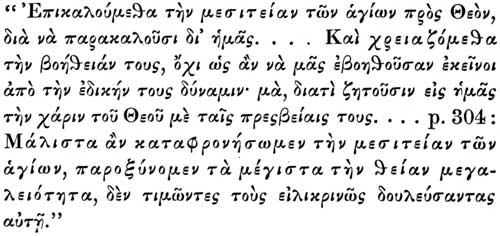
"We implore the Mediation
of the Saints with God, that they may intercede for us. . And we need
their help, not as if they assisted us by their own power, but that
they may apply in our behalf for grace of God through their prayers. .
. Yea, if we despise the mediation of the saints, we most
grievously irritate the Divine Majesty, not honouring those who
unblamably served it (i. e. the Divine Majesty)." Moreover I refer to
the acts of the Synodus Hierosolymitana, chiefly the VIIIth Decree (OroV) of Dositheus, Patriarch of Jerusalem, and
to the XVIIth [44/45] Chapter of the Confession of Metrophanes
Critopulos. Remark in this Orthodox teaching the unequivocal
decidedness and precision of language. What a gratifying contrast with
the tame style and subdued voice of the Romish teaching in the Council
of Trent, which seems to be made for entrapping converts, presenting
the minimum and hiding the maximum. Let our course be
the contrary, laying before the reader the strongest language of
the Orthodox formularies, representing the practical working of the
system. Can you heartily adopt this mode of thinking and living? If so,
it is all right. If not, do not think of joining or constituting the
Orthodox Catholic Church. It is nothing but a hoax of
Orthodoxy. I saw the other day a strange little book, "Private
Devotions as enjoined by the Holy Eastern Church, for the use of
her members." London, J. Masters, 1851. It is apparently the work
of an Anglo-Catholic who took the trouble to clear the original of the
stain of the Invocation of Saints, as the compiler ingenuously
confesses in the Preface to the work: "We must also plead guilty to
having, in one particular, adapted them (viz. the prayers) to English
use, by substituting, wherever an invocation to the saints or
to the blessed Virgin occurs, the words 'for Christ's sake,' or such
like." If the compiler had intended the book for English Churchmen, we
would have less to object, although also in this case he ought to have
put on the title-page "revised and adapted to the use of English
Churchmen;" but as he expressly writes "for the use of her members," i.
e. [45/46] those of the Orthodox Church, I find the proceeding
unjustifiable and downright Jesuitical. Is it not intended to level,
in this insidious way, Orthodoxy with Anglicanism, in order to bring
about a Union on the ruins of Catholicity?
But to proceed to the strong
language of the Orthodox formularies, I choose a few pages of the
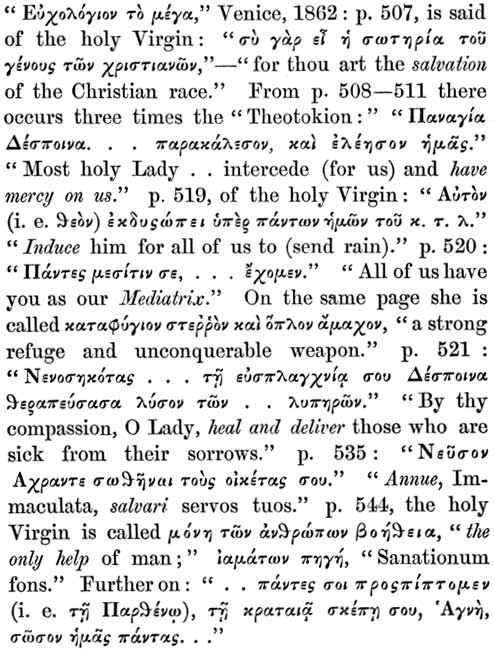
"We all fall down before
[46/47] thee (O Virgin); by thy mighty protection save us all."
p. 545: Maria . . kaqarison . hmaV, "Mary, purify
us."--These passages will produce, I am sure, a most painful
feeling on the sensitive nerves of Protestants, and will confound the
Anglo-Catholics in the eyes of their Evangelical brethren, as they
prided themselves to hold the same faith with the Orthodox. But I
appeal to your common sense. If a man, destitute and unhappy to the
utmost, approaches you, falls down, embraces your knees, conjuring you
to help him, and, after you have helped him, calls you his only helper,
should you consider this man a blasphemer, and his proceedings
derogatory to God's honour? Neither you nor the man thought of
interfering with the honour of God. You would say, all I approve that
the man has said or done, for, humanly speaking, it is true and
right. Why should we always expressly repeat that the Mediation
of the Saints is only a secondary one? I think every one knows that by
himself. St. Augustin owes his eternal salvation to his mother
Monica, since she was the chief instrument, by which God operated on
him. God can and does operate without intervening
medium, as the case of St. Paul's conversion shows. But the rule is
that God operates and dispenses His grace through the medium of His
saints. The reason is obvious, as soon as you have well understood and
weighed the living and working triune Church. Jesus Christ
founded his Church to be a living and efficient Organism, which can
only subsist by and through mutual co-operation. I showed
above, how deeply [47/48] St. Paul understood and entered upon this
vital characteristic of the Church. Now if the intercourse between the
Triumphant and Militant Church were stopped, it would paralyse the
whole Organism; in fact, it would destroy the same. Look round
yourselves; does God not operate upon us through our fellow-members of
the Church? Does He not dispense His grace chiefly by their hands? And
still His arm is not shortened; He needs no assistant in his work. But
to kindle faith, hope, and charity in the body of His Church, He
appoints the members of His Church to be the channels of His grace to
each other, in order to cement the Church, which is the
mystical body of Christ.
Such a faint and dull shadow of
the Church, as Dr. Fraser and the other Anglo-Catholics confess, cannot
be very hopeful. I do not accede to Mr. Geo. Potessaro, who thinks, "if
many Anglicans felt like him (Dr. Fraser), the union of churches
would soon be a reality" (the Churchman, Sept. 28, 1865). I wish
not to be misunderstood; for personally I highly esteem both the
character and zeal of Dr. Fraser. It is the same with Dr. Pusey, who
has not the slightest idea of the vital importance of the dogma
of the Invocation of Saints; otherwise he would not say: "I have on
different occasions in public, and very often in private, spoken
against, discouraged, and prevented the use of any devotions except to
God Alone" (A letter to the Bishop of London, in explanation of
some statements contained in a letter by the Rev. W. Dodsworth. Oxford,
1851, [48/49] p. 100).--Very poor indeed is Tract xc. on the matter.
All it says is contained in the phrase: "Now there was a
primitive doctrine on all these points (viz. Purgatory, Invocation of
Saints, &c),--how far Catholic or universal, it is a farther
question,--but still so widely received, and so respectably supported,
that it may well be entertained as a matter of opinion by a
theologian now" (p. 23).
The deepest and conclusive reason
of the aversion to this doctrine, even with the most advanced
Anglo-Catholics, is the fear of superstition which might
attend the practice of this doctrine, and which de facto has
attended it. However, in innumerable instances the indefatigable
censurers grapple with shadows, awfully misinterpreting the respective
passages, so awfully that it reminds me of Hamlet's words:
Wise men know well enough,
What monsters you make of them.
The right interpretation of most
of the censured passages or expressions does not want a great amount of
learning, but merely common sense. The same expression you find
fault with as a divine, you use, perhaps, an hour later in every day
life, unmindful of your own inconsistency. Still
Fas est et ab hoste doceri.
And what do we learn then from the opposition of the
Anglo-Catholics to this dogma? It shows clearly that their idea of the
Church is defective and truly Protestant. In fact, the Anglo-Catholics
assert scarcely more about our doctrine than the [49/50] Rationalistic
Remonstrants did. Let us hear what Phil. Limborch (Theologia
Christiana. Amsterdam, 1686, p. 476) says: "Potest quidem in precibus
nostris mentio fieri Sanctorum, quibuscum Deus foedus erexit, in cujus
partem pii veniunt; ut nempe foederis ac promissionum suarum meminisse
velit. Ita olim Israëlitae Deum precati sunt, ut memor foederis
cum Abrahamo, &c, erecti ipsis parcere velit: quoniam enim Deus
respectu promissionis suae parentibus factae posteris gratiam facit,
uti liquet 1 Reg. 15, 4, etiam promissionis illius in precibus mentio
fieri potest. Sed ut per eorum merita a Deo exaudiri petamus, Deo plane
injurium est. Et sive per merita sua Sancti intercedere dicantur, sive
nobiscum orare tanquam sanctiores aut Deo conjunctiores, perinde est."
Since the fear of
superstition will be the greatest difficulty to be overcome by English
Churchmen, both in this point and on the whole in the work of Church
union, let us add a few words
On Superstition.
Superstition is a prolific
relic of the old serpent's poison. Although we are by Baptism cleansed
from the Original Sin, the "fomes peccati" still remains. Every one of
us has some inclination to superstition. But the more true religion,
the less superstition, not (as people commonly fancy) the contrary. You
may find [50/51] Atheists trembling for superstitious fear; and such a
practical Atheist invented the verse:
Timor fecit Deos.
It is very true what Disraeli
said in the Sheldonian Theatre (25th November, 1864): "Man is a
being born to believe, and if you do not come forward--if no Church
comes forward, with all its title-deeds of truth sustained by the
tradition of sacred ages, and the convictions of countless generations
to guide him, he will find altars and idols in his own heart and
his own imagination." It is just the unbeliever who is practically
most addicted to superstition, he who
tremblant de faiblesse,
Attend, pour croire en Dieu, que la fièvre le presse;
Et, toujours dans l'orage au ciel levant les mains,
Dès que l'air est calmé, rit des faibles humains.
Car de penser alors qu'un Dieu tourne le monde,
Et règle les ressorts de la machine ronde,
Ou qu'il est une vie au-delà du trépas,
C'est là, tout haut du moins, ce qu'il n'avoûra pas.
Why did, just in the last
years, Swedenborgianism gain ground and attract the attention
even of the higher classes of English Society? Swedenborgianism is but
bare Unitarianism decked with some prophetic and mystic rags, a fine
combination of unbelief and superstition. What do you say of Spiritism,
Spirit rapping, Spirit correspondence, Table turning? Nil novi sub
luna. A few years ago, when reading Tertullian's Apologeticus, I fell
in with the following passage in the 23rd chapter (edit. Ritter.
Elberfeld, 1828, p. 73): "Porro si et [51/52] magi phantasmata edunt,
et jam defunctorum infamant animas; si pueros in eloquium oraculi
elidunt; si multa miracula circulatoriis praestigiis ludunt; si et
somnia immittunt, habentes semel invitatorum angelorum et dsemonum
assistentem sibi potestatem, per quos et caprse et mensæ
divinare consueverunt: quanto magis, &c." From this one sees
most clearly that the human heart yearns for communion with the other
world, and if you preclude the lawful way of the Invocation of Saints
and of the Prayers for the Departed, superstition will pour in through
a hundred loop-holes. You think it better to abolish doctrines liable
to superstitious abuses. Had you not better first remove Knife, Rope,
and Sword, and empty the Ocean to prevent their ravages? Had we not
better discard the Bible, which, torn from the body of the Church,
creates heresy and schism? As long as Religion is conveyed in "earthen
vessels" (2 Cor. iv. 7), faith will be mingled with superstition, wheat
with tares, divine excellency with human frailty. Now the true Catholic
Church may never teach, nor support, nor tolerate Superstition,
but it is her province always to oppose and combat it.
Döllinger (Kirche und Kirchen, p. xxxi.) expresses this thought
masterly: "Auch das haben wir anzuerkennen, dass sich in der Kirche der
Rost der Missbräuche, des abergläubischen Mechanismus, immer
wieder ansetzt, dass die Diener der Kirche zuweilen durch Trägheit
und Unverstand, das Volk durch Unwissenheit, das Geistige in der
Religion [52/53] vergröbern und dadurch erniedrigen, entstellen,
zum eigenen Schaden anwenden. Der rechte reformatorische Geist darf
also in der Kirche nie entschwinden, muss vielmehr periodisch mit
neu verjüngender Kraft hervorbrechen, und in das Bewusstsein und
den Willen des Klerus eindringen."
But to come nearer to the
question, you point to Roman Catholicism and its superstitions fostered
by the Popes and their votaries. Well, I have nothing to contradict;
but suffice it once for all to state, that Papism has apostatized
from Catholic Orthodoxy, and has involved itself in Heresy and Schism.
Thus we have nothing to do with Papism, and consider it not only a
mistake but a blunder of Dr. Pusey and of the large majority of
Anglo-Catholics to long for a union with Rome. Let us not defile the
pure Catholic deposit of faith, as preserved by the Orthodox Church, by
shaking hands with Rome. NO TRUCE WITH PAPAL ROME! No compromise with
Rome, before the Pope renounces his pretended Divine right, before he
restores the pure Catholic faith and canons. The Romish tendencies
within the Anglo-Catholic body are most pernicious to the development
of this body. If mere aggrandizement is aimed at, you will do well to
join Rome; but if the pure Catholic faith is your great mark, look to
the rising sun: "Ex Oriente lux!" Does not Elijah's voice ring
in your ears: "How long halt ye between two opinions? if the Lord be
God, follow him: but if Baal, then follow him. And [53/54] the people
answered him not a word." Either--or. Will you be Romanists, then
you can never be Orthodox Catholics.
Are there superstitions to be
found in the Orthodox Church? Yes. Are these superstitions taught,
supported, or tolerated by the Orthodox Church? No. If you deny my
statement, bring proofs to the contrary; but remember, all that you
call superstition, is not therefore real superstition. Ponder
my explanation given above, extracted from the writings of Orthodox
authorities.
There is one Orthodox
Church to which I wish chiefly to draw your attention, for two reasons:
first, because its reputation is most undeservedly aspersed; secondly,
because its prospects are bright, and its destiny great. I mean the Russian
Church. Placed by Providence between the East and the West, it
forms, as it were, the natural ligament of both. Not too proud to
recognize and appropriate the scientific progress of the West, it is
able to enter into the thoughts and feelings of the West. It knows and
studies both Romanism and Protestantism. It knows and studies them,
from choice and necessity, as it is, politically, in contact with both.
It is eminently the vital and formativebildsam) element
in the Eastern Church, in contradistinction to other merely
conservative bodies. Within the Russian Church there are
superstitions, no doubt; but these are not superstitions of the
Church, but against the Church. The Church continued to
explode them, thus forming the "Raskol" (schism, heresy) without
herself. Consult the Official [54/55] Documents of the Raskol
(Sbornik pravitelstvennych svedenii o Raskolnikach) compiled by
Kelsieff, and you shall see how these sectarians are almost all
mystical visionaries, grown in the native soil of superstition. The
Church cut off those withered branches in order to preserve her own
life, and by cutting them off showed her life and health unimpaired.
The Russian Raskol is not to be compared with the English "Dissent."
The Dissenters left the Church by their own accord; the Raskolniks were
driven out by the authority of the Church. All shades of Dissent may
openly remain in the Church; no Raskolnik may, and if he does, he can
only do so surreptitiously and hypocritically. The Raskol is therefore
the dark background, from which Orthodoxy sets off so much the
brighter. The Dissent, on the contrary, is the living reproof of the
deliquium of the English Church. Still there is one event which might
seduce the superficial reader of Russian history into the belief that
as early as 1551 the Russian Church sanctioned superstitious usages. I
allude to the "Stoglaff" or the Council of the hundred chapters,
held at Moscow under the 40th Metropolitan Macarius, of which A. N.
Mouravieff (A History of the Church of Russia. Oxford, 1842, p. 104 and
105) relates: "Though the object of the Council itself was to eradicate
superstitions and abuses; yet, notwithstanding all this, the prejudices
and ignorance of the dark ago of John showed themselves in some of the
acts of this council, because there was no enlightened eye which could
impartially overlook its [55/56] decisions. . . . They did not apply to
the oecumenical patriarchs to approve the Council of the Hundred
Chapters. In this way it came to pass that certain superstitious
customs and local errors were clothed with the sanction of authority,
and taking root in time among the people, produced those pernicious
schisms with which the Church is even yet afflicted..... Its acts were never
confirmed by the subscription of the Russian bishops; and not only
has the original copy of them not been preserved, but none of the
chronicles even so much as mention it, before the times of Nikon; and
the metropolitan Macarius himself is silent concerning the council, in
his Books of the Genealogies, in which he has related the history both
of State and Church affairs." Since 1860 we possess the text of the
Council published by Trübner, London [Stoglaff--Sobor byvshii v
Moskve pri velikom gossudare tsarei velikom knäze Ivane
Vassilyevitshe (v leto 7059)]. (
In finishing this first point we
come to the conclusion that Anglo-Catholicism cannot lay claim to
Catholic Orthodoxy; not only because it is part of a body composed of
omnigenous Protestantism, but on the ground of its own inherent
Protestantism. Let us conclude with a sweeping passage from Mr. Allies'
work: "The Church of England Cleared from the Charge of Schism." Second
Edition. Oxford, 1818, p. 506 seq.: "Farewell, indeed, to any
true defence of the Church of [56/57] England, any hope of her being
built up once more to an Apostolical beauty and glory, of recovering
her lost discipline and intercommunion with Christendom, if she is by
any act of her rulers, or any decree of her own, to be mixed up with
the followers of Luther, Calvin, or Zwingle: with those who have
neither love, nor unity, nor dogmatic truth, nor Sacraments, nor a
visible Church among themselves: who, never consistent but in the depth
of error, and the secret instinct of heresy, deny regeneration in
Baptism, and the gift of the Holy Spirit in Confirmation and Orders,
and the power of the keys in absolution, and the Lord's Body in the
Eucharist. That is the way of death; who is so mad as to enter
on it? When Protestantism lies throughout Europe and America a great
disjointed mass, in all the putridity of dissolution,
Monstrum horrendum, informe, ingens, cui lumen, ademptum,
judicially blinded, so that it cannot perceive Christ
dwelling in His Church, while she grows to the measure of the stature
of the perfect man, and making her members and ministers His
organs--who would think of joining to it a living Church? Have we gone
through so much experience in vain? Have we seen it develop into
Socinianism at Geneva, and utter unbelief in Germany, and a host of
sects in England and America, whose name is Legion, and who seem to be
agreed in nothing else but in the denial of sacramental grace and
visible unity; and all this at the last hour, in the very turning point
of our destiny, to seek alliance with those who have no [57/58] other
point of union but common resistance to the tabernacle of God among
men? A persuasion that nothing short of the very existence of the
Church of England is at stake, that one step into the wrong will fix
her character and her prospects for ever, compels one to say that
certain acts and tendencies of late have struck dismay into those who
desire above all things to love and respect their spiritual mother. If
the Jerusalem bishopric, the stillborn offspring of an illicit
connection,
Cui non risere parentes,
be the commencement of a course of amalgamation with the
Lutheran or Calvinistic heresy, who that values the authority of the
ancient undivided Church will not feel his allegiance to our own branch
of it fearfully shaken? 'May that measure utterly fail, and
come to nought, and be as though it had never been.' The time for
silence is past. There is such a thing as 'propter vitam vivendi
perdere causas.' It must be said publicly that such a course will lead
infallibly to a schism, which will bury the Church of England in its
ruins. If she is to become a mere lurking-place for omnigenous
latitudinarianism; if first principles of the Faith, such as baptismal
regeneration, and priestly absolution, may be indifferently held or
denied within her pale,--though, if not God's very faiths, they are
most fearful blasphemies,--THE SOONER SHE IS SWEPT AWAY THE BETTER."
Thus far Mr. Allies. He is gone since; gone where we cannot follow him;
gone where nobody expected him to go. Nobody did wonder at Dr. Newman
joining the Romish Church. His [58/59] propensity was, ever since he
looked out for the Catholic Church, plainly Romish. He never looked to
the East, never was kind to the East. But Mr. Allies studied the
Eastern Church, loved it, defended it against the Romish pretensions.
Why then is he gone where our eyes follow him sorrowing? Mr. Allies was
a Western mind, born and trained in a Western atmosphere, imbued with
Western notions. The Western mode of thinking, of feeling, of
worshipping had pervaded, as it were, his system. He looked for the
Catholic Church, i. e. that part which was in unison with his Western
mind and heart, the Romish Church, which, in spite of her errors and
innovations, is still the only exponent of Western Catholicism. My
dear Eastern friends, I conjure you not to undervalue the difference of
the Eastern and the Western minds, and their different forms of
thinking and worshipping. The Roman-Catholic Church is wrong,--that is
most true,--and she must be restored to Orthodox purity; otherwise she
will not form a sound branch of the Universal Church; but it is a
requisite of paramount importance, not to lose the Western ground, not
to attempt to assimilate, extrinsically, the Eastern and Western
Orthodox Churches. Both, though having the same faith and fundamental
constitution of the Catholic Church, must keep their formal
peculiarities, which have become a part of their innermost life, and
which cannot be changed like a dress. Divine Providence framed the
Western Church on the Western mind; therefore our Western form is inalienable
from our Western minds. [59/60] Our difference from the East is
only formal; but I venture to maintain that often formal obstacles
were a more serious bar to unity than even material ones. Had
the Orthodox Catholic Church of the West existed, Mr. Allies and
thousands of seceders to Rome would have been fully satisfied, more
than now, as they have to take Papacy with its ominous tail of
consequences into the bargain. However, these Westerns prefer even the
contaminated Western form to the pure Eastern, because the former is congenial
to them.
II.
The English Church claims Apostolical
Succession for her bishops, and valid Ordination for her
ministers. If both were granted, the sacramental character of the
English Church would be settled, even if labouring under schism. There
is a certain correlativeness between both, but it is rather
negative and one-sided. By this I mean: a valid ordination cannot be
made by an invalid bishop; it pre-supposes, therefore, Apostolical
Succession. But a valid bishop can make an invalid ordination
by not observing the proper "materia et forma sacramenti." It is not
our mind to settle the historical question about the unbroken line of
English Bishops.
Non nostrum est, tantas componere lites.
Within the pale of the
English Church this seems [60/61] to be an undoubted fact. Beyond the
English Church both Catholics and Protestants find the question
considerably intricate, and so beset with difficulties "that the orders
are, to say the least, exceedingly doubtful" (Milner's End of
Controversy. 8th edition, p. 211).--We propose only to collect some
little stones lying in the way--"scrupulos congerere"--and are anxious
to know, how the Anglicans will be able to clear them away.
The celebrated Hooker was
an eminent Anglican divine, "perhaps the most profound and accurate
amongst them" (Milner, 1. c. p. 208). He says: "There may be sometimes
very just and sufficient reason to allow ordination made without a
bishop. Where the Church must needs have some ordained, and neither
hath nor can have possibly a bishop to ordain, in case of such
necessity the ordinary institution of God hath given oftentimes, and
may give place. And therefore we are not simply without exception
to urge a lineal descent of power from the Apostles by continued
succession of bishops in every effectual ordination." (Quoted by
Macaulay in his Review of Gladstone's "On Church and State." London,
1851, p. 50.) Have you ever heard anything more un-Catholic?
Fancy one of these priests not ordained by a bishop, and therefore (on
Catholic principles) mere laymen, elevated to the rank of a bishop, and
ordaining priests! Would one such lay-bishop not break through the
Apostolical line of bishops and annihilate the claim of Apostolical
Succession?
"Hundreds, both in King
Edward's and in [61/62] Queen Elizabeth's reign, ministered in the
Church of England as legal pastors, who had no episcopal ordination"
(Protestant Ordinations examined by the Rev. H. Smith. London, p. 48).
Hooker (Eccl. Pol. Book VII. p. 285) says: "The whole Church visible
being the true original subject of all power, it hath not ordinarily
allowed any other than bishops alone to ordain: howbeit, as the
ordinary course in all things is ordinarily to be observed, so it
may be in some cases necessary that we decline from the ordinary ways."--Hooker
(Eccl. Pol. VI. 8): "Let the bishops continually bear in mind, that it
is rather the force of custom, whereby the Church, having so
long found it good to continue under the regimen of her virtuous
bishops, doth still uphold, maintain, and honour them in that respect,
than that any such true and heavenly law can be showed, by the evidence
whereof it may of a truth appear, that the Lord himself hath appointed
presbyters for ever to be under the regimen of bishops. Their
authority is a sword, which the Church hath power to take from them."
On Hooker's views, Warburton, a no less learned divine, remarks, "The
great Hooker was not only against, but laid down principles that have entirely
subverted all pretences to a divine, unalterable right in any form
of Church government whatever."--Bishop Cosins, who, upon the continent
of Europe, took the Lord's Supper repeatedly in Presbyterian
Churches, says, "Are all the Churches of Denmark, Sweden, Poland,
Germany, France, Scotland, in all points, either of substance or
circumstance, disciplinated alike? [62/63] Nay, they neither are, nor
can be; nor yet need be, since it cannot be proved that any set and
exact particular form is recommended to us by the word of God" (Ans. to
Abstr. sect. 18, p. 58).--Field says: "Who, then, dare
condemn all those worthy ministers of God, who were ordained by
Presbyters in sundry Churches, at such times as bishops, in those
parts where they lived, opposed themselves against the truth of God?"
(Book III. c. 37.) Francis Mason, an enthusiastic defender of the
Anglican Church, says: "If you mean by Divine right, that which is
according to Scripture, then the pre-eminence of bishops is jure
divino. . . . But if by jure divino you understand a law or
commandment of God binding all Christian Churches perpetually,
unchangeably, and with such absolute necessity that no other order of
regimen may in any case be admitted, in this sense neither may we
grant it, nor yet can you prove it to be jure divino." The same
Mason says (Def. of Foreign Ord. Oxford, 1641, p. 160): "Seeing a
Presbyter is equal to a Bishop in the power of order, he has
equally intrinsical power to give orders."--Stillingfleet
(Irenicum, p. 10) says: "I doubt not but to make it evident, that
before these late unhappy times, the main ground for settling episcopal
government in this nation, was not any pretence of Divine right, but
the conveniency of that form to the state and condition of this Church
at the times of its reformation."--Bishop Hall, who is found in Dr.
Pusey's Catena, says: "Blessed be God, there is no difference in
any essential matter betwixt the Church of England and her sisters of
the [63/64] Reformation. We accord in every point of
Christian doctrine, without the least variation. Their public
confessions and ours are sufficient convictions to the world of our
full and absolute agreement. The only difference is in the form of
outward administration, wherein also we are so far agreed, as that we
all profess this form not to be essential to the being of a
Church" (Peacemaker, sect. 6). We should feel greatly indebted to Dr.
Pusey if he would give us a Catholic interpretation of such a specifically
Protestant passage of one of the most prominent Anglo-Catholic
Doctors of the Church!!--Archbishop Bramhall (Works, fol. 164) writes
of the Presbyterian Churches: "Do I ... account them formal
schismatics? No such thing. It is not at all material, whether
episcopacy and priesthood be two distinct orders or distinct degrees of
the same order."--Archbishop Usher writes: "For the testifying of my
communion with these Churches, which I do love and honour as true
members of the Church universal, I do profess that with like
affection I would receive the blessed sacrament at the hands of the
Dutch (i. e. presbyterial) ministers in Holland, as I would do
at the hands of the French ministers."---Archbishop Wake (the same
who transacted with Du Pin, under sanction of Cardinal de Noailles, on
the Intercommunion between the Romish and English Churches) writes: "I
should be unwilling to affirm, that where the ministry is not
episcopal, there is no Church nor any true administration of the
sacraments; and very many there are among us, who, zealous for
episcopacy, yet dare not go so far as to [64/65] annul the
ordinances of God performed by any other ministry."
The last twelve passages are
quoted by Dr Cumming in his "Lectures on Tractarianism and Popery,"
Third Edition. London, p. 58-61. I need not add that I consider those
lectures to be nothing but "geistreicher Flugsand," interspersed
with such startling "inventions and discoveries" that the author ought
to take out a patent for the same. Thus he has found out that "Cain
was, in principle, the first Roman Catholic priest; and Abel, in
principle, was the first Protestant martyr" (p. 29). Still the
quotations (as far as reliable) are useful materials for better
purposes. Here we may collect from the same:
1. That the "Anglo-Catholic
Fathers" were, on the point of Apostolical Succession and its
needfulness, not so strict as Dr. Pusey and the modern Anglo-Catholics,
but held rather Latitudinarian views subversive of the whole fabric of
the Church;
2. That the boasted Unity
and Concord of Anglo-Catholicism, even in essentials (to
which the Hierarchy belongs agreeably to Catholic teaching), is a specious
illusion;
3. That Anglo-Catholicism is genuine
Protestantism decked and disfigured by Catholic spoils.
The Catholic Church never
recognized ordinations made by presbyters. It is notorious that, when
the Arians charged St. Athanasius with having ill-treated the priest
Ischyras, the synod of Alexandria declined this charge on the score of
[65/66] Ischyras not being a priest, because he had not been
ordained by a bishop, but by the schismatic priest Colluthus, who
had ordained many, all of whom the Church considered mere laymen.
Hooker's exception would
destroy the whole fabric of an Apostolic Church. But what Hooker made
an exception, Archbishop Cranmer and Bishop Barlow made a rule.
For they answered to the question:
"Whether in the New Testament be
required any consecration of a bishop and priest, or only appointing to
the office be sufficient?"
Cranmer. In the New
Testament, he that is appointed to be a bishop, or a priest, needeth
no consecration by the Scripture, for election or appointing
thereto is sufficient.
Barlow. That only the
appointing is necessary. Macaulay therefore concludes justly (1. c. p.
52): "We do not pretend to know to what precise extent the canonists of
Oxford agree with those of Rome as to the circumstances which nullify
orders. We will not, therefore, go so far as Chillingworth. We only say
that we see no satisfactory proof of the fact that the Church of
England possesses the apostolical succession."
"There is the same necessity of
an apostolical succession of mission, or authority, to execute
the functions of holy orders, as there is of the holy orders
themselves. . . . Conformably to this, Dr. Berkley (in his sermon at
the consecration of [66/67] Bishop Horne) teaches, that 'a defect in
the mission of the ministry invalidates the sacraments,
affects the purity of public worship, and therefore deserves to be
investigated by every sincere Christian'" (Milner, 1. c. p. 213). Now
Dr. Berkley cannot have considered this Mission as being implied in
the consecration as modern Anglicans use to do, who feel the difficulty
of deriving the Apostolical Mission from the State.
And still it is so. "Authority of jurisdiction, spiritual and
temporal," says the statute of 1 Edward VI. c. 2, "is derived and
deducted from the king's majesty, as supreme head of these churches
and realms of England and Ireland." Elizabeth undertook to place
Matthew Parker in the See of Canterbury, "supplying, by her supreme
authority" any defects or impediments to his ordination, and then
declaring it valid by the agency of her obsequious parliament.
[Parker was never considered by the Catholics to be a bishop. Even Le
Courayer admits of this: "Il est constant que sous Elisabeth les
catholiques anglais refusèrent de reconnaître Parker pour
évêque, aussi bien que ceux qu'il avait consaerés:
Sanderus, Stapleton, Harding, et tous ceux qui ont écrit contre
les anglais, on fournissent des preuves authentiques."] In him she laid
the foundation of a new fabric, which she herself modelled and
constructed, "the church by law established," which subsists to this
day (Kenrick: The Primacy of the Apostolic See. 3rd Edition, London,
1849, p. 266).
The consecration of
Matthew Parker was invalid because the forma sacramenti was insufficient.
This forma, or the words used in conferring the episcopal
dignity, were:
[68] "Take the Hollie Gost, and
remember that thou stirre upp the grace of God, which is in the, by the
imposicion of handes, for God hath not given us the Spirite of fear,
but of Power, and love and soberness."
[Dr. Pusey (Eiren. p. 232, seq.)
seems to intimate that this form was the same or similar to that used
in the consecration of Archbishop Chichele ("It has indeed escaped
observation, that the form adopted at the consecration of Archbishop
Parker was carefully framed on the old form used in the
consecration of Archbishop Chichele, a century before--as I found by
collation of the Registers in the Archiepiscopal Library at Lambeth,
now many years ago--"). We should feel extremely obliged to Dr. Pusey,
if he would tell us the exact wording of Chichele's consecration, i. e.
the form said to be identical or equivalent to that used with Parker.
If both forms proved to be the same (which I very much doubt), the
consequence would be that Chichele's consecration was simply null.]
This form might be used with
just as much propriety in Confirmation, since we find in it not the
slightest allusion to the sacrament of order. Now I apply, not to a
deep canonical learning, but to plain common sense, if it is not
unheard of to confer an office without even mentioning it? The
Anglicans themselves felt this want, and introduced in 1662 the still
existing form: "Receive the Holy Ghost for the office and work of a
Bishop in the Church of God now committed unto thee by the imposition
of our hands, &c." This alteration is not so insignificant as
the Anglicans would like to make us believe, but it is an alteration of
the utmost importance. For slight reasons fixed
religious forms are not altered. But they discovered a flaw in
the form of consecration and tried to repair it; but,
unfortunately, the [68/69] preceding consecration of bishops could not
be made valid by the later improved form. Had Parker been consecrated
conformably to the present form the case would lie quite differently.
But as Parker's consecration was invalid, the Apostolic line was broken
off, irremediably broken off. The Anglican difficulty lies, if not
solely, at least chiefly in the deficient form of
Episcopal Consecration. Perrone (Praelectiones theologicae. Paris,
1842, tom. I. p. 484, seq.) says: "Quodsi invalidae censentur
ordinationes Anglicanae, non ideo est, quia ab episcopis haereticis et
schismaticis conferuntur, sed tum ob defectum successionis episcoporum,
tum ob vitiatam essentialiter formam." Liebermann
(Institutiones theologicae. Moguntiae, 1861. Editio nona, tom. II. p.
731) says: "Praecipuum controversiae pondus in quaestione juris
est. Certum est, Parkerum a Barlowio ordinatum fuisse juxta formam
ritualis ab Eduardo VI. editi. Videndum igitur est, an hic ritus ea
habeat quae ad substantiam sacramenti pertinent. Imprimis de forma ordinationis
quaestio instituitur." Dr. P. G. A. Grosch (Grundzüge des
Kirchenrechtes der Katholiken und Evangelischen. Breslau, 1845,p. 148,
note): "Nur die Weihe, welche von einem ausserhalb der Kirche zugleich
aber in ununterbrochener Succession von den Aposteln stehenden Bischofe
in dem vorgeschriebenen Ritus ertheilt worden ist, erkennt die Kirche
als gültig (valida) an. Daher sind die Weihen der griechischen
Bischöfe gültig, dagegen die der englischen Bischöfe, welche
bei Ertheilung der Weihen von den ursprünglichen
Förmlichkeiten abgewichen sind, ebenso ungültig, resp.
nichtig, wie die der dänischen und schwedischen Bischöfe,
deren Succession unterbrochen ist."
In order to obviate the
objection, which might be made, that the authorities cited above are
Roman-Catholic: I beg to remark that the Roman-Catholic doctrine of the
sacrament of order, and the practice based thereon, are perfectly
Orthodox; and Rome never disagreed in this point with the East. True
Episcopacy and sacramental operation in both churches form the
mysterious bond, in spite of strife and antagonism. Rome, although
degenerated from what it was in happier times, when the East and the
West were still undivided, when the Bishop of Rome held still the
Primacy without affecting the Supremacy--Rome, I say, is and ever will
be infinitely nearer and dearer to the heart of the East, and the
East to the heart of Rome, than Protestantism ever can be. We
rejoice at the traces of Orthodoxy which are still left in the Church
of Rome, and consider them the stepping-stones which mark the way back
to the primitive purity which the East so providentially preserved. Ear
from us the wild cry: "Rather Protestant than Papist!" Certainly, neither
of the two, but least of all Protestant.
Rome's dealing with the Anglican
clergy who went over to her, is a true pattern of Orthodox dealing. If
Rome considered all ordinations by Parker and his successors, i. e. the
whole present English Episcopate and Clergy, to be invalid, null and
void, and, consistently, re-ordained all those converts [70/71]
who wished and were fit for orders: the Eastern Church can but imitate
her proceedings, as both follow, in this point, the very same
principles. [Liebermann (Institutiones theologicae, Tom. II. p. 370)
says: "Neque illud omittendum, quod potuerimt ad ecclesiam accedere,
qui se dicebant ab episcopis haereticis ordinatos, de quibus an
characterem episcopalem habuerint non constabat; quippe fortassis se
ipsos multitudinis tumultuantis impetu intruserunt. Aut incertum erat,
an legitima forma aut cum debita materia administratum fuerit
sacramentum. Ejusmodi ordinationes dubiae iterabantur, et quidem
sine conditione: id enim per mille et ducentos annos in usu
ecclesiae non erat ut conditio adjiceretur."] Yea, it is noticeable
that Rome, though in many respects guilty of the Jesuitical bias of
eager Proselytism, yet, in this point, continued rigorously Orthodox.
Rome's recognition of Anglican orders would have been a successful bait
to allure English clergymen into her communion. But she resisted firmly
the temptation, and, by her practice, cut off for ever the remotest
thought or faintest hope of yielding to the contrary. This Impossibility
of yielding Dr. Newman seems not to be quite prepared to affirm, but I
fear his opinion stands very solitary, and will create uneasiness and
dissatisfaction among his co-religionists. The fact of
"re-ordination" is the final and conclusive verdict on the Invalidity
of Anglican Ordinations. By this fact all further
controversy is broken off and indisputably settled.
Finally, I cannot refrain from
quoting the admirable passage from Froude's History of England (London,
1863, tom. VII. p. 174): "A Catholic bishop holds his office by a
tenure untouched by the accidents of time. Dynasties may
change--nations may lose their liberties--the firm fabric of [71/72]
society itself may be swept away in the torrent of revolution--the
Catholic prelate remains at his post; when he dies, another takes his
place; and when the waters sink again into their beds, the quiet figure
is seen standing where it stood before--the person perhaps changed--the
thing itself rooted like a rock on the adamantine basements of the
world. The Anglican hierarchy, far unlike its rival, was a child of
convulsion and compromise: it drew its life from Elizabeth's throne,
and had Elizabeth's throne fallen, it would have crumbled into sand.
The Church of England was as a limb lopped off from the Catholic
trunk; it was cut away from the stream by which its vascular system
had been fed; and the life of it, as an independent and corporate
existence, was gone for ever. But it had been taken up and grafted
upon the State. If not what it had been, it could retain the form
of what it had been--the form which made it respectable, without
the power which made it dangerous. The image, in its outward aspect,
could be made to correspond with the parent tree; and to sustain the
illusion, it was necessary to provide bishops who could appear to
have inherited their powers by the approved method as successors of the
apostles."
INTERCOMMUNION
is the great word echoed from
certain quarters of the English Church, hailed by fervent believers and
devout souls. It is a watchword, implying the [72/73] joy of
expectation and the power of pressing forward--but, alas! implying in
the same time the sad want of the thing longed for, the
melancholy consciousness of an ill-omened deficiency. The Insulation of
the English Church, which is not recognized by any Catholic Church, may
escape the observation of those Churchmen,
Qui reposaient la nuit et dormaient tout le jour;
but weighs heavily upon the
minds of those who look beyond the average distance. Intercommunion is
but another word for Unity restored; and Unity is one of the
characteristics of the Catholic Church. There is no Unity in the Church
without Intercommunion of the Churches. The "invisible Unity" is
the poorest expletive of Theology in a fix. Unity refers to
doctrine and to the fundamental constitution of the Church. Two
Churches may disagree in discipline (e. g. the paschal controversy)
without loosening the bond of Unity. Two Churches never may disagree in
dogmas, as the English Church opposed to the Catholic Church does. Or
is our above-made statement, based on the acknowledged doctrine of the
Orthodox Church, and substantiated by passages from her Church-books,
an illusion? No, there is no tergiversation; you may not hold the
complete Orthodox doctrine, as long as you remain in the English Church;
and if you do so, you are no upright Churchmen, you are Anglican
hypocrites. Dr. Pusey does not hold the complete Catholic
doctrine, and we are glad that Dr. Pusey has spoken out his full mind;
and we sincerely hope that no one will in future suppose [73/74] him to
be a whit less Protestant or more Catholic in opinion than he has now
declared himself to be" ("The Month," December, 1865, p. 621). The
Evangelicals and the Broad-Churchmen will understand me and fully
appreciate my words, while they will condemn the Orthodox Church as
unscriptural or un-protestant. Their condemnation is consistent with
their views; and consistency I like as much as I detest disingenuous
manipulation. Why do you wish for a forbidden fruit? Do you perhaps
think, Orthodoxy would enter into a compromise with Anglicanism,
throwing overboard the treasures she has jealously watched and kept for
eighteen centuries past? Let us for a moment grant what is impossible,
viz. that the Orthodox Church sacrificed half the lot of disagreeing
doctrines, and requested you to adopt the other half. What would you
do? Convocation is impotent and incompetent to settle doctrines.
Parliament is unwilling to heighten the standard of belief; or would
defer the matter "ad Calendas Graecas;" or would enjoin a Creed by
Act of Parliament! Thus no hope is left, but sheer despair!
However, to illustrate the
matter more distinctly, I will put a few questions.
"Shall Intercommunion be
established between the English Church, taken as a whole, and
the Orthodox Church?"
But there is no Unity within
the English Church. The intestine divisions split her into as many
Churches. The English Church is nothing but a conventional name for an
aggregate of disparate [74/75] components bound together solely by
the same roof and food. "Mr Gladstone dwells much on the importance
of unity in doctrine. Unity, he tells us, is essential to truth. And
this is most unquestionable. But when he goes on to toll us that this
unity is the characteristic of the Church of England, that she is one
in body and in Spirit, we are compelled to differ from him widely. The
apostolical succession she may or may not have. But Unity she most
certainly has not, and never has had. It is matter of perfect
notoriety, that her formularies are framed in such a manner as to admit
to her highest offices men who differ from each other more widely than
a very high Churchman differs from a Catholic, or a very low Churchman
from a Presbyterian; and that the general leaning of the Church, with
respect to some important questions, has been sometimes one way and
sometimes another. Take, for example, the questions agitated between
the Calvinists and the Arminians. Do we find in the Church of England,
with respect to those questions, that unity which is essential to
truth? Was it ever found in the Church? Is it not certain that, at the
end of the sixteenth century, the rulers of the Church held doctrines
as Calvinistic as ever were held by any Cameronian, and not only held
them, but persecuted everybody who did not hold them? And is it not
equally certain, that the rulers of the Church have, in very recent
times, considered Calvinism as a disqualification for high preferment,
if not for holy orders? Look at the questions which Archbishop Whitgift
[75/76] propounded to Barret, questions framed in the very spirit of
William Huntingdon, S. S. ["One question was, whether God had from
eternity reprobated certain persons; and why? The answer which
contented the Archbishop was "Affirmativè, et quia voluit."] And
then look at the eighty-seven questions which Bishop Marsh, within our
own memory, propounded to candidates for ordination. We should he loth
to say that either of these celebrated prelates had intruded himself
into a Church whose doctrines he abhorred, and that he deserved to be
stripped of his gown. Yet it is quite certain that one or other of them
must have been very greatly in error. John Wesley again, and Cowper's
friend, John Newton, were both Presbyters of this Church. Both were men
of ability. Both we believe to have been men of rigid integrity, men
who would not have subscribed a Confession of Faith which they
disbelieved for the richest bishopric in the empire. Yet, on the
subject of predestination, Newton was strongly attached to doctrines
which Wesley designated as "blasphemy, which might make the ears of a
Christian to tingle." Indeed, it will not be disputed that the clergy
of the Established Church are divided as to these questions, and that
her formularies are not found practically to exclude even scrupulously
honest men of both sides from her altars. It is notorious that some
of her most distinguished rulers think this latitude a good thing, and
would be sorry to see it restricted in favour of either opinion.
.... [Only a few days ago (on the 13th February, 1866) the actual
Archbishop of Canterbury replied to a deputation, beaded by Lord Ebury,
on the Revision of the Liturgy: "Each school of thought has, since the
days of the Reformation, found a resting-place within the pale of the
Church of England. She has been a loving mother to us all. May we still
continue to repose together in her bosom and cultivate that Spirit of
peace and good-will which is quite consistent with the earnest
convictions of a different stamp on either side."] But what becomes of
the unity of [76/77] the Church, and of that truth to which unity is
essential? .... Is it not mere mockery to attach so much importance to
unity in form, and name, where there is so little in substance,
to shudder at the thought of two Churches in alliance with one State,
and to endure with patience the spectacle of a hundred sects
battling within one Church? . , . . He (Mr. Gladstone) objects to
the vote for Maynooth, because it is monstrous to pay one man to teach
truth, and another to denounce that truth as falsehood. But it is a
mere chance whether any sum which he votes for the English Church in
any colony will go to the maintenance of an Arminian or a Calvinist, of
a man like Mr. Froude, or of a man like Dr. Arnold. It is a mere
chance, therefore, whether it will go to support a teacher of truth, or
one who will denounce that truth as falsehood" (Macaulay on Gladstone,
1. c. p. 53-57). No wonder that Dr. Pusey has strong misgivings on the
want of unity in the Church. He says (A letter to the Bishop of London,
2nd Edition, Oxford, 1851, p. 188 seq.): "Again, we must admit,
all upon all sides cry out, that there should not be this
conflicting teaching. While some of us are anxious to come to a
better understanding with one [77/78] another, others are anxious to
cast out those who differ from them. The great outcry which is ringing
through our great towns (although in great degree arising from those
external to the Church), yet, as far as it comes from Churchmen, is an acknowledgment
that the state of things is not right, that there ought not to be so
many various voices. Multitudes will, I trust, abide patiently,
trusting that when this Babel-cry is past (?!) the
Church will be allowed, in peace within and without, and seeking the
peace of her children, to bring them to a right understanding with one
another. But now, it does press hardly upon some who would serve the
Church devotedly, whether this clamour be not perhaps the voice of the
Church, whether both parties who speak against one another, do really
at all misunderstand one another, or whether they can ever be
brought to understand one another in the one truth."
But the deficiency of Unity Dr.
Pusey tries to compensate by showing the Life pervading the English
Church (Eiren. p. 276 seq.). Now as real Life presupposes
Truth, and truth presupposes Unity, he thinks to
return more safely to his end. By this Dr. Pusey transfers the matter
on a dangerous ground; for who is to decide whether the pretended Life
is real organic Life, or a mere Counterfeit of Life? If
you commit the judgment to the spectators, the sentences will be
contradicting. If Dr. Pusey is the spectator, he will, of course,
easily find out the Life which he is anxious to discover in the Church.
This "something which is going on in the Church" a Broad-Churchman
might term a [78/79] "strong party feeling," a "spirit of cast,"
"ceremonizing, drilling, trimming, &c," but he never will discover
"healthy life." No more will the Evangelical, who pities the
High-Churchman for fixing his eyes on trifles, while losing sight of
the "One thing necessary." This "stirring and moving" in the Church is
certainly derived from "individual life" in members of the Church, not,
however, from the English Church itself, which is devoid of
priesthood and sacraments. It is Queen Elizabeth who brought in
this new-fangled priesthood, when the old Protestant episcopate was
nearly extinct. Only five of Edward's bishops were left, of whom
Kitchen's "character did not bear inspection," and Bale was "a
foul-mouthed ruffian," and Barlow's consecration was attested by a
"blank in the episcopal registers."--"Her (Elizabeth's) own creed was a
perplexity to herself and to the world. With no tinge of the meaner
forms of superstition, she clung to practices which exasperated the
Reformers, while the Catholics laughed at their inconsistency; her
crucifixes and candles, if adopted partly from a politic motive of
conciliation, were in part also an expression of that half-belief with
which she regarded the symbols of the faith; and while ruling the
clergy with a rod of iron, and refusing as sternly as her father to
tolerate their pretensions to independence, she desired to force upon
them a special and semi-mysterious character; to dress them up as
counterfeits of the Catholic hierarchy; and half in reverence, half in
contempt, compel them to assume the name and [79/80] character of a
priesthood which both she and they in their heart of hearts knew to be
an illusion and a dream" (Froude). It is a mystical dream of Dr.
Pusey, if he thinks to perceive the sacramental working and the
vigorous life of the English Church--bioV abiwtoV (a
life wanting the very requisites of sound life), nothing else. Such a
subjective fancy cannot he dispelled by any argument, no more than the
vagaries of any other mystical sect. I have witnessed Irvingite life,
and Mormon life, and was (though a mere looker-on), by over-exertion,
almost frightened into the beneficial silent death of Quakerism. "Some
have all along been in the habit of looking to certain modes of
revival; at the best, to the way in which God blessed the workings of
one class of individuals. To these they appealed, as furnishing 'tokens
of life in the English Church.' For myself, I always turned away, sick
at heart, from this feverish watching for tokens of life. It is
not in the flush of the cheek or the more brilliant eye alone, in which
you would recognize the returning health of the body. These might be
fever, not health-tokens. What is concentrated around individuals, even
though manifoldly multiplied, is individual still. To us, the
workings seemed all along far beyond any efforts of human zeal or
energy or faithfulness, even as blessed by God" (Pusey, Eiren. p. 279 seq).
To others, the workings of the English Church seemed not
to be beyond individual agency--karpoi tou logou
tou spermatikou. What Dr. Pusey observes on the life in the
English Church, is his personal opinion, is a debatable ground, and
[80/81] consequently of no use in establishing great principles.
Still in order to show
more fully how the very same thing presents two extremely different
aspects according to where you take your stand, either here on the rock
of the Church or yonder on the drifting sand of Churchism--I select,
for dissection, the "locus palmaris" (Pusey, Eiren. p. 276 seq.),
putting in brackets [ ] the Catholic view of the matter. "Those who
have pointed to ' life' as a great note in the English Church, did not
mean the life of grace in individuals. They have meant the organic
operation of God the Holy Ghost upon the Church as a whole.
[Did ever the English Church act as a whole? When did it step
forward as one body? Never. How, then, can Dr. Pusey show the
pretended operation upon the Church as a whole? At the best, it is only
an individual quickening on a larger scale than at other more different
times.] It is the mark given by our Lord Himself. By a wonderful
analogy between nature and grace, the branch, which had been severed
from the True Vine, carried out with it for a time the life of the
tree; but, the life-giving sap being cut off, after a time it withered.
[Very true. But how long the period extends till withering becomes
death, God alone knows. The Arians, Nestorians, Monophysites are not
yet dead--why should Anglicanism, which is a thousand years younger,
already be dead? Nay, it may (like the Lutheranism of the last thirty
years) by some superior genius be galvanized into a kind of high
[81/82] life. Let us, therefore, wait a while longer and watch the
symptoms of decay, the stages of the withering going on steadily. It is
of no use growing impatient on account of history rolling on slowly.
But, likewise, it is of no use building sanguine hopes and gratuitous
assertions on the fact that the Church, which will break down
to-morrow, has not yet broken down to-day.] Contrariwise, as our friend
observed ("Catholicity of the English Church," in British Critic, No.
LIII. p. 77), the Church of England has had a tough, vigorous life.
[Because it was "grafted upon the State;" and "had Elizabeth
fallen, it would have crumbled into sand." Macaulay (Gladstone, p. 69)
remarks very appositely: "We should say that the State which allied
itself with such a Church postponed the primary end of government to
the secondary: and that the consequences had been such as any sagacious
observer would have predicted. Neither the primary nor the secondary
end is attained. The temporal and spiritual interests of the people
suffer alike. The minds of men, instead of being drawn to the
Church, are alienated from the State." This is the tough,
vigorous life. Tough it was, because it was the life of a
society "established by law," and this Establishment formed part of the
"English Constitution." But vigorous it, most decidedly, was not,
as the Church underwent all the great vicissitudes to which
State-institutions are liable. It is true, Dr. Pusey declines to
recognize that the Church drew its life from the State, and points to
the "American Protestant Episcopal Church." But [82/83]
beware! If you are in communion with a Protestant Church, your
Catholic claims are forfeited. You allude to its present flourishing
state; but we know the up-and-downs of heresy. There is always some
sect en vogue. So it was with Baptism; so it is now with
Unitarianism. Of course American Anglicanism is more uniform than the
English Establishment, since it has no attractive endowments, no
support from the State. Broad and Low Churchmen are, therefore, at
liberty to associate with any other more congenial denomination.
Nevertheless there is no true Catholic decisiveness in the American
Church, but pale and sickly irresolution, the ominous bequest of the
English mother-church. Head but a few numbers of the "American Church
Review," and your eyes will be opened on the pretended life of the
American Church. It is perhaps not so insignificant, not so despicable
as some other sects, but, after all, it is merely a fashionable
Protestant sect--nothing else.] Its life has been tried in every
way in which it could be tried. " It has been practised upon by
theorists, browbeaten by sophists, [successfully] intimidated by
princes, betrayed by false sons, [which means, in many cases, denounced
as a human fabric by those who left her for conscience's sake,] laid
waste by tyranny, [as well as it was planted and fostered by tyranny,]
corrupted by wealth, torn by schism, and persecuted by fanaticism
[--and it remained unshaken and invariable?! Oh no; intimidation,
treachery, tyranny, corruption, persecution shook the fabric
effectually, and [83/84] proved that it was not built on a rock!]
Revolutions have come upon it sharply and suddenly to and fro, hot and
cold, as if to try what it was made of [--and they found they could
make of it what they liked. Henry, Edward, Mary, Elizabeth, all saw
their parliaments equally obsequious, changing Articles of religion
like dresses.] It has been a sort of battle-field, [where heresy was
uppermost,] on which opposite principles have been tried [and the
heterodox was victorious.] No opinion [and dogma!], however extreme any
way, but may be found, as the Romanists are not slow to reproach us,
among its bishops and divines. [Because your Church does not teach the
truth. There is indeed no reason to glory in this discrepancy of
teaching but rather to be ashamed of. It is as if a rambler boasted of
his ragged dress. Forsooth, such discrepancy of teaching is a bad
evidence of the Holy Ghost teaching your Church.] Yet what
has been its career upon the whole? Which way has it been moving
through three hundred years? [I will tell you. Eirst it changed from
Romanism to Calvinism; then from Calvinism to Laudism; then from
Laudism to Sabellianism; then from Sabellianism to Paleyism; then
followed the Evangelical Era; then the Anglo-Catholic Era; then . . .
heaven knows what will follow . . . perhaps by and by a Colensonian
Era. Bossuet's "Histoire des Variations des Eglises Protestantes" is
generally known; not so the little book: "The Variations in the Church
established by law, as traced in her past history and present
condition; showing the [84/85] diversities of faith compatible with the
writings of her prelates and clergy." London, Ward & Co., 1846. I
have nothing to do with the bias of the book, but its materials and
quotations are suggestive of serious reflections.] Where does it find
itself at the end? [At an unfathomable precipice.] Lutherans have
tended to Rationalism; [and so have Anglicans; for what is the
difference between Rationalism and Broad Churchism?] Calvinists have
become Socinians; [and so have Anglicans. "Many of the clergy, amongst
whom was .... Theophilus Lindsey, were satisfied to remain in the
Church, and to use the Liturgy, under this modal hypothesis of the
Trinity, after they had become Unitarians .... There is no
doubt but that from the time of Dr. Clarke, Arianism, or more pure
Unitarianism, became the covert faith of the great body of the
established clergy, as appears by their printed sermons still
extant, in which the marked absence of the doctrines of imputed
righteousness, vicarious satisfaction, and other dogmas, before and
since considered as the fundamental principles of orthodoxy, is quite
obvious." The Variations in the Church, &c, p. 19, 20] but what has
it become? [Answer: A queer medley of quarrelling parties; an
instructive pattern-card of heresiology; a compendium of Protestant
Church-history] Now, after above three centuries, it alone has a more
vigorous life than ever. [An incredible infatuation--a fata
morgana not uncommon in sandy deserts.]--We conclude the
declamatory apostrophe of Dr. Pusey and his friend, and are,
involuntarily, reminded of [85/86] the saying: "Speech is given to hide
the truth;" not as if Dr. Pusey spoke against his conviction--we know
He loves his Church's rule and order,
And weeps to see her in disorder,
Still true to first love, will not dare
To leave her in her hour of care;
He feels that there is cause enow
To pledge himself to former vow,
To take his stand (though men rebel)--
["What is a Puseyite?" by a little Sprite. London, 1860, p. 26.]
we know from his own mouth why he is still an Anglican: "What
we learn earliest sinks the deepest:
Quo semel est imbuta recens, servabit odorem
Testa diu.
This we drank in when our
minds were freshest," (The Real Presence. Oxford, 1857, p. 184); but it
is quite inconceivable how Dr. Pusey and his friends feed upon Catholic
antiquity, smuggling its doctrines into the Anglican Church,
overlooking the emphatically Protestant character and history of the
latter. Mr. Merle d'Aubigné delivered a lecture on the matter,
which Rev. Bickersteth translated and prefaced, under the title "Geneva
and Oxford." You will find there quotations from Pusey, Palmer, the
late Froude and others, to the effect that they must un-protestatize
the English Church, thus confessing themselves that the Church of the
present day is Protestant, consequently fallen away from the truth, and
to be left by those who wish to be Catholics. However let us be fair.
It [86/87] is a painful thing for an earnest Christian to see the
untenableness of his Church, in which he has been born and bred. In
sinking with his Church lie catches hold of every straw. And such a
straw is the pretended life in the English Church.
Aquesta vida es sueno!
Yes, this sacramental
Church-life is a dream, a dream pregnant with mischief, in as far as it
tends mystically to settle those minds which, by God's grace, felt
unsettled. By showing the sacramental Church life, Dr. Pusey withdraws
from the bright daylight into the dark recess of mysticism, accessible
only to spirits, either angels or devils. Here all rests on the
feelings of the subject. This is the way how Mormons, Irvingites, and
all the other mystical sects prove irrefragably the truth of
their more or less blasphemous tenets. Dr. Pusey, it is true, produces
facts, and chiefly one fact; I allude to the unworthy communicant who
committed suicide (Eiren. p. 275). If his personal belief was in the
Real Presence (though he did receive nothing but common bread and
common wine), his act was sacrilegious, and the pangs of conscience
might have driven him to suicide; but to take the fact as God's "awful
judgment" is a still more awful word--a word which is condemned by
Jesus Christ. "Judge not, that ye be not judged." (St. Matt. vii. 1.)
It is a scandalous abuse of piety to judge others. I know only one man
who is condemned in hell, viz. Judas, the son of perdition. Of all the
rest of mankind God strictly forbids to judge. If this principle
[87/88] were observed more strictly by the so-called pious and godly
Christians, there would be less scoffing and sneering at religion, to
be sure. When Dr. Pusey infers from the above-mentioned suicide that
the bread and wine received were the validly consecrated Eucharist, it
is as much illogical as when he says (Eiren. p. 275): "Presbyterians
have what they believe [i. e. their Calvinistic heavenly
Christ in the Lord's Supper]; we, what we believe" [we=the
small body of Anglo-Catholics, opposite the overwhelming majority of
Churchmen who are satisfied with naked Zwinglianism in the Lord's
Supper.] How does Dr. Pusey know that? It is outright ridiculous to
say: "Presbyterians have what they believe"--as if
truth depended on human fancies. Would not, on this ground, Irvingites have
what they believe, i. e. Apostles and Prophets?! On the whole,
Dr. Pusey is fond of making assertions and putting them down as axioms,
without even attempting to prove them. Now, most unfortunately, we are
such matter-of-fact men as to ask for evidences, and to reject whatever
is not substantiated. Everybody knows (and most likely Dr. Pusey also)
how small a portion of the English Church believes in the Real
Presence, in the efficacy of priestly Absolution, in the sacramental
grace of Confirmation and Orders--and still he speaks of an organic and
sacramental operation of the Holy Ghost upon the Church as a whole!
However, logic is not commensurate to mysticism.
There is no organic life, no
Unity in the English Church; and the Orthodox Church could not
[88/89] therefore find the Church to transact with; and even
if she wished to transact, she could not find an Authority to ratify
the compact. A national synod of the bishops under their head, the
Primate of Canterbury, would be a fitting authority, it is true, but,
alas! this Anglo-Catholic idea is both an Anachronism and an
unlawful Neology. Let us pass by--there is no spiritual
authority in the English Church.
But if all the Anglican bishops
proved to be Intercommunionists, what then?
First, there is no fear of that.
However, the case granted, the matter is very simple: the dissenting
Churchmen would keep the Church and allow the bishops to retire. The
bishops cannot, authoritatively, force upon their diocesans (clergy and
laity) their private opinion and personal feeling. Nay, Parliament
overrules them, and would set at nought their lofty schemes.
May the Orthodox Church
enter into transactions with the English Church at large?
As long as you harbour Heresy
in the bosom of your Church, without being able to secrete it
from the system, either this system is no Church at all or a
Church infected, degenerated, and disabled by heresy, an empty,
hollow Church which the Holy Ghost has left. It is hard to choose one
side of this sad alternative, but I know no sincere, pious, and open
Orthodox Catholic can disavow that alternative. There is no mistake
about that question. Let it only be put in such a concise, plain, and
straightforward manner. The Orthodox Catholic Church does not [89/90]
recognize the English Church to be a Church in her own meaning
of the word, no more than the Lutheran, Reformed, or any other
Protestant Church. If we nevertheless use the term "Church" in the
controversy, it is only a conventional mode of speaking, adopting the
usual nomenclature of a "fait accompli," while disapproving the fact
and denying the truth of the underlaid idea.
That there is heresy, plenty of
heresy in the English Church, not heresy creeping in the dark, but
open, boastful, clamorous heresy, which the Church tolerates, since
there are no means to get rid of the same--this is a palpable fact
which needs no demonstration.--The Broad Churchmen have no Bible, but
only Hebrew, Chaldaic, Greek classics, Jewish standard works of very
questionable authority. They abhor the Athanasian creed, and hate all
dogmatic teaching. If they had to manage the business, the first thing
would be to expunge the Athanasian creed, which is but a precise
abstract of the five first oecumenical councils, compiled about the end
of the sixth century.--The Evangelical watchword is "all-sufficiency of
the Bible," and "general Priesthood," that is to say, exactly the same
foundation as that of the Protestant dissenters. They somewhat value
their Church as being a human bond, an imposing fabric, a magnificent
establishment, whereas the dissenters are to be pitied for their loose
and scattered position. The English "Church" is an aristocratic and
national pride which pervades equally the minds of the wealthy and of
the poor Churchmen, which [90/91] pervades indiscriminately the minds
of High, Low, and Broad Churchmen, however great the distance of their
religious tenets may be. This national feeling is a real
bond, but how little it has to do with religion, everybody knows.
It ranks among the other noble passions of human frailty. But to return
to the Evangelicals, they form a strong stock of the English Church.
They have leading men of power and ability; and (which is highly
creditable to them) they know what they are about; they have their
fixed mark in view. So the late Canon Stowell was a staunch upholder of
Evangelicalism in the Church. He said ("Abstract of report and speeches
at the 29th annual meeting of the Church Pastoral-aid Society," May 5,
1864): "I am convinced that we need not only to be vigilant and
watchful against Latitudinarian tendencies, but against Romanizing
tendencies. Be assured of it, we may have our attention so magnetized
and concentrated by the one as to lose sight of the other. But I
believe they are both tending to give advantage to that personage whom
my friend (Canon Boyd) has traced as emerging out of the power of sacerdotalism
into his vast and usurping ascendency. I believe the Jesuits are
looking on behind the scenes, and rejoicing at Latitudinarianism not
less than at Tractarianism" (pp. 13,14). "Let us not be chilled in our
love to her (viz. the Church). We love her all the more, because we
believe that, as she has braved the storm of Sacerdotalism and
SACRAMENTALISM (!!), so she will brave the storm of subtle
Latitudinarianism" (p. 15). Now I ask [91/92] Dr. Pusey: Did you
disclaim Church-communion with Canon Stowell who denounced Sacerdotalism
and Sacramentalism? Or do you not consider this
denunciation heretical? Differing religious opinions were and
ever will be in the Church; but here is more than opinions; here are dogmas
at stake, vital principles on which depends the very
existence of the Church. But--mark the inconsistency!--even advanced
Anglo-Catholics are not so particular in this respect. They regard
Evangelicalism as a legitimate shade of Church-teaching, betraying
their indifference concerning Catholic truth. Catholicity must be exclusive
of any admixture of heresy. Now the Anglo-Catholics do not
approve of Evangelical teaching, and still they continue
Church-communion with the Evangelicals. No true Catholic would do such
a thing. However the Anglo-Catholics (at least Dr. Pusey and his
friends) are half-Evangelicals, since they believe in the
"all-sufficiency of the Bible." Eiren. p. 95, we read of "a tendency
(among Catholics) to hold cheaply by Holy Scripture, as being
comparatively unimportant to them, who have the authority of an
infallible Church, forgetting that the authority of the Church
depends upon Holy Scripture." To this the reply is to be found in
"the Month" (December, 1865), p. 625: "It would be difficult to explain
. . . the object of the long note filled with quotations
from the Fathers about the faith being contained in the Scriptures,
unless it be to give an impression that Dr. Pusey's
adversaries--Catholics of course--differ from the Fathers on this
point. It is quite as easy [92/93] to prove from the Fathers--almost as
easy from many of Dr. Pusey's own quotations--that they most fully
recognized tradition, and the authority of the Church as the guardian
of Scripture. Dr. Pusey knows, as well as he knows anything, that the
Fathers do not in the least support the notion that the "faith is
contained in the Scriptures" in any sense in which Catholics deny it
and Protestants maintain it." Thus Anglo-Catholicism is a
semi-Evangelical sect confessing the "all-sufficiency of the Bible;"
but at the same time it is strongly anti-Evangelical, since it
maintains the sacerdotal character of the English Church, which
sacerdotalism (implying sacramentalism) is a horror to the
Evangelicals, an apostasy from Gospel truth, an abominable heresy. The
author of "the Variations in the Church," &c, is, therefore, quite
right in saying (p. 40): "While the Evangelical party felt confident
that in the records of the English Church they had found ample proof of
their principles being the true standard of English orthodoxy, their
opponents with equal confidence gleaned, from the same records, the
most satisfactory confirmation of their views being the only true and
orthodox belief. Alas! said our Enquirer,
'Who with another's eye can read?
Or worship by another's creed?'
And yet each of these
opposite parties, taking their own eyes alone as the unerring standard
of other men's perceptions, unhesitatingly condemn .... all who cannot
see, think, and believe, just as they do." And again (p. 5): "Our
Enquirer could [93/94] not help remarking the obviously direct
incompatibility between the new Protestant Articles, and the High
Church and priestly claims of the Creeds and other formularies derived
from the Romish Church, and still retained in the Liturgy, Rubrics,
&c, of the newly reformed Church; and he wondered how such
ill-assorted elements could have been expected ever to work well
together. That they had not done so was proved by following the stream
of time, which exhibited these discordant principles at perpetual
variance, and showed the alternate ascendency, at one time of the
Articles over the Liturgy, and at another of the Liturgy over the
Articles; and thus forming a sort of high and low Church barometer,
indicative of the changeable atmosphere in which the newly reformed
Church was destined to live and move and have her being." No other
Protestant Church was ever so full of contradictions, so full of
variegated heresy, as the English Church was, and is, and will be to
the end of her existence. With such an heretical Church the
Orthodox Church never would allow her bishops to transact. With individualsEnglish
Church she does not know, and may not know, as long as she
preserves pure Orthodoxy. It is significant that the Romish Church
pretends to be the CATHOLIC Church, priding herself in
numbers; on the contrary, the Eastern Church calls herself
emphatically the ORTHODOX Church, knowing that
Catholicity without Orthodoxy is good for nothing, but Orthodoxy
necessarily implies Catholicity. The [94/95] Orthodox Church always
watched the pure immaculate belief, watched it with the utmost
concern of a fond lover; despised poverty, sword, torture inflicted by
an infidel master; lost everything except the pure faith, "counting all
things but loss for the excellency of the knowledge of Christ Jesus"
which is only to be found in pure belief; laughed at the sneers of the
wise of this world; resisted both the flatteries and the persecutions
of heretical emperors; stood firm when the Pope of Rome apostatized
from the truth, involving half the Christendom in his ignominious fall,
delivering up his fellow Christians to the iron rod of Muhammed's
disciples, when he could have saved them, sacrificing the cross to the
crescent, out of mere spitefulness, because the Easterns declined to
desert the standard of Catholic truth, and would not accept the novel
pretensions of divine right based on insatiable human pride and
presumption. There she stands--the Holy Orthodox Church--like the
adamantine rock of ages. Romanists and Protestants decry her as petrified,
because she refuses to move from the place where Christ has fixed her;
because she will not descend to human innovations; because she will not
divest herself of her divine privileges. For these reasons both her
enemies hate and envy her, for she is a living reproof
to both of them; she is the voice of History written in a lapidary
style outliving a thousand years, and no letter is altered or vanished,
since the finger of God had written them and no man! What has the
Orthodox Church to glory in? Has she a [95/96] pompous history of Popes
who ruled the world? Has she a Legion of diversified religious orders?
Has she an almighty order of Jesuits who like cross-spiders spin their
cobwebs all over the world, in the church-doors, in the confessionals,
as well as in the ante-chambers and boudoirs? Has she a lot of monarchs
to protect and support her? Has she a Canon-Law like Rome? A canon-law,
an exquisite tissue of subtilty, craftiness, and loquacity? No, she has
nothing but a pure faith, and besides poverty and singleness of
heart! Oh, there arose temptations to the Orthodox Church, greater than
man could stand. Rome took her up into an exceeding high mountain, and
showed her all the kingdoms of the world, and the glory of them; and
said unto her: All these things will I give thee, if thou wilt fall
down and worship me. But she said: Get thee hence! I will go on
penniless and friendless--my only friend and comfort is Christ's pure
faith, my only staff and shield is Christ's pure faith. Then came Sloth
and Indifference, the fatal companions of want and poverty. Love and
Charity gave way, and ruder passions trespassed on God's holy
commandments--but nobody dared to touch the pure faith. Then came the
fiend, a cynical scoff on his lips, sowing Voltaire's and Rousseau's
tares; and infidelity and superstition, levity and credulity,
wickedness and despair, sprung up like the prophet's gourd--but nobody
touched the faith. Infidelity did not enter the Church, but left it
alone. Comes the Eastern Church Association, offers her substantial
assistance. Comes [96/97] Dr. Pusey and says (Eiren. p. 263): "Our
position gives us an advantage towards her (the Greek Church) also;
because, while we are widespread enough to be no object of contempt
(!?), there can be no dread on either side of any interference with the
self-government of each." The Orthodox Church says: ""We do not want
your power nor your riches--these are no baits for us--we are content
with our poverty and with our pure faith which nobody shall sully. And
are we to commune with a belonging to the English Church
she will be most happy to treat, but an Church so replete of heresy
as the English Church is! Are we to expose our only treasure,
our pure faith, to such a calamity! True, heresy may arise and be
concealed, for a time, in the Orthodox Church, but as soon as it
shows itself openly, it is directly and without delay cast out in order
to preserve the body whole. But you--you have installed heresy on your
pulpits; you do not cast it out; nay, you cannot cast it out,
because your Church is historically a Protestant Church, and
Protestants framed your Articles which you contrive in vain to
unprotestantize. God forbid! No communion with an heretical Church!
No communion with the English Church--it would be the grave of
Orthodoxy!!! What communion hath light with darkness? [2 Cor. vi.
14.] Woe unto them that put darkness for light, and light for darkness;
[Isa. v. 20.] that say: Peace, peace, when there is no peace. [Jerem.
vi. 14.] Behold, for peace they have great bitterness. [Isa. xxxviii.
17.] Think not that our Lord came to send peace on earth; he came not
to [97/98] send peace, but a sword. [St. Matt. x. 34.] He came to send
fire on the earth; [St. Luke xii. 49.] and if your fabric is not
fire-proof; if you have built upon the foundation, which is Jesus
Christ, hay and stubble, your work shall be burned. [1 Cor. iii.
11-15.] As yet your feet stumble upon the dark mountains, and, while ye
look for light, blind not yourselves, lest He turn it into the shadow
of death, and make it gross darkness. [Jer. xiii. 16.] The light
shineth forth from Orthodoxy; but the light shineth in darkness, and
the darkness comprehended it not. [St. John i. 5.] Still you wait for
light, but behold obscurity; for brightness, but you walk in darkness.
You grope for the wall like the blind, and you grope as if you had no
eyes; you stumble at noonday as in the night; you are in desolate
places as dead men. You roar all like bears, and mourn sore like doves:
you look for judgment, but there is none; for salvation, but it is far
off from you. [Isa. lix. 9-11.] Thus saith the Lord: Stand ye in the
ways, and see, and ask for the old paths, where is the good way,
and walk therein, and ye shall find rest for your souls." [Jer. vi.
16.]
Every one who believes in a
visible Church, however poor his idea of the Church may be, feels the
necessity of Unity and Intercommunion between its several
branches. So much the more so at a time when unbelief raises its head
and threatens to desolate the Church. You look for assistance; you
strengthen your position; you fortify your weak points; and you
discover from how many points your [98/99] fortress is assailable. You
have plenty of work to do within, in order to repair and
restore the Church to its ancient glory and power. You have plenty of
work to do without, in order to find the way, by which you
might enter into the visible communion with the Catholic churches. You
send your learned men to the different quarters of the Catholic Church,
that they may bring about a mutual understanding. You write and read
about your own Church and about those with which you like to commune.
You discuss, publicly and privately, the matter at issue.
All these efforts are creditable
to the promoters of a work which proceeds from a good intention.
However, a good work may be misunderstood and mismanaged. I may be
allowed, therefore, to add a few general remarks and strictures on the
subject.
"There is a conventional homage
due to all attempts at reconciliation and union, however abortive or
utterly hopeless, and we should be sorry to break the good old custom.
We can only regret that this purely conventional homage is all that we
can render to" the said efforts. Those discussions are merely a
friendly exchange of opinions, showing that in some quarters of the
English Church an Intercommunion with any recognized Catholic Church is
wished for. The invitation comes from the English Church, not from the
Orthodox Church. This is a remarkable fact suggestive of the question:
Why is it that the Orthodox Church, whose longing for reunion of
Christendom is world-known, is waiting [99/100] quietly till matters
change, while the English Church shows, in attaining this end, an
uneasiness indicative of certain misgivings as to her foundation and
constitution, being insulated and not recognized by any Catholic
Church? Hence the hasty course which even Bishops recommended. They
"urged that, in their opinion, we should not content ourselves with
preparing the ground, leaving the harvest to be reaped by future
generations, but deferring all dogmatical debates, proceed to
celebrate the Lord's Supper by intercommunion, if such were the wish of
the chiefs of our Church." That is not a parliamentary course of
proceeding; that is neither a judicial nor judicious way to bring a
union about. First, I think, we must know whether the two parties are unitable;
then we ask how they are to be united; lastly, we conclude
the Union; and the first act of this concluded Union
is the holy Communion. I think plain common sense marks out
these successive stages of proceeding. As yet the question stands in
the first stage, discussing the Unitability or the Harmony of
Faith and fundamental Church-constitution; or rather the question ought
to stand in this first stage, and not to leap precipices, anticipating
the end before having passed the first stage. The Anglicans, most
significantly, apprehend the sifting cross-examination in the first
stage, as you will see from the Canada correspondence of "the
Churchman" (Jan. 4, 1866): "The desire after unity, especially with the
Greek Church, appears to be steadily progressing in the United States,
and one of the [100/101] Clergy of the Diocese of Huron lately proposed
a resolution expressive of the same hopes, but did not bring it forward
in Synod, as upon inquiry he found that a large portion of the
Diocese was not yet prepared to receive it. . . It appears to me
that the only proper course (?!) to adopt is to receive each other's
members to the sacred rites of our respective Churches on the simple
ground of their membership and good standing in their own branch of the
Church Catholic. Anything more is surely inconsistent with all correct
Church principle. Greek or Anglican, the individual should certainly be
received by the Sister Church, not on the ground of correctness of
his private opinions, but from the fact of his being an accredited
member of a valid branch of the Church Catholic." [What the writer
understands by "private opinions" we see afterwards when he
speaks of Baptismal Regeneration and the Real Presence.
Anglo-Catholicism is so deeply Protestant, that it never will learn to
distinguish between inalienable dogmas and private school
opinions.] But if so, there is no more propriety in questioning him
on his private judgment concerning certain, often obtuse, questions,
than there would be in examining a parishioner from Islington upon his
views of Baptismal Regeneration, or the Real Presence, before we
admitted him to the privileges of the Church in our own parishes. [Just
the contrary is the case in the Orthodox Church. If a communicant does
not believe Baptismal Regeneration, or the Real Presence, the priest must
refuse him the Lord's Supper; and if he doubts of the communicant's
belief, he must question him, or he will both be an accomplice
of heterodoxy and incur the censure of the Church. Likewise St.
Athanasius would have refused the holy communion to an Homoiusian. But
would Dr. Pusey have refused the Lord's Supper to Canon Stowell, who
denounced sacerdotalism and sacramentalism, and published a volume of
sermons against the vital doctrines of Catholicism, under the title:
"Tractarianism tested"? This shows the genuine indifference of
Protestant Anglo-Catholicism.] If we go beyond this general [101/102]
acknowledgment of each other's communion as being essentially valid
portions of the "One Catholic and Apostolic Church," rely upon it,
we shall get into inextricable difficulties. More than this, will
on both sides infringe on individual liberty, or cause parties to condone
what they cannot but consider serious, though not damnable error,
and nothing less than the latter should prevent intercommunion." [My
Orthodox friends, take notice of this. You hold "serious, errors"
and if the English Church would "condone" them, she would "get
into inextricable difficulties." Now you know what you have to
think and hope of the English compliments of union. They only wish to
extend their acquaintance, but, respecting the Orthodox Faith and holy
Canons, they will have nothing to do with you.] "Deferring all
dogmatical debates" This is an instructive sentence which suffices
to lay bare the character of Anglo-Catholicism holding cheaply by the
first requisite of Catholicity, viz. "true faith" (orqh
doxa). Do you think the Orthodox Church is to accept
her partner without looking into the matter and previously ascertaining
whether this partner is not heterodox? Mixed marriages and
misalliances never proved happy, and divorce is a sad thing. However,
the Orthodox Church is cautious, and never tampered with youthful
passions; and the English Church (or rather the few Intercommunionist
members of her) must feel thankful to the Orthodox Church for not
over-hurrying the matter. For, [102/103] after the conclusion of peace,
the war would begin and place the Intercommunionists in an awkward
dilemma. Fancy the bulk of the English Church, which is just now crying
aloud against the tame and feeble attempts of High-Churchism to
introduce a few Ritualistic innovations--this very bulk of Churchmen
should enter a Greek Church, being told their Church and the Greek were
essentially the same. They see pictures, standards, priestly garments,
crosses, candles, incense, holy water, crossing, kissing of relics,
&c.--shocking indeed for the jejune taste of those soi-disant pure
Gospel-Christians! They would sneer at those who would make them
believe that the two churches were one. A regular war and disruption of
the English Church would ensue--and then only you would see how intensely
Protestant the majority of the English Church is. To predict this
result we need, indeed, no prophetical gift. The Anglo-Catholics
boast of their gaming ground--of course, they hear no other opinions
but their own, as the Low and Broad-Churchmen do not apply to them,
whom they consider masked papists. This is the matter-of-fact view,
rather discouraging for High Churchmen, but, after all, alarmingly true
and correct.--In some desperate cases it may be expedient to break down
or burn the bridge behind one. Well, where is that great Captain who,
with the weight of his colossal genius, will overpower the unity of
Churchmen, muffle the mouth of Private Judgment, strike a blow
bewildering Protestant mankind, and thunder out his [103/104]
determination: I will you to be Catholics! We have no Savanarola; but
were he born, he would be of no avail against Protestantism. Luther was
a mighty man; he thundered down Papacy, but when the waves of Private
Judgment threatened to sweep Christianity away, his power was gone.
Such a Captain is a dream, and his army is Hope forlorn. "The
Times" says: "The Church of England is the United Church of England and
Ireland, and, harsh as the expression may seem, it is nevertheless . .
. a creature of the law." Mr. Palmer tried, and all the
Anglo-Catholics try, to divest the Church of this ominous
characteristic, or at least to declare it harmless, not affecting the
substance of the Church. How they can maintain this assertion in spite
of the explicit expressions of the law, which claims spiritual power,
nobody can understand besides the Anglo-Catholics, and most likely they
do not understand it themselves. To the English Church the State is
something more than the impressed stamp to "The Times." Let us suppose
the Anglo-Catholics had brought about a union with the Orthodox Church,
would it be a union of the Orthodox and English Church without
sanction of the government, without Act of Parliament? "The Times"
proceeds: "The Russian Church is also a State Church, like our own."
And "The Churchman" assents. In this both are eminently wrong. There is
a lawful, necessary, and expedient bond between Church and State (for
we are not Cavourian Utopists); but the State is not to overrule the
Church in spirituals. The State has a "jus circa sacra;" it
may look into [104/105] the secular administration, into the money
matters, &c, of the Church, as of any other public institution
within the State. The State, however, has no "jus in sacra,"
may not interfere in spirituals, as it is the case in the English
Church. a "Gorham case," the erection of a Lutheran-Anglican bishopric
by the crown, the proceedings against the Essays and Reviews, and
against Bishop Colenso, are occurrences inconceivable and impossible
in the Orthodox Church. From this follows, 1. That the Emperor of
Russia is not and never was the head of the Russian Church, he
holds no Supremacy in the Church; 2. The Emperor is, with
regard to settling and interpreting the Faith and holy Canons, as
impotent as any other layman. He cannot alter a jot in the deposit of
Faith; 3. The Emperor would, in spite of his autocratic power, be
unable (e. g.) to obtrude on the Church a single clergyman of Broad
Church principles. The Bishops would refuse him, and--the Emperor have
to yield; 4. "Articles of Religion" imposed by Act of Parliament would
have been declined by all the Russian clergy. They would have
considered such an act both ridiculous and usurping; 5. The Russian
loves his Orthodox Emperor as a child loves his father, and the Russian
Church likewise bows to the Emperor in filial love and devotion. But
let the Emperor cease to be Orthodox; let him allow an Heterodox
influence to take place--what will happen? Revolve the pages of
history; there you may read it. Not where Church and State are blended,
as in the Papal State (indeed an exemplary State!?), but where both act
[105/106] in harmony, as in the Russian Empire, their beneficial
influence and sincere mutual devotion are manifest. Thus the Russian
State is rather subject to Orthodoxy than Orthodoxy to the State. The
Russian Church is, therefore, neither a "State engine," nor the State a
Church engine, but both Church and State are pervaded by the same
spirit, linked by a solidarity of interests.
The Churchmen who set the
Intercommunion movement on foot, irrespective of any settled doctrinal
basis, gained nothing by it, absolutely nothing, not even the
consciousness of the eternal gulf between both Churches, which, by the
by, would have been a real gain, as it would prevent people from making
preposterous attempts to unite two disparate parties, not unitable as
long as both rest on their present foundations. We do not know what
"The Churchman" means by these words: "Some few ' Extremists' in the
Eastern Church, who are tainted with the Jesuit teaching (!), which was
so profusely poured into Constantinople two centuries ago, may feel in
this way (i. e. unfavourably to Intercommunion); but the majority are
liberal, open to reasoning, and fair beyond expectation to the claims
of Anglo-Catholics, though they feel still [and ever will
feel!] bound by the spirit of their ancient traditions." Jesuitism,
being the opposite pole of Orthodoxy, never entered the Eastern Church.
But I fear "The Churchman" calls the staunch champions of Orthodoxy,
who explode Protestantism in any shape (also under a Catholicising
disguise), Jesuits. Liberalism, with [106/107] its elastic notions of
truth, is unknown to the Orthodox clergy. The words: In Russia "the
Anglican Church is highly popular, as far as it is known and
understood," are simply to be changed into: "as far as it is not known
and not understood." The only reason why the Orthodox are more
friendly to the Anglicans than to any other Protestants is their good
will and their upright longing for Catholic truth. This cements a
friendship between individuals, not between their Churches. The
English Church is Protestant, and therefore null; there does
not exist an English Church in the eyes of the Orthodox Church.
No transaction, no compromise, no bartering about dogmas. In this
respect "the Eastern is an absolutely iron system." Full and
explicit Orthodoxy is required as the first requisite of partnership.
We ask with all submission, Why this move in the direction of the
Russian Church? Of course it is not uncommon for people to think
that their own neighbours are the very worst in the whole world, and
that they could find very much better neighbours by going a little
farther off, and beating up some new quarter." This remark of "The
Times" shows a great ignorance of the whole affair. The Orthodox
movement within the English Church originated from men entirely
conversant with Orthodoxy as early as 1716. They did not try the
Orthodox, because they found the Roman-Catholics inflexible, but
because they saw that Rome had lost the pure Catholic faith. The
present movement, it is true, has not such clear views; [107/108]
otherwise a considerable number of Anglican clergymen would not have
compromised themselves and presented to the world the most ludicrous
spectacle in applying to the Pope for general Intercommunion between
the East and the West, between Papists, Anglicans, and Orthodox. They
had to pocket a sharp rebuff from Rome; and the East was astonished at
the naivete and gross ignorance of such men. Who, on the part of the
East, had commissioned them? Is it not dogmatical indifference
undervaluing doctrinal differences?" "We do not want controversy, we
want Intercommunion," says the Churchman; which would be about the same
as if a man wished to be your partner in business but declined all
other particulars. Let us first examine your books, whether you are not
perhaps a bankrupt. Still the present Orthodox movement is not an
expletive of failure in Romish transactions. The Orthodox Church is really
more liberal than Rome (which is only satisfied by entire
submission), whereas it requires Unity of faith and of fundamental
Church constitution, but does not enforce Uniformity (as Rome
does). An Anglican Church in Western garb would be recognized by the
Orthodox Church, provided all the Doctrines and Holy Canons, the
Apostolical foundation and succession were established. The actual
English Church does not possess these requisites; a future Anglican
Church, to be recruited not only from amongst the members of the
actual Church, but from Papists and Protestants generally, to be built
up on Orthodox basis, but preserving its Western peculiarity and
[108/109] national independence, will be recognized by the East. We ask
once more: "Why this move?" Why this cry for Intercommunion? We answer:
It is nothing but the uneasy feeling of Isolation. The English Church
is not, and never was, recognized by any Catholic Church. This indisputable
fact weighs so heavy in the scales of all unprejudiced minds as to
unsettle them and to expose them to serious doubts. Is not Dr. Pusey's
Eirenicon a spasmodic struggle against this feeling? Is not every
assurance, that he feels perfectly easy and at rest, a suppressed cry:
I wish I were at rest? My Anglican brethren, stop here awhile, and
ponder these words.
It is remarkable that the
Anglo-Catholics are so incredibly short-sighted as to identify the
English Church with their own limited party in the Church. Even if
they were at the helm (which they are not) it would be quite
insignificant. But let us consider the Anglo-Catholic subdivision of
the English Church separately and as a whole (although it
would be by no means easy to draw a line of demarcation between the
parties; and even in the camp of the Anglo-Catholics there are strong
shades of opinions and doctrines which would soon prove
irreconcilable). How far and how long would (e. g.) the two champions
Dr. Pusey and Dr. Neale agree? The Anglo-Catholics form a Coalition,
which it would be difficult to sublime into a Church;
And he who understands it would be able
To add a story to the Tower of Babel.
[110] "We will suppose" (says
"The Weekly Register") "that not only Dr. Pusey, but a large body who
are willing to be represented by him, are prepared for bonâ
fide negotiations for reunion, . . . but here occurs a difficulty,
so great as to be almost overwhelming. Dr. Pusey represents, as yet, only
a School of opinion. Not one English Bishop has publicly identified
himself with this School, and few of the Anglican Bishops ever lose an
opportunity of publishing their energetic dissent from many of the
doctrines, which Dr. Pusey and those who think with him, hold as
integral portions of the Faith." The Christian Remembrancer
says: "Within the English Church there exists a large School, who look
upon the desire to unite with Rome [and with the Orthodox Church] in
any form as sinful, and who must pari passu be conciliated,
unless the unity of Christendom is to determine the break-up of the
Church of England." The writer of the Sermon: "Difficulties of Reunion"
(Sermon IX. in the New Series of Sermons on the Reunion of Christendom.
Hayes: London, 1805) comments thus on the words quoted: "We have no
desire to make light of this very serious consideration, and no honest
discussion of our present subject can escape its force and urgency.
There are, it may be, some among us who would make short work with it.
They would regard the expulsion of the so-termed Evangelicals from the
Church as a blessing only inferior to the reunion of Catholic-minded
Churchmen with the Latin and Greek communions. We cannot agree with
them in this judgment." Dr. Pusey is of the [110/111] same opinion, but
"the union, such as it is, between Dr. Pusey and the Evangelicals, can
only be made real and lasting by a growing indifference to sound
doctrine" ("The Month" Dec. 1865, p. 637). We subjoin two more
passages from "The Month" (Dec. 1865), p. 622: "We need only repeat,
that he (sc. Dr. Pusey) defends Anglicanism on grounds which would
probably be repudiated by every single bishop on the bench, by nine
hundred and ninety out of every thousand of her clergy, and by the
laity in the same proportion." And again, p. 623: "What would be the
use of considering proposals which would be at once disavowed by those
in whose name they are made? Unless Dr. Pusey thinks and speaks as the
head of a party in the Establishment, which would act for itself,
it is difficult to see how he can suppose it to be of any use to make
such statements." We conclude with a passage from "The Weekly
Register": "The national Church, as a body, can make no
advances which could be accepted by the (Roman-)Catholic authorities,
or even by the Oriental or Russian Communions, because it can have
no authoritative voice, or common principle, or moral personality,
there would be no one to treat or to be treated with. It must
continue a heterogeneous body so long as it does not put from it one of
the two great Schools which have always held divided sway. How then,
meantime, will that School in the Anglican Church, supposing it to be
able legally to hold its ground, be able to do so conscientiously,
should its members have advanced so far individually, as to be
[111/112] ready to seek for corporate reunion, on the principles of
Bossuet and the Gallican divines?" We endorse the opinion of the
Roman-Catholic paper, and see no other expedient for the
Anglo-Catholics than, before all, to leave the actual Church.
Then only could we find a Corporation to treat with.
Thus Intercommunion is neither
wanted by, nor possible to, the English Church as a whole. It is
equally impossible to the party that set the present movement on foot,
as long as it remains a part of the whole.
No Intercommunion but Reunion!
REUNION
presupposes a schism; and a
schism is generally the fruit of a deeper misunderstanding than mere
disciplinary quarrels. Schism and heresy set in, as soon as a person or
a body tampers with novel doctrines, relaxes the bond of the Church, or
lays hands upon its sacred privileges. Where, at first, only schism was
intended and the work began with pure schism, in the long run heresy
crept in, in order to make full, as it were, the vial of God's wrath.
The English Church separated
from Rome. We have no reason to blame her for that, since Rome itself
was schismatically separated from the East. If England's schism had
proved a Repristination of true Catholic principles, it would
have been a [112/113] blessing to herself and to all Western Catholic
Christendom. The East would have hastened to embrace her sister-church,
and to support the great work of occidental Reunion. Alas! the Anglican
Church, after having shaken off Rome's fetters, fell in with the
Reformers, and was carried off, far away from Catholic ground, by the
fluctuations of Private Judgment. It is true, there is a strong
Catholic feature in the English character, which even three centuries
of Protestant influence could not efface, and which made of Anglicanism
a strange compound of Protestantism and Catholicism. This feature is the
innate Traditional and Conservative disposition of the English mind sticking
to History as the living foundation of nations and of all their vital
institutions. The German mind is inclined to soar in ideal spheres far
above the real life here below. Philosophical conceptions, subjective
fancies are to replace the matter-of-fact reality. Luther was the chief
incarnation and representative of this German mind, and the Eather of
Protestantism. Had Luther kept the historical ground of the Catholic
Church; had he dived into the vast depths of Dogmas divinely taught and
heartily to be embraced--he might have become a Eather of the Church, a
Eather mightier than many a faithful philosopher and profound divine in
by-gone ages, a popular Eather of the Catholic people at large. But
Luther, emancipating the Subject from the objective
ground and condition of mankind rooted in History, became the curse and
scourge of his race. The English had enough German blood in [113/114]
their veins to follow with curiosity the progress of Reformation, but
not enough to break thoroughly with the past, to strip themselves of
everything substantial. The English people never introduced
Reformation; it was imposed upon them and, so to say, "octroyée"
by unprincipled tyrants supported by a handful of innovators. But in
spite of tyranny and persecution the English would not part with their
Church; and only when something like a Church, some delusive phantom,
was presented to their eyes, they were duped into what they considered
their ancient Church cleansed from Popish rubbish. This is the real
history of the English Reformation; and the inconsistency of
Anglicanism is but its glory and hope in the eyes of all true
Catholics. It is gratifying to muse on the English Church, and to think
that this is the only Protestant body which tenaciously clung to the
idea of the Catholic Church. All Protestant sects, indeed,
claim for themselves Catholicity; but none, except the Anglicans,
think, at least to a certain extent, to be saved by the instrumentality
of their Church. Hence the more intense Catholic feeling of the
Anglicans; hence their yearning towards Reunion with the rest of
Catholic Christendom.
But where is the Catholic
Church? This is naturally the first question of all serious
Anglican Re-unionists. Is it the Eastern or the Western Church? Both do
not agree; both disclaim one another's title to sound Catholicity. Both
cannot go together. Therefore the wise Reunionist knows he must choose.
[115] In some quarters of the
Anglican Church there exists a signal propensity to Rome. This
is easily to be accounted for. 1. Roman Catholics surround and
influence the Anglicans. They are scattered about all over the country.
Their churches, sermons, lectures are attended by Anglicans. A Roman
Hierarchy has drawn a net-work over the country, and has both
practically set at nought the Anglican Hierarchy, and practically
decided the invalidity of Anglican Ordinations. Thus the Roman
Catholics have settled down in England, and feel quite at home.
Churches, Convents, Educational Establishments supply their wants. They
have their Lords, their Members of Parliament--in short, they form an
influential part of Society. 2. The Anglican Church springing from the
Roman has preserved many points of contact available to reunite the
parties. 3. The Western Catholic mind is, as yet, only represented by
the Roman Catholic Church. And the Eastern mind has a very different
stamp. Although the same Catholic truth existed, for many centuries,
undefiled in both portions of Christ's Church, still the individual
frame of mind, the characteristics of both the East and the West were
by God's will and providence always differing, as their respective
countries and nations are different. 4. The Eastern Church is far off,
and, just on account of her distance, is more like an ideal Church,
intangible, inaccessible to our grasp. "Aus den Augen, aus dem Sinn" is
a true German proverb. We like what is near and palpable; it stares at
us till we are charmed into its embrace. [115/116] Such is the spell of
every "fait accompli" before our eyes. You curse the Kingdom of
Italy, but you cannot help recognizing it.--Now let us view Romanism,
whether its claims to true and sound Catholicism hold good or not.
ROMANISM.
The sad event of the schism dividing the East and the
West has one striking feature confounding Rome's claims to pure
Catholicity. It is the wonderful fidelity and adherence of the East to
its Church. Rome's pretensions found the East resisting to a man. The
whole clergy and laity withstood unflinching. The Eastern Church
remained what it was, neither losing ground, nor altering its faith and
holy canons. And when the vain attempt of the Council of Florence was
made, it appeared to the world once more, how the whole Eastern Church
is fundamentally opposed to Romanism.--It is not so with the
schism which, at a later period, Reformation brought about within the
pale of the Roman Church. Then only individuals separated;
there was no compact body which continued holding its ancient
belief and as such was cut off from Rome. The Romans like to compare
both these schisms, in order to put a slur upon these Easterners. But
truth is so irresistible that even Romanism must admit of the
invariableness of the Eastern Church; while the Western Church moved on
in [116/117] her self-chosen track, one-sided, independent,
self-sufficient, presuming to represent the Universal Church,
developing her system into novel doctrines, thus combining arrogance
with corruption.
Our defence of Orthodoxy can, according to the limited plan
of this book, only be short. We cannot enter into details. We confine
ourselves to an exposition of the Spirit of Romanism.
Latet alto in pectore vulnus.
This fatal wound is Papacy. By Papacy
we understand the doctrine that the Pope is divino jure the
Head of the Church and the Vicar of Christ. The Catholic Church granted
the first place among the bishops to the bishop of Rome (who with that
of Alexandria shared the title of "Pope"). Rome, the capital of the
world, took precedence; and Constantinople, the second capital,
obtained the second place. Thus it was the important position of the
two bishops which determined their rank. The Roman Pope never was the
divinely instituted head of the Church, but only its ecclesiastically
instituted Primate. The Roman commentators explain the Rock on which
the Church was built (St. Matt. xvi. 18) as signifying St. Peter and
his successors on the see of Rome. And the German Bible of Allioli (approved
by the Pope) adds in a note: "This is the consonant teaching of all
the holy Fathers." It is scarcely conceivable how a divine, who
compiled a commentary from the Fathers, could make such a flagrant
misstatement; since the overwhelming majority of the Fathers
understands the Rock of St. Peter's belief in the Divinity of Christ.
[117/118] Is this not an irrefragable proof that this majority of
Fathers did not know nor believe that St. Peter was the Rock on which
the Church was built? And if the majority of the Fathers did not know
it, they were not taught so. Dr. Newman might plead here the "Doctrinal
Development" in the Church. But this doctrine of the Rock, on which the
Church is built, belonged to the very essentials of the foundation of
the Church. The foundation of the building cannot be developed any
more, as soon as the structure is erected upon it. We should first have
to undo what we have done in order to reach the foundation. Had the
Apostles recognized in St. Peter the divinely instituted head of the
Church, to be sure, all the Apostolical Churches would have transmitted
such a fundamental truth of Church Constitution, and no Father would
have ignored it. But did the Apostles neither know nor teach it
(although the Church was built, and, consequently, nothing lacking in
its foundation), this doctrine was imported and not developed.
Romanists may discover in the New Testament and early Church History
all sorts of hints of St. Peter's Supremacy; they may interpret
expressions of devotion and affection as signs of submission; the
direct teaching of the Fathers shows better than anything else that the
Pope of Rome was not what, in later times, he pretended to be, and
strove to become. Had St. Cyprian lived at our times, he would not only
not be considered a Saint, but Rome would have excommunicated him and
placed his books on the Index. The germ of the Pope's [118/119]
Supremacy is fast developing as early as the fall of the Western
empire, or rather as early as its decline, when the Pope extended his
power in a quasi-masterless country. Crescit eundo. The
increase of practical power (both spiritual and secular), and the
securing of its permanency, necessitated Popedom to look for a doctrinal
basis, the utilisation of which could still extend the power
existing. And so it was. History shows us how Episcopal rights were,
bit by bit, swallowed up by Papal usurpation; how Lainez, general of
the Jesuits, plainly maintained in the Council of Trent that all
Episcopal power was vested in the Pope, and was to be derived from the
Pope. Insatiable greediness palliated by a cloak of divine right is the
awful characteristic of Papacy. He who is not deaf to the voice of
history will discover this eminently human tissue of im-periousness and
oppression. We do not allude to the Pope as secular prince; we only
regard his ecclesiastical government. Do we not find the same or rather
a greater arrogance in the Encyclicals and the Syllabus of the present
Pope than in the documents of Innocent III.?
Let it be understood that
the Orthodox Church recognizes, conformably to the canons of the
Oecumenical Councils of Nice, Constantinople, and Chalcedon, the Ecclesiastical
Primacy of the see of Rome, but rejects its Divine Primacy
or Supremacy as an human innovation contrary to the true
[119/120] Catholic tradition. It is astounding to see the amount of
confidence with which Roman divines advance their doctrine on the Pope,
tracing it back to the Apostolic age, twisting Holy Scripture according
to the Protestant rule of Private Judgment, instead of interpreting the
same by the voice of lawful tradition as found in the holy Fathers;
imposing upon the superficial student by quotations from the Fathers,
which, torn from their context and disfigured by unwarrantable
misinterpretations, are paraded to make up for the want of a solid
traditional basis. A lot of pseudonymous works, written for the purpose
of supporting the doctrine of Papacy, attributed to the most important
Fathers are now discarded, it is true; but must not the observation
strike the reader that among the many apocryphical works of the middle
ages by far the greater part treats about Rome's Supremacy and its
privileges? [Compare Thomas James "On the Corruption of
Scripture, Councils, and Fathers by the Prelates, Pastors, and Pillars
of the Church of Rome, for the Maintenance of Popery." Revised and
corrected from the editions of 1612 and 1688, by the Rev. J. E. Cox, M.
A. London, 1843.] If Rome's Supremacy is so clearly stated by the
Fathers, as the Papists affect, why should one undertake the gratuitous
labour not only to look for more supports but to forge them?
Commonly such means are considered most desperate expedients to prevent
the ruin of a tottering fabric.
How the Romans conceive the
origin and progress of the Papal Supremacy, and how the [120/121]
Orthodox impugn it I have shown in another place. ["Die orthodoxe
katholische Anschauung im Gegensatz zum Papstthum und Jesuitismus,
sowie zum Protestantismus. Nebst einem Rückblick auf die
päpstliche Encyklica und den Syllabus vom 8. December 1864. Von J.
J. Overbeck." Halle, 1865 (London: Williams & Norgate).--See p.
101-111.--Many subjects, which I could only touch upon in this book,
are more fully treated in the German work, and vice versâ.] Still
we must confess that in the last years the naive and unhistoric
conception of Papacy as a ready-made institution of the primitive
Church has, within the pale of the Romish Church, lost much of its
ground. Dr. Newman develops it out of very faint outlines, and Mr.
Allies ("Dr. Pusey and the Ancient Church," London, 1866, p. 68 seq.)
applies to them the key of the saying of the fourth Council: ". . your
Holiness, the very person intrusted by the Saviour with the
Guardianship of the Vine" (p. 54). Mr. Allies proceeds: "But how
was Pope Leo intrusted by the Saviour with this Guardianship? .
. . Had anything unusual taken place in his instance, with reference to
which it could be said that Christ Himself had intrusted him with the
Vine? Nothing; he was simply the legitimate Pope. The Council, as we
have seen, called the good and murdered Archbishop of Constantinople,
Flavian, a plant of the Vine, torn up by that wild beast the heretical
Patriarch of Alexandria; but of Leo it is said that our Lord had made
him the Guardian of the Vine. In these words then it recognizes not
only St. Leo, but the whole line of Roman Pontiffs down to his time as
'Guardians of the Vine.' It puts the stamp of an oecumenical council
upon the [121/122] fact that Peter was first appointed by our Lord
Guardian of the Vine, and that every Roman Pontiff succeeding him was
appointed by our Lord as such. In no other way was St. Leo appointed by
the Saviour the Guardian of the Vine but this." The very same Council
which issued the famous Canon XXVIII. advocating the Roman Supremacy!?
If one requires consistency in the words and dealings of every sensible
person, one must do much more so with respect to the proceedings of an
oecumenical council guided by the Holy Ghost. Now it is a hermeneutical
rule that a controverted passage of an author is to be interpreted by
other plain passages of the same. Well, the Canon XXVIII. is
unmistakeably plain, is an impregnable bulwark against papal
encroachments, and shows fully the consciousness of the Fathers that,
opposite Rome, they must keep on the defensive or are sure to lose
their position. From this feeling the necessity of the canon arose. We
know that the Pope and the Romish Church did not approve of this canon.
But what was to be done? No subsequent oecumenical council cancelled
the canon, and it obtains up to this day its place in the Canon-law of
the Eastern Church whether Orthodox or Papal. Why has not the Pope used
his divine power (if the council knew such a thing) to abolish it? Now
these very same Fathers call Pope Leo "the very person intrusted by
the Saviour with the Guardianship of the Vine." But how was
he the Guardian of the Vine? The Vine was ravaged by the heterodox
teaching of Eutyches, when our Saviour raised [122/123] St.
Leo to be the foremost champion of orthodoxy, and thus
intrusted him personally with the Guardianship of the Vine, as
He had intrusted St Cyril with the same Guardianship at the time of
Nestorius, and St. Athanasius at the time of Arius. I think this
interpretation is much more natural and congenial to the minds of the
Fathers of Chalcedon. Unfortunately the chief argument of Mr. Allies'
advocacy of Papal Supremacy rests on the wrong interpretation of the
"Guardianship of the Vine."
But to return to Dr. Newman's
faint outlines of primitive Papal Supremacy, I put down the passage,
affixing to it a short Commentary:
Faint they (i. e. the ante-Nicene testimonies) may be one by
one, but at least they are various, and are drawn from many times and
countries, and thereby serve to illustrate each other and form a body
of proof.
But if these testimonies turn out not to be to the point, or
to be misunderstood or misinterpreted?
Thus St. Clement, in the name of the Church of Rome, writes a
letter to the Corinthians when they were without a bishop;
This does not prove any
pre-eminence of his see but, at most, St. Clement's personal influence
and acquaintance with the Church of Corinth which he, having been St.
Paul's fellow-labourer, must have known. Or are we to draw the
inference from St. Polycarp's letter to the Philippians, that the see
of Philippi was subject to that of Smyrna? The Apostle St. John at
Ephesus must have been too old at that time to be consulted in
intricate quarrels, since in the last years of his life his bodily
power seems to have been exhausted (Hieron. Comm. [123/124] in Ep. ad
Galat. cp. 6). To the objection that in spite of the nearness of Smyrna
and other celebrated Churches the Corinthians applied to distant Rome,
I simply reply that the commerce between the capital and the chief
towns of the empire must necessarily have been frequent. However,
irrespectively of the distance, it appears to be most likely that St.
Clement was personally known and respected in the Church of Corinth,
and therefore his assistance requested; or if not personally
known, he was consulted on account of his being a disciple of St. Paul,
founder of the Church of Corinth. Abbé Guettée ("La
Papauté schismatique," Paris, 1863, p. 30) remarks very
appositely: "On ne pout inférer, ni de la lettre elle
même, ni des circonstances dans lesquelles elle a
été écrite, rien qui puisse faire
considérer la démarche des Corinthiens comme une
reconnaissance d'une autorité supérieure dans
l'évêque ou dans l'église de Rome, ni la
réponse comme un acte d'autorité. Les Corinthiens
s'adressaient à une église où résidaient
les collaborateurs de saint Paul, leur père dans la foi; et
cette église, par l'organe de Clément, l'engageait
à la paix et à la Concorde, sans la plus
légère prétention à une autorité
quelconque." A. Archinard ("Les Origines de l'Église Romaine,"
tom. II. p. 148) finds also that the request of the Corinthians
"constituait, non un appel proprement dit, mais une demande de
médiation." A great many Roman divines do not mention this
instance as a proof of the Roman Supremacy, led by the true feeling
that one objectionable proof adduced is apt to injure [124/125] the
whole. Kenrick ("the Primacy of the Apostolic See vindicated." London,
1849, p. 131 seq.) is rather timid in advancing this testimony: "The
terms of the letter may not satisfy a fastidious critic that superior
authority was claimed by the writer, because persuasion only is used;
but the judicious reader will easily understand, that where passions
are excited, they can scarcely be subdued by urging abstract views of
power. The interposition of a distant prelate in the internal affairs
of the Church of Corinth, cannot be accounted for satisfactorily
unless by reference to his universal charge. [I think it is easier
and more natural to account for it as we have done, without referring
to the pretended charge.] . .. Had not Clement felt it to be his duty,
he scarcely would have ventured, in such circumstances, to address the
revolters." [A strange sort of argument. Did St. Clement then obtrude
himself on the Corinthians? "Was he not asked? Would it not have been
both unchristian and unpolite to refuse his mediation? There was
nothing to venture in this case. Yea, even unasked he might have
addressed authoritatively the revolters in the name of St. Paul, their
and his common father in the faith.] And now hear the high strain of
Pitzipios ("L'Église Orientale," Rome, 1855, I. Partie, p. 43):
"Dutemps encore des Apôtres, les Corinthiens soumirent
à la décision du Pape St. Clément leurs
contestations, que celui-ci régla par une lettre aux
Corinthiens." Finally, Mr. Allies ("The See of St. Peter," 3rd Edition,
London, 1866, p. 154 seq.) says: "... the Bishop of Rome, and
he alone, claims a control [125/126] over the Churches of the whole
world.... The well-known instances of S. Clement writing to the Church
of Corinth to heal its divisions, in the very lifetime of S. John ....
are sufficient proofs (!?) of this. The force of the fact lies
in this, that the Bishop of Rome, and he alone, claims, as need
may arise, a control over all; but no one claims a control over him."
However, St. Clement did not claim a control, but was asked. Now this
argument is very poor indeed. One can scarcely believe that the same
person wrote "The English Church cleared from the Charge of Schism," a
book of stupendous learning and diligence, and "The See of St. Peter,"
full of bold assertions and weak proofs. Mr. Mouravieff ("Question
religieuse d'Orient et d'Occident," 3ème livraison. St.
Pétersbourg, 1859, p. 141) says of Mr. Allies: "Après
avoir écrit un ouvrage très-étendu et savant
contre la suprématie papale, lorsque, plus tard, il eut
lui-même plié la tête sous le joug, il ne fut pas en
état de réfuter, dans une brochure insignifiante, les
preuves canoniques de son livre, basées sur les Conciles; aussi
sa rétractation n'est-elle qu'une accusation de plus." Indeed,
there is plenty of reason to quote Allies versus Allies. It
would be a real benefit to every one, whether Anglican or Papist or
Orthodox, if Mr. Allies would take upon himself the trouble to
refute, if he can, line by line his former substantial work, and he
ought to do so for his own conscience' sake, since his former work
continues to attract and convince. His "Preface to the Third Edition:
being [126/127] a Letter to Dr. Pusey" (p. 1-64), does not supply this
want.
St. Ignatius of Antioch addresses the Roman Church, and it only
out of the Churches to which he has written, as 'the Church which has
the first seat in the place of the country of the Romans;'
St. Ignatius' letter to the
Romans, although considered the first marked proof of Rome's supremacy,
is rather derogatory to the papal claims. "Ignatius--to the
Church.... which presides in the place of the district of the Romans .
. . which also presides in love....." Thus the Bishop of Rome presides within
the district of the Romans, as the Bishop of Alexandria does in
Egypt, Libya, and Pentapolis, and as the Bishop of Antioch does within
his territory (Cf. Canon VI. of the Council of Nice). Consequently
Ignatius points to Rome being the head of the Western Patriarchate; not
as if the Patriarchal system was, at such an early date, already
nominally introduced, but our passage contains a real germ of what was
fast developing. If St. Ignatius has wished to express the modern
notion of Papal Supremacy, he would and ought to have written, "htiV
kai prokaqhtai thV kaqolikhV ekklhsiaV." Möhler ("die Einheit
in der Kirche," p. 207 note) understands the words of the Metropolitan
Church Constitution. See "die orthod. kath. Anschauung," p. 106.
But as the Papal Supremacy
cannot be realized from the former part of the sentence, the Roman
champions (Möhler, Döllinger, Hefele, Rothensee, [127/128]
Alzog, Wocher, &c.) try to elicit it from the latter part,
translating agaph, "Liebesbund" (a society
of persons loving each other), i. e. "the Church." How far English
Catholics participate in this German Catholic forgery I do not know.
Most certainly those who so translate cannot adduce a single instance
of agaph signifying "a society." Such a
society of loving friends would have been called etaireia.
The several meanings of agaph are, 1. a
fond affection (opp. erwV "carnal love"),
2. the love-feast of the Early Church, 3. the kiss of peace (Lat. pax
or osculum pacis), 4. an extra allowance at table in convents (Lat.
caritas, pitancia), 5. Alms, 6. a term of respect (Cf. Littledale's
Glossary to his Offices of the Holy Eastern Church, 1863). Neither of
these significations points to "Liebesbund," although Döllinger
and Wocher attempt to derive it from "love-feast," Pichler ("Geschichte
der kirchlichen Trennung zwischen dem Orient und Occident," 1844, tom.
I., p. 105 note), however, disagrees, on this point, from his master
Döllinger.--Again, had St. Ignatius wished to express by a word
the Presidency of the Roman Church, he would rather have written "prokaqhmenh thV pistewV" instead of thV agaphV. The longer Latin translation renders
the words: "Ignatius--Ecclesiae--fundatae in dilectione;" the shorter:
"praesidens in caritate;" the first Syriac: "sedens in capite (i. e.
praesidens) in caritate;" the second Syriac very freely:
"--ecclesiae--illuminatae--amore Jesu Christi;" similarly both Armenian
versions which were made from the Syriac. Thus: [128/129] "praesidens
caritatis" means "caritate excellens," which is most apposite to what
St. Ignatius wants to express. He entreats the Roman Christians not to
exert themselves in his behalf, not to yield to their world-known
affectionate feeling by taking steps for his liberation, and thus to
deprive him of the crown of martyrdom.--And now, to sum up
the evidence, we find that, even were the Pope's Presidency over the
Catholic world, at these early times, an undoubted and established
fact, this passage at least would not be available for the purpose. But
how easy certain people take the matter, Bishop Kenrick (1. c. p. 101)
shows, who, after having quoted the passage, simply and naively adds:
"This language clearly indicates the pre-eminence of the Roman Church;"
as if anybody, who accepts the holy canons, doubted it, but this
pre-eminence has nothing to do with Supremacy, which Kenrick is anxious
to establish.
St. Polycarp of Smyrna betakes himself to the Bishop of Rome on
the question of Easter;
"He went, it appears, to
Rome, and the Pope, St. Anicetas, and he, not being able to agree as to
the rule of keeping Easter, agreed to retain their several customs; a
fact which is as much opposed to the present notion of the Roman
Supremacy, as any fact can well be." Allies: "The Church of England
cleared," 2nd edition, p. 20.
the heretic Marcion, excommunicated in Pontus, betakes himself
to Rome;
"Here it is sufficient to ask,
which is the stronger proof, the flight of the profligate Marcion to
Rome [129/130] in behalf of the Supremacy, or the answer of the Roman
clergy in denial of it?" Allies: "The Ch. of Eng." p.
71.--However, considering that Epiphanius is the only reporter of this
incident; considering that his credulity was easily led away, and that
his dramatic description of this incident strongly savours of Fama's
myth, no conscientious critic can admit so untenable a proof. [J.
Fessler, "Institutiones Patrologiae," 1850, tom. I. p. C47: "Leviores
quidam naevi, in rebus praesertim historicis et chronologicis,
ubi vir, fraudis ipse nescius pietatisque zelo aestuans, nimia
quandoque facilitate fidem adhibuit .. . ."--R. A. Lipsius "Zur
Quellenkritik des Epiphanios." 1865 Wien.] Justin, Irenaeus,
Tertullian, Cyprian, Clemens Alex., the Author of the Filosofoumena (Hippolytus?), Cyril of Jerusalem,
Eusebius the Church-Historian, James of Msibis, Ephrem Syrus, Jerome,
Theodoret, the Armenian Bishop Esnig (5th Century), Philastrius (4th
Century), Chronicon Edessenum (6th Century), &c, speak of Marcion,
and some of them speak of him and his system at considerable length,
but do not mention Marcion's appeal to Rome, either not knowing or not
believing the tale, or attaching too little importance to the matter to
touch upon it.
Soter, Bishop of Rome, sends alms, according to the custom of
his Church, to the Churches throughout the Empire, and, in the words of
Eusebius, "affectionately exhorted those who came to him, as a father
his children";
I do not know what this
has to do with Papal Supremacy, unless the Romans argue thus: The old
practice of the popes "to do good to all the brethren in every way, and
to send contributions to many churches in every city" (Eus. H. E. IV.
[130/131] 23), is the duty of a Superior, since the right of
Supremacy involves the duty of Charity ("sollicitudo omnium
ecclesiarum," Rothensee), and the discharge of a duty points to a right
existing.--If the Romans conclude in this way, they would have to show
first that the Popes considered this charity to be the duty involved in
their Suprematial Office. Now, St. Dionysius does not alone not assign
this reason as the origin of the practice, but simply and plainly
derives it from Pagan Rome: "Thus .... you preserve, as Romans,
the practices of your ancestors the Romans" (Eus. 1. c). Moreover, what
is more natural than that the first and most important Bishop of
Christendom should assist his brethren abroad. True, the Bishops of
Rome were then not yet living in such an affluence of wealth as to be
able to give banquets of more than royal splendour (Ammian. Marcellin.
XXVII. 3), but they were not so poor that they could not easily give
large contributions merely from the motive of charity. Euseb. (H. E. V.
21) informs us that about A. d. 180 "many of those eminent at
Rome for their wealth and kindred, with their whole house and family"
joined the Christian Church. [Hippolytus (Refut. IX. 11) calls Pope
Zephyrinus dwrolhpthn kai filarguron.]
That Soter "affectionately exhorted
those who came to him, as a father his children," is what
every one would expect from a senex venerabilis who is Bishop
of the first Church of Christendom. But mark as well that Pope Victor
was reproved by Polycrates, who finished his letter by the
[131/132] significative words: "We ought to obey God rather than men!"
(Eus. H. E. V. 24). Further on Eusebius says: "Upon this, Victor, the
Bishop of the Church of Rome, forthwith endeavoured to cut off the
churches of all Asia, together with the neighbouring churches, as
heterodox, from the common unity. And he publishes abroad by letters,
and proclaims, that all the brethren there are wholly excommunicated.
But this was not the opinion of all the bishops. They immediately exhorted
him, on the contrary, to contemplate the course calculated to
promote peace, unity, and love to one another. Their writings too are
extant, very severely censuring Victor. Among this also was
Irenaeus .... He becomingly also admonishes Victor, not to cut
off whole churches of God, who observed the tradition of an ancient
custom." Here you see pious Bishops exhorting a Pope, not only
claiming but exercising a control over a Pope, and
even censuring a Pope. How, then, can Mr. Allies ("The See of
St. Peter," p. 155) assert: "The force of the fact lies in this, that
the Bishop of Rome, and he alone, claims, as need may arise, a control
over all; but no one claims a control over him"? On the
contrary, Pope Anicetus and Bishop Polycarp only tried "to persuade"
each other (Eus. H. E. V. 24).
But to return to the letter
"ascribed" (Euseb.) to St. Dionysius of Corinth, and directed to Pope
Soter, its testimony is rather doubtful, since Dionysius himself owns
of his letters that "these the apostles of the devil have filled with
tares, [132/133] exchanging some things, and adding others" (Eus. H. E.
IV. 23).
the Montanists from Phrygia came to Rome to gain the countenance
of its Bishop; Praxeas from Africa attempts the like, and for a while
is successful;
The Montanists calculated
very wisely that, if they could gain the countenance of the first
Bishop of Christendom, they would get a greater ascendency than by any
other means. Most likely they speculated at the same time on the
passions of parties at the great court of the Pope. No doubt there were
côteries and intrigues at such a court, and
heretics could more easily find a court-party to lean upon by engaging
themselves to combat the other. But was there not another reason in
Rome to attract the Montanists? As early as the end of the first or the
beginning of the second century we find in the Roman Church a party of
rigorous principles, the exponent of which is the "Pastor" of Hermas.
These principles, although indeed not Montanistic, prepared the ground
for the later heresy. The times of persecution nurtured this
rigorousness, raised the authority of Martyrs and Confessors, and fixed
the eyes of pious Christians on the imminent coming of the Lord. Thus
Rome was a fit place to be chosen as central point of Montanism. The
Montanists transacted with the Popes, till at last "literae pacis"
were issued (jam emissas). Who was the Pope that issued those
credentials of Church-communion? Either Eleutherus or Victor. I think
[133/134] (with Döllinger and Gieseler) it is the latter.
[Döllinger: Handbuch der christlichcn Kirchengeschichte, I. p.
280; Gieseler: Lehrbuch der Kirchengeschichte, 4 edit., I. p.
287.--Neander, Schwegler, and A. Ritschl believe the Pope to be
Eleutherus.] The stern and passionate Victor, excommunicating or
threatening to excommunicate the Asian bishops, receives into
Church-communion the Montanists who were excommunicated by those
bishops. Victor was an African; and Africa was a prolific soil of
rigorous sects rooted in the austerity of the national character. Thus
Victor was not opposed to the rigorous tendency of Montanism; its
excommunication by his Asian antagonists was rather a recommendation to
him; and the peaceful words of the Confessors at Lyons and Vienne to
Eleutherus in behalf of the Montanists may have had their influence on
him. Thus the Church of Rome was contaminated by heresy, i. e. by
Church-communion with heretics who were explicitly excommunicated by
their ordinary bishops. It is true, the Pope rescinded the heretical
bond, as he found he was deceived by the Montanists. But whether this
imposition lasted an hour, or a year, or a century--it is clearly shown
by our case that the Pope is not a safe Guardian of the Vine.
The person by whom Victor
was disabused and induced to revoke his "literae pacis" in favour of
the Montanists, was Praxeas, once a Montanist himself; but at that time
an inveterate enemy of the sect. He came to Rome chiefly for the
purpose of having his enemies excommunicated. Of course, he addressed
himself to the Pope, because it was [134/135] the Pope who had received
them into Church-communion. This is the plain and simple reason why he
applied to the Pope; and there is not a jot in the whole relation which
justifies the gratuitous supposition of those who point to Praxeas as
recognizing the supreme power of jurisdiction lodged in the Pope.
Praxeas not only attained his end, but succeeded in gaming over Pope
Victor to his own heresy of Patripassianism (Cf. Tertull. de
Praescript. cp. 53, and Kurtz: Handbuch der allgemeinen
Kirchengeschichte, 3 edit. 1853, I. p. 275). Another proof that the
Pope is not a safe Guardian of the Vine. And not only Victor but
also his successors Zephyrinus and Callistus countenanced the heresy of
Patripassianism or Monarchianism, as we know from the contemporary
author (St. Hippolytus?) of the Filosofoumena.
St. Victor, Bishop of Rome, threatens to excommunicate the Asian
Churches;
We heard already what
Eusebius relates about the matter. Mark well apotemnein
peiratai, "he attempts to cut off," but was restrained
by his dissenting brother bishops, who checked him effectually, and
censured his arrogance in condemning the observance of Apostolical
practices, in order to create a uniformity in the Church. He made his
position very awkward indeed, being obliged to withdraw what he so
obstreperously began. The Romans are quite right in appealing to Victor
as a fair specimen of a Pope holding (or, at least, affecting)
Supremacy. Victor is indeed the first Pope who [135/136] went beyond
the limits of his lawful Primacy. His imperiousness led him to
experiment on the Church-government, but his attempt to rule the Church
absolutely proved to be a piteous miscarriage. The bishops disavowed
the principles of Victor's administration as novel and uncatholic; and
Victor was repeatedly defeated. Victor went his own way, and associated
with all sorts of heterodox people. Victor's proceedings were branded
as innovations and usurpations, and Victor was
compelled to yield, thus recognizing himself that he did not
claim an inalienable right (which he would have acted wrongly to
resign), but affected an unlawful privilege. This affected privilege
sprang from imperiousness, and imperiousness springs from the Original
Sin, since the serpent said unto the woman: "Ye shall be as gods!" And
imperiousness is most perfectly developed in Papal Supremacy. No wonder
that Victor's principles were gradually developed by some of his
successors; mankind would not be "fallen mankind," if it were
otherwise. But what was considered Catholic at Victor's time, the
self-same thing is Catholic up to the end. Polycrates resisted Victor's
usurpation; and so did all the upholders of Catholic truth in the
subsequent ages oppose the unlawful claims of Papacy. Mr. W. Palmer
(Dissertations on subjects relating to the "Orthodox" or "Eastern
Catholic" Communion, 1853, p. 105) remarks to the point: "That spirit
of unbounded domination, with the capacity for exercising it, which
characterized pagan Rome has been transmitted as a [136/137] local
inheritance to Rome Christian. Already in the second century a Pope
(Victor) could think of cutting off from Communion whole Churches
merely because they presumed to maintain a ritual tradition differing
from his own: And a long history might be written of the encroachments,
fresh precedents, conflicts, partial and occasional defeats, great and
ultimate victories and conquests, by which the Roman See has subjugated
and incorporated under its dominion the greater part of the Church, so
as to afford a parallel with the gradual extension of the pagan Roman
Empire over the habitable and civilized world." Dr. Newman accounts for
this opposition by the tendency of fallen mankind to shake off the yoke
of authority. I leave it to my readers to choose between the two ways,
how to account for the Pope's Supremacy. I conclude with a passage of
Mr. Allies "the Ch. of Engl. cleared," p. 59: "Could Polycrates have
acknowledged in the Roman See any authority different in kind
from that of other Bishops, such as the Supremacy? Could he have said
distinctly to the power which could cut him off from the Church of God
and the covenant of salvation, 'having conferred with my brethren
throughout the world, .... I am not alarmed at what I am threatened
with'? i. e. excommunication from Rome."
St. Irenaeus speaks of Rome as "the greatest Church, the most
ancient, the most conspicuous, and founded and established by Peter and
Paul," appeals to its tradition, not in contrast, indeed, but in
preference to that of other Churches, and declares that "in this Church
every Church, that is, the faithful from every side, must meet" or
[137/138] "agree together, propter potiorem principalitatem."
"O Church, happy in its position," says Tertullian, "into which the
Apostles poured out, together with their blood, their whole doctrine!"
First of all we have, in
this eulogy of the Roman Church, not to strain the
expressions, for panegyrical exaggerations are of daily occurrence. For
instance, Dr. Newman knows as well as St. Irenaeus knew, that Rome is not
the most ancient Church, which is Jerusalem. And St. Ireneaus
knew, most likely, what Firmilian (writing in the name of the Asian
Bishops) knew: "Eos, qui Romae sunt, non ea in omnibus
observare, quae sint ab origine tradita, et frustra Apostolorum
auctoritatem praetendere."--Now let me give an explanation of the
Irenaean locus palmaris, "this splendid testimony" (Kenrick) of
Papal Supremacy, in the words of the Roman Catholic Dr. Pichler
(Geschichte der kirchlichen Trennung zwischen dem Orient und Occident.
1864, I. p. 106 note 1): "On this passage, as well as on many others,
there is too much stress laid. Irenaeus produces the Roman Church alone
to the heretics, not because the faith of every single Catholic Church
had to conform to that of the Roman Church--which has neither been
maintained by Irenaeus nor by any one else for a long time--but because
the true faith has been preserved in every Catholic Church through
Apostolical tradition, and therefore necessarily so in the greatest and
oldest Church, which was founded by the two chief Apostles, and, for
that reason, had a prominent excellency."--Abbé Guettée
(La Papauté schismatique, p. 39 seq.) justly remarks:
"Comment saint [138/139] Irenée, qui s'applique à donner la
foi universelle comme règle de la croyance
particulière et qui s'étend précisément sur
ce point dans le chapitre d'où le text ci-dessus est tire,
aurait-il pu logiquement dire ce que les papes et leurs
théologiens lui attribuent? Il eût alors ainsi
raisonné: Il est nécessaire de prendre pour
règle la croyance de toutes les Églises; mais il suffit
d'en appeler à celle de l'Église de Rome à
laquelle on doit se rattacher et se sou-mettre à cause de sa
primauté. Saint Irénée n'a pas émis une
opinion aussi peu raisonnable. Il pose en principe la foi universelle
comme règle; et il indique la foi de l'Église de Rome
comme vraie, grâce au concours des fidèles qui s'y
rendaient de toutes parts et qui y conservaient ainsi la
tradition apostolique. Comment la conservaient-ils? Parce qu'ils
auraient protesté contre tout changement aux traditions de leurs
propres Églises dont ils étaient à Rome les
témoins. Saint Irénée ne donne pas la
prétendue autorité divine de l'évêque de
Rome comme le principe de la conservation de la tradition dans
l'Église de cette ville; mais il attribue logiquement
cette conservation aux fidèles des autres Églises qui
controlaient ses traditions par celles de leurs propres Églises
et qui formaient ainsi un obstacle invincible à toute
innovation."--A. Ritschl ("Die Entstehung der altkatholischen Kirche,"
2 edit. 1857, p. 573 seq.) says: "Vor Cyprian hat von den uns
bekannten Schriftstellern nur Irenaeus einen Vorrang der römischen
Gemeinde vor allen übrigen behauptet: Ad hanc enim, &c." (He
re-translates potentiorem principalitatem ikanwteran
arcaiothta, which, I think, [139/140] is not so correct as ikanwteran prwteian (Thiersch), or exaireton prwteion (Philaret, Metropolitan of
Moscow, similarly Döllinger). Alzog renders ikanwteron
kuroV, smuggling in the papal notion of "jurisdictional
authority.") "Dem Zusammenhang nach ist damit nicht mehr gemeint, als
dies, dass sich Irenaeus benügen könne, die durch die
bischöfliche Nachfolge vermittelte Ueberlieferung des Glaubens
bloss in der römischen Gemeinde anstatt in allen Gemeinden
nachzuweisen, weil wegen des hervorragenden Alters [?!] jener zu
erwarten sei, dass die übrigen Gemeinden mit derselben
übereinstimmen. Auch durch diese Aussage wird es bewiesen,
dass die Idee eines römischen Primats [R. means "Supremacy"] damals
höchstens ein Anspruch auf die Zukunft, nicht aber einfestes
altgegründetes Recht war. Es ist der Charakter der Stufe der
Katholischen Kirche, deren Entstehung geschildcrt werden sollte, dass
sie den eintrachtigen Episcopat als höchste Form der kirchlichen
Verfassung gewonnen hat, wahrend das drastischere Organ der Einheit,
der Primat, im Bedürfnisse [?!], im Wunsch und im Anspruche zu keimen
beginnt, aber weder schon durch eine ausgebildete Theorie, noch
durch folgerechtes Handeln der römischen Bischöfe nach einer
solchen sich kund gibt." Now the reader himself may judge of the
following pompous passage of Bishop Kenrick (p. 102): "A better or more
powerful principality is ascribed to this (i. e. the Roman) Church,
since heavenly empire surpasses earthly dominion; and its influence in
maintaining the integrity of Christian tradition is shown from the
necessity of [140/141] harmony between all the local churches and this
ruling church." Kenrick, and many Roman Catholics with him, do not
distinguish the significations of "necesse est" (anagkh estin) and "oportet" (dei).
The former signifies a physical necessity, "it cannot be
otherwise," therefore often synonymous with "consentaneum est"; the
latter, on the contrary, implies a moral obligation, "all the other
churches ought to agree with the Roman." On this last
misinterpretation is founded Mr. Palmer's intimation ("A Treatise on
the Church," vol. II. part VII. ch. V. p. 502): "The necessity of
resorting to the Roman Church arose from the principality or
pre-eminence of that Church." Mr. Allies ("the Ch. of Engl. cleared,"
p. 61 seq.) understands the meaning of our passage better: "I
suppose that the actions of St. Irenaeus towards the Apostolic See of
the West are a comment upon his words respecting it. ... He really
means what he says, and what his actions indicate, that the Bishop of
Rome was first among his brethren: and he does not mean a totally
different thing, which his words are quoted to prove, namely, that the
Bishop of Rome stood in the same relation to him and to all the other
Bishops of the world as he himself stood in to his own presbyters at
Lyons. If he did mean this latter thing, he selected the strangest
words to express it, and he exemplified it by the strangest actions
which I can well conceive." I think Mr. Allies' inference from the
actions of a person explaining his words is much more reasonable than
Dr. Newman's opposite course, considering "St. [141/142] Cyprian's own
doctrine more weighty than his act" ("Development," p. 24).
Now, what imparted this potentior
principalitas to the Roman Church? It is its foundation by the two
Apostle-princes Peter and Paul. St. Irenaeus and St. Dionysius
of Corinth know only of this double foundation, and Tertullian
agrees with them in the passage above quoted. It is as if God clearly
showed by this the amalgamation of the Christians from Jewry and
Paganism into one Universal Church, which ought to be aloof from any
Particularism. What St. Peter was wanting, even after his conversion
(Gal. ii. 11 seq.) St. Paul supplied. Therefore St. Peter and
St. Paul together consecrated Linus to be the first Bishop of
Rome, for the Apostles had the whole world allotted as their bishopric,
and were not confined to a particular See. St. Peter was co-operating
with St. Paul, and not overruling him, in spite of Luke xxii. 32, which
the Infallibilists interpret of the Pope's doctrinal Supremacy. The
Fathers did not understand the passage in this way. Let us hear one
instance. St. Cyril of Alexandria in his Commentary on St. Luke
(translated from an ancient Syriac version by the Rev. R. Payne Smith,
Professor of Divinity and Canon of Christ Church, Oxford, 1859, p. 676 seq.)
says: "For, lest his impending fall should lead the disciple to
desperation, as though he would be expelled from the glories of the
apostleship, and his former following (of Christ) lose its reward,
because of his proving unable to bear the fear of death, and denying
Him, at once Christ fills him with good [142/143] hope, and grants him
the confident assurance that he shall be counted worthy of the promised
blessings, and gather the fruit of steadfastness. For He says, 'And do
thou also, when converted, strengthen thy brethren.' O what great and
incomparable kindness! The disciple had not yet sickened with the
malady of faithlessness, and already he has received the medicine of
forgiveness: not vet had the sin been committed, and he receives
pardon; not yet had he fallen, and the saving hand is held out; not yet
had he faltered, and he is confirmed: for 'do thou, He says, when
converted, strengthen thy brethren.' So to speak belongs to One Who
pardons, and restores him again to apostolic powers." Philaret of
Moscow ("Entretiens sur l'Orthodoxie de l'Église Orientale,"
traduit par Soudakoff. Paris, 1862, p. 95) explains to the effect: "Tu
seras ébranlé dans ta foi en moi, et tu tomberas; mais tu
seras de nouveau converti à elle, et tu te releveras.
Tâche alors de réparer ta faute, et par une ardente
repentance, par une inébranlable confession de la
vérité, donne un exemple salutaire à ceux qui
chancellent dans la foi."
That Peter and Paul chose
Rome, the Capital of the world, as the sphere of their combined
action, is so natural, that we rather should wonder if it were
otherwise. 1. Rome was the largest city of the world, having a
population of about four millions, thus surpassing even modern London
by a third. Was not the richest harvest to be expected in such a
populous place? 2. Rome might be called, at that time, a Summary of
all nationalities, partly settled [143/144] down as residents,
partly visiting the city on business or for pleasure. These different
nations heard of Christianity, and either brought themselves back its
germ to their countries, or, if settled at Rome, they had their
relations and acquaintances in their mother country with whom they
communed on all the matters dear to their heart. Thus Rome was like a
flower, the seed of which is carried away by the wind in all
directions. The first sermon of St. Peter at Jerusalem was delivered
before a similar Universal public. 3. Rome was also the centre of
human depravation. Read Tacitus, Juvenal, Persius, Petronius--and a
ghastly picture, worse than many a representation of Hell in some
mediaeval writers, will stare at you. Here Christianity could show its
divine origin and saving power, and could realize a new creation. Where
sin abounded, grace abounded still more.
This importance of the
Roman Church justifies its Primacy. The Fathers and Councils,
therefore, sometimes trace back this Primacy to Rome being the Capital
of the Roman empire, sometimes to the foundation of the Roman Church by
the two chiefs of the Apostles. In order to fully appreciate the basis
of the Roman Primacy we ought to combine both reasons. At the same time
we must not overlook a great drawback in the Roman character which
could, and really did, jeopardize the Roman Primacy. I allude to the
propensity of Pagan Rome to rule the world by her laws, and to settle
and, so to say, to codify every question in a juridical way. To rule
and give laws--was also the [144/145] distinctive feature of Christian
Rome, as soon as the Christian Pontiff entered (though perhaps
unconsciously) upon the heritage of the Pagan Pontiff (Cf. "Die
orthodoxe katholische Anschauung," p. 103). The continual Eastern
opposition was a salutary breakwater to this pernicious stream of
absolute ecclesiastical monarchy. Therefore Rome did not succeed, yea,
did not even dare, up to the great schism, to have the Roman supremacy
sanctioned as a dogma. This only was done, when the Western
Patriarchate was cut off from the East. Why did Rome never before move
and have its suprematial rights settled by holy canons? Was it not an
instinctive feeling, that ecclesiastical rights never can grow
into divine privileges? Therefore Rome went on, supple and
engaging, adopting the opponent's standing-point where the opponent
disclaimed Rome's pretensions. This we see in the case of Apiarius. Mr.
Allies ("Dr. Pusey and the Ancient Church," p. 70-80) takes great pains
"rightly to estimate it," i. e. to defend Papal Supremacy, but in doing
so he entangles himself in principles which scarcely can be approved.
He says (p. 78 seq.): "But why does not the Pope at once appeal
to his apostolic authority? Why does he cite canons of Councils,
instead of his inherent right? I think it was part of the prudence
which has ever belonged to the Apostolic See to cite to men what they
would with least feeling of personal offence acknowledge: now the
canons of Councils, as being the acts of Bishops, were their own acts.
[This is scarcely the course of open sincerity, though I may [145/146]
not call it direct double-dealing. However of what use is it to make
one yield on the ground of canons, if he ought to yield on the ground
of Papal Supremacy? If he, after your victory over him, persist in his
abhorrence of papal authority, your victory is only apparent. But if
you think that having once gained him, you could work and practise him
into your belief, then he really did not belong to you, when you
received him. This would be an unpardonable "pia fraus."] The Holy See,
being filled with consistent tradition from the very first, and having
to impress this upon the whole Church, took men as it found them;
employed one argument here, another there: content sometimes to accept
as the concession of a Council what it knew to be contained in its own
charge of feeding the universal Church. [Now, to accept as the
concession of a Council what one knows he possesses already, is most
certainly not upright, but direct double-dealing in order to entice the
other party.] Now I admit, that to those who look at ecclesiastical
history outside and by whom the Guardianship of the Vine intrusted by
the Saviour to the Pope is not acknowledged, this long process of
unifying and, as I should term it, consolidating the Church's power,
carried on by the Holy See century after century, may appear an
usurpation. [And an usurpation it was, since the fundamental Church
Constitution (as we find it unmistakably in the first Christian
centuries) was broad, comprising the whole body of the Episcopate. Thus
Christ had not taught a Supremacy of St. Peter's successor in the Roman
See, [146/147] else no controversy could have arisen on this
point. But had Christ intended such a Supremacy, to be sure, he would
not have laid a foundation to be contracted and centralised afterwards.
The very foundation of a fabric is a very bad object for development,
after a building has already been erected upon it. With regard to the
Guardianship of the Vine intrusted by the Saviour to the Pope, we have
already seen above Mr. Allies' mistake. This Guardianship is the prism
through which he sees and reads history. This Guardianship (as he
understands it, not as the Fathers meant it) exploded, his whole system
breaks down.] Such a one, not having the key in his mind, may even cry
out, after detailing this very case of Apiarius, 'I cannot imagine how
a Divine right can be constructed out of a series of successful
encroachments' (Allies, Ch. of Engl. p. 145)." [This key is Mr. Allies'
preconceived notion of the Guardianship, which prevents him from being
an impartial judge. The former Mr. Allies is perfectly right in the
last quotation. If one may not look at ecclesiastical history outside,
I wonder how Mr. Allies came ever inside. Or is it requisite
and necessary, first to accept, on the word of man, the Papal
Supremacy, and then to try to mould and interpret history accordingly? Rationabile
sit obsequium vestrum!]
The Presbyters of St. Dionysius, Bishop of Alexandria, complain
of his doctrine to St. Dionysius of Rome; the latter expostulates with
him, and he explains. The Emperor Aurelian leaves 'to the Bishops of
Italy and of Rome' the decision whether or not Paul of Samosata shall
be dispossessed of the see-house at Antioch;
[148] Dr. Neale ("A History of
the Holy Eastern Church. The Patriarchate of Alexandria," Vol. I. p. 72
seq.) states the case of St. Dionysius of Alexandria as
follows: "These [ambiguous] expressions of S. Dionysius occasioned no
small controversy throughout Pentapolis. Some, who were entirely
opposed to the doctrine of Sabellius, saw as much danger in that of
Dionysius; and their zeal caused them to forget their charity.--Without
writing to their own Patriarch [what they ought to have done, cf. S.
Athanas. de Sentent. S. Dionysii, §13], without considering that
he might be able to explain or willing to retract that which they
deemed heretical in his statements, they laid a formal complaint before
S. Dionysius of Rome. .....A Council, whether already assembled for
some other cause, or convoked by the Pope to decide on this, condemned
without hesitation the doctrine contained in, or deduced from, the
extracts submitted to them. The Bishop of Rome wrote, in their name as
well as in his own, to his namesake of Alexandria, informing him both
of the charges made against him, and of the decision to which the
Council of Rome had come. At the same time, perhaps to vindicate
himself from the suspicion of holding an opposite error, the Pontiff
himself composed a work against the Sabellians.--The Bishop of
Alexandria, on the receipt of these missives, found himself put, as it
were, on his trial, with Rome for his accuser, and the whole Church for
his judge. That he, whose whole life had been one long struggle with
heresy,--he, who could look back on the time when he confirmed in
the faith or [148/149] disposed to unity the very Pontiff who
now appeared as his opponent,--that he should thus be compelled to
stand on his defence must have been a bitter task; and one which a
proud spirit would probably have refused, even though he had
thereby plunged the whole Church into an abyss of confusion. Not so
Dionysius.--He had already, it appears, addressed a letter to the
Bishop of Rome on the same subject; and more particularly in defence of
his unwillingness to use the word Consubstantial. But he now, under the
title of a Refutation and Apology, composed four books, or epistles
(for they are indifferently called by both names) against the
accusations of the Pentapolitans. He complains that his accusers quoted
his words in so disjointed and arbitrary a manner, that they
misrepresented his sense;--that they uniformly affixed to them the
worst signification, and made him say things which he was far from
intending. . . . This apology was considered satisfactory;--and the
Bishop of Alexandria retained his reputation as the first living
Doctor of the Church." Let us make a few remarks on this: 1. It was
against the canons to pass over any of the successive judicial
instances. Now, either the Bishop of Rome supposed the Bishop of
Alexandria had been resorted to before, or he knew this had not been
the case, and nevertheless acceded to the immediate appeal of the
Egyptians. In the latter case Rome would have acted wrongly. As to the
appeal, of course, it could from the second See of Christendom only be
directed to the first, which was Rome. However, it was apparently not
[149/150] the power of the Pope as Supreme Judge that cut the knot, but
the peaceful disposition of that holy man, Dionysius of Alexandria,
whom St. Athanasius called, on account of both his learning and piety, a
Doctor of the Church. 2. There is still another reason for an
appeal of the Egyptians to Rome. The Churches of Rome and Alexandria
entertained a particularly close union; either because Alexandria was,
so to say, the link which joined the Eastern to the Western Church, or
because Alexandria, in its political importance, was only second to
Rome, towards which it naturally gravitated. This is also the deeper
reason why Alexandria obtained the second Patriarchate, whereas on
ecclesiastical grounds, Antioch could claim a preference, for
Alexandria was not a direct Apostolical See. Here again we
see, how necessarily the political importance of a place must greatly
influence its ecclesiastical standing. The two Popes (for both
bore this title since time immemorial, and bear it up to the present
day) were generally good friends. The Bishop of Alexandria calls that
of Rome "brother," and does not think to interfere with Rome's
authority in addressing a letter "to the faithful at Rome in general,
dwelling on the virtue of penitence, as effecting a re-admission into
the Church even for apostates, and exhorting all parties concerned to
peace and brotherly love" (Dr. Neale, 1. c. p. 49 seq.). In the
question of re-baptism "it would seem that [Pope] Stephen himself was
the first to bring the subject before Dionysius. The latter, in his
reply, earnestly requested the [150/151] Pope to proceed with
moderation, and not to disturb the peace of the Church .... by any
harsh decision with respect to the African and Oriental Prelates.....To
S. Sixtus, the successor of Stephen, Dionysius again wrote; and a
second time urged the necessity of union and mutual forbearance" (Dr.
Neale, 1. c. p. 60 seq.). It seems to have been an old
custom,--and it lies in the nature of the thing--that the second See
(Alexandria) appealed to the first (Rome), and the third
(Antioch) to the second, as we find in the case of Paul of Samosata.
This heretic was excommunicated by a Council of Eastern Bishops, to
which the Bishop of Alexandria was summoned, but not the Bishop
of Rome. The Council informs the Bishop of Rome of their sentence on
Paul, however they do not submit this sentence to his approval or
reconsideration. Paul would not yield, and the case was brought before
the heathen Emperor Aurelian. What would have been more natural than
that the pagan, who was certainly not versed in canon-law, referred the
matter to the Bishop of the capital? And could any inference in favour
of Papal Supremacy have been reasonably drawn from such a proceeding?
But Aurelian did not even do such a thing, but left the decision "to
the Bishops of Italy and of Rome." Abbé Guettée
("La Papauté Schismatique," p. 66 seq.) puts another side of the
case in the foreground: "On a voulu voir dans la décision
d'Aurélien une preuve en faveur de la juridiction universelle de
l'évêque de Rome. Il est plus exact de dire que l'empereur
voulut s'en [151/152] rapporter, dans l'affaire qui lui était
déférée, au témoignage
d'évêques que les deux partis ne pouvaient raisonnablement
récuser, puisqu'ils n'avaient aucun intéret a favoriser
l'un plutôt que l'autre; d'évêques dont
lui-même pouvait connaître facilement la sentence, puis
qu'il demeurait au milieu d'eux. Il est à remarquer que
l'empereur ne donna point la sentence de l'évêque de Rome
comme irrefragable; il le nomma avec les autres évêques
d'ltalie et après eux; s'il le mentionna d'une
manière spéciale, ce ne fut évidemment qu'à
cause de l'importance de son siège fixé dans la capitale
de l'empire, et non parcequ'il jouissait d'une autorité
particulière. Il faut vraiment avoir grand besoin de preuves
en faveur de la suprématie romaine pour en aller chercher
dans la conduite d'un empereur païen, lorsque tous les
détails ecclesiastiques de l'affaire de Paul de Samosate
prouvent que cette suprématie n'était point reconnue par
l'Église."--The Roman Catholic church-historian, Dr. Pichler
("Geschichte der kirchlichen Trennung zwischen dem Orient und
Occident," I. p. 109), points to "the jurisdictional importance of
Rome, being the last instance in deciding doubtful civil cases, in
accordance with which already heathen Emperors, e. g. Aurelian in the
case of Paul of Samosata, assigned the judgment on ecclesiastical
affairs also to the Bishop of Rome [i. e. Rome was made a court of
final appeal in ecclesiastical affairs, because it was, and had been
for a long time, such a one in civil affairs]. Rothensee (who most
anxiously sweeps together all historical dust which might be utilized
[152/153] for supporting the Papal Rock, and who is most thankful for
every contribution, however small and insignificant, even for bad coin)
calls Aurelian's proceedings "ein eclatantes historisches Zeugniss" in
favour of Papal Supremacy. He refers to Bossuet ("Discours sur l'hist.
univ.") who meant, that Aurelian had always seen that Christendom was
kept together by its communion with the Pope, and, therefore, had
commissioned the latter to decide in this case as well.--Here one
cannot even say: "Se non è vero, è ben trovato;"
for if heathen eyes saw so distinctly what Christian eyes could not see
for centuries to come, either heathen penetration was unprecedented, or
Christian stupidity unparalleled. Rothensee puts the very mockery of
Leo of Acrida down as a testimony, and winds up his account by
Bercastel's ("Geschichte der Kirche," II. 198) high words: "So
weltkundig war es, dass man keinen bessern Beweis des wahren
Christenthums haben konnte, als die Einigkeit mit der römischen
Kirche. Paulus [von Samosata] wurde schändlich vertrieben, und
Domnus kam an seine Stelle." Forsooth, it must be a desperate cause,
where such untenable proofs are eagerly picked up and held out with
triumphant joy!
But to return to St. Dionysius,
we conclude with an observation of Dr. Neale (1. c. p. 84): "We may
remark, as an instance of the extraordinary power of the See of
Alexandria, that S. Dionysius, though writing to a Bishop
[Basilides], addresses him by the title of Son,--an appellation
not used in the like sense, even by Rome." Dr. Newman can
[153/154] only state that Pope Soter "affectionately exhorted those who
came to him, as a father his children;" but Eusebius does not mention a
Bishop, whom Soter or another Pope called his Son.
St. Cyprian speaks of Rome as "the See of Peter and the
principal Church, whence the unity of the priesthood took its
rise--whose faith has been commended by the Apostles, to whom
faithlessness can have no access;" St. Stephen refuses to receive St,
Cyprian's deputation, and separates himself from various Churches of
the East; Fortunatus and Felix, deposed by St. Cyprian, have recourse
to Rome; Basilides deposed in Spain, betakes himself to Rome, and gains
the ear of St. Stephen.
Before considering the
testimony of St. Cyprian in favour of Papal Supremacy, the reader will
allow me to make a preliminary remark.
It is a great drawback to
attaining the truth of any historical fact or statement, when the
sources are troubled. This is a sad experience which every patristic
student, who does not, in company with the great public, swim on the
surface of the "textus recepti," is obliged to undergo. We have already
heard St. Dionysius of Corinth complaining of the corruption of his
writings which "the apostles of the devil have filled with tares,
exchanging some things, and adding others, for whom there is a woe
reserved." Dr. Cumming ("Tractarianism and Popery," 3rd edit. p. 85 seq.)
says: "The corruptions of the writings of the Fathers is a topic I must
not pass over. Erasmus says in his Epistles (In S. Basilii librum de
Spiritu Sancto),--'I appeared to myself to have detected, in this work,
what we behold with indignation to have been done [154/155] in certain
of the most celebrated and extolled writers, as in Athanasius,
Chrysostom, and Jerome. You ask, what is this? After I had gone through
half of the work without weariness, the phraseology appeared to me to
belong to another parent, and to breathe a different genius; sometimes
the diction swelled out to the tragic style, and it subsided again into
common discourse; sometimes it appeared to me to have something flowing
softly. .... From these circumstances a suspicion entered my mind, that
some student, in order to render the volume more copious, had
interwoven some things, either grafts culled from other authors (for
this subject has been accurately handled by many of the Greeks), or
devised by himself; for some of these are erudite, but differing from
Basil's style. .... Moreover, it is a most wicked species of
contamination, to interweave one's own cloth with most distinguished
purple of celebrated men, or, to express myself more correctly, to
corrupt their generous wine with one's own dead stuff; which has been
done, with intolerable sacrilege, in the divine Jerome's Commentaries
on the Psalms, so evidently, that it cannot be denied.' And, again,
quoting still from Erasmus (In Hilarium Epist. lib. 28),--'What is this
temerity with other people's books, especially those of the ancients,
whose memory is (or ought to be) sacred to us ... that every one,
according to his fancy, should shave, expunge, add, take away, change,
substitute?' And, once more (In Athanas. Ep. ad Serapionem, de Spiritu
Sancto),--'We have given some fragments of this sort; [155/156] for
what purpose? you will say: that it may hence appear with what impiety
the Greek scribes have raged against the monuments of such men, in
which even to change a syllable is sacrilege. And what has not the same
temerity dared to do among the Latins, in substituting, mutilating,
increasing, and contaminating the commentaries of the orthodox?' A
multitude of works, it seems, have been falsely ascribed to Chrysostom.
In the Benedictine edition of that Father, tom. V. p. 672 (Paris,
1836), in the admonition to the homily on the 15th Psalm, we
read--'John Chrysostom was so highly esteemed by the Greeks, that his
works and small treatises were sought with the greatest eagerness; and
whatever bore the name of Chrysostom was held as genuine by men not
endowed with critical knowledge, such as were almost all those of the
later ages. These were persons who rashly embellished with the name of
Chrysostom sermons and homilies written by themselves. Transcribers of
books also, for the sake of gain, sold homilies patched together by
themselves or others, with the name of Chrysostom in the title page.
Hence proceeded innumerable spurious works, of which some immediately
supply the evidences of spuriousness; others require a full
investigation.' Doubts, also, are felt about Basil's works, as may be
seen by the Benedictine Preface (Paris, 1721). 'It remained that I
should separate the true works of Basil from the false ones; which
separation revealed a labour of the most extensive kind, since there
are not a few of his writings that are called in question, but all of
[156/157] them. The learned, indeed, differ among themselves respecting
the number of the homilies on "the six days' work" and the Psalms.
These 31 Orations are not all ascribed to one and the same writer. The
two books which we have on Baptism are held to be doubtful by some
persons. The book on true Virginity is controverted. That most ample
book on the first 16 chapters of Isaiah is not exempt from all
suspicion. The opinion of all persons is not one respecting the five
books against Eunomius. There are those who have not been ashamed to
place among the false and supposititious, the last 15 chapters, and
those the principal chapters, of the book on the Holy Spirit. The
opinions of the ancients and more modern concerning his ascetic
writings do not agree. Hardly anything certain can be defined
respecting the Liturgy. His Epistles contain, as it were, a sort of
seminary of quarrels and discords. For, in what year, in what month,
from whom to whom, respecting what subject, they were written, is
daily, vehemently, and sharply disputed. All must perceive, I think,
how easy it is to err in this so great variety of things and
opinions as in a moonless night.' Of the falsifications of the works of
the Fathers generally, we read in the same Preface--' It is difficult
to say how great diligence must be applied by him, who wishes certainly
and safely to decide respecting the spuriousness or genuineness of any
work; for it is wonderful, since truth and falsehood so greatly differ,
yet one very frequently so much resembles the other, that in
distinguishing between [157/158] them, we can scarcely avoid error,
unless we take great care.' And again: 'Perhaps there is no class of
men, who have more injured good study, than those who have mixed up the
true writings of the Fathers with false ones. For how many evils have,
both formerly and in the present day, sprung up from hence, every one
who is not altogether unexperienced in ecclesiastical matters, fully
knows; doctrines are obscured, morals are polluted, history
falters, tradition is disturbed; and to express my meaning in a
word, if once the genuine writings of the holy Fathers are confounded
with the adulterous ones, all things must necessarily be confounded
together. The examples of what I have stated are too frequent for it to
be necessary for me to mention any of them. I will only call to mind
the imprudence of the Apollinarists and the Eutychians, who, when they
had promulgated their own works for the sincere and true writings of
the holy Fathers, so infected the whole Church, that even until this
present day it has been impossible to close and cure this kind of
wound. For, at the present day, so great is the disagreement among the
erudite respecting the authorship of certain writers, that if any one
adduces any evidence either of that great Athana-sius, Bishop of
Alexandria, or of Julius, the high Pontiff, or of Gregory the
wonder-worker, immediately you will hear some say that Athanasius,
Julius, Gregory, did not say these things, but Apollinarius, some of
whose works were formerly deceitfully attributed to those great men, in
order that the more simple might be led astray. But, to be now silent
[158/159] respecting the Apollinarists and Eutychians, I will generally
observe, that innumerable inconveniences flowed from the same
fountain.'" Of what use was all the evidence drawn from the Apostolic
Father, St. Ignatius of Antioch, up to the year 1644, since before that
time only the interpolated and spurious works were known? How many of
the Greek works of S. Ephraem Syrus, which I. S. Assemani published,
might, on closer examination, prove to be spurious or falsified, since
Ephraem's Greek "Testament" is so signally different from the Syriac
original?
Perhaps the worst treatment, or
at least a very bad one, was experienced by St. Cyprian's works by
all sorts of corruption, both accidental and intentional, so that he
who inquires into the views of that great man, ought to be cautious,
lest he be deceived by a corrupt or forged text. [Nectarius, Patriarch
of Jerusalem, and Mouravieff charge the Roman Catholics with falsifying
the texts of the Fathers, and Adam Zörnikaw in his classical work
on the Procession of the Holy Ghost substantiates this charge by
singling out and examining a lot of texts. In the second and third of
his nineteen treatises he points out 25 falsifications in the Greek
Fathers, and 43 in the Latin; but as the Latin forgeries are too
numerous, he treats them under the heading: "Corruptelae variae de
ingenti numero unico argumento demonstrantur," p. 98-309. See Dr.
Pichler in his remarkable work on the Schism between the East and the
West (tom. I. p. 29 seq. note) where he touches upon
Zörnikaw's work "das leider noch immer keinen
lateinischen Kritiker gefunden hat," and most likely will not find,
since it was published in the year 1774. If the Romans had found the
Orthodox critic exceptionable, they would have replied long ago,
whereas they now try "es todtzuschweigen" which is a common knack with
them in such cases of perplexity. W. Palmer ("Dissertations on the
Orthodox Communion," 1853, p. 147) says: "The general practice of Roman
Catholic writers has been to defend all the existing doctrines of their
Church, and (on the most important points) her discipline also and
ritual, on the ground of tradition, either written or oral, preserved
uninterruptedly from the beginning. Enslaved to this theory, they
have too often interpolated and corrupted the text of ancient authors,
denied or explained away their plain meaning, and given a false
colouring to Ecclesiastical history."] Jo. Georg. Krabinger, a
[159/160] most conscientious and felicitous Roman Catholic critic and
last editor of Cyprian's works "de catholicae ecclesiae unitate, de
lapsis, et de habitu virginum" (Tubingae, 1853), remarks in the
Preface to his minutely accurate edition: "Cypriani . . . opera .... in
omnibus, quotquot hucusque in lucem prodierunt, exemplaribus etiam post
doctissimorum virorum curas hic illic mirifice esse depravata atque
interpolata nemo nescit, qui aliquid in illis emendandis studii
collocavit." I only notice a few instances, and those
respecting the Roman primacy, putting in brackets the interpolations. De
Cath. Eccl. Unitate, cp. 3 (Krabinger, 1. c. p. 10 seq.):
"Hoc erant utique et ceteri apostoli, quod fuit Petrus, pari consortio
praediti et honoris et potestatis, sed exordium ab unitate
proficiscitur [et Primatus Petro datur], ut ecclesia Christi una
[et cathedra una] monstretur. [Et pastores sunt omnes, sed
grex unus ostenditur, qui ab apostolis omnibus unanimi consensione
pascatur."] Compare Krabinger's elaborate critical note to the
passage. But though the critic has, in this passage, incontestably
cleared the way, theologians still continue quoting what Cyprian never
wrote, e. g. Magon ("Handbuch der Patrologie und der kirchlichen
Literaturgeschichte," 1864, [160/161] tom. I. p. 234). Döllinger
and Möhler did mention the critical difficulty, it is true, but
did not positively reject the appendicula or glossema,
as Mr. Allies, very justly, did ("The See of St. Peter," 3rd edit. p.
180).--De Cath. Eccl. Unitate, cp. 4: "Hanc ecclesiae [Petri]
unitatem qui non tenet, tenere se fidem credit; qui ecclesiae renititur
et resistit [qui cathedram Petri, super quam (alii: quem)
fundata est ecclesia, deserit], in ecclesia se esse confidit,
&c."--Again, how early corruption crept into St. Cyprian's
writings, we may infer from Pope Pelagius II. (in the sixth
century) quoting the former passage in its interpolated form, and Ivo
(Decret. de Sublimit. Episcop.) who quotes the latter.--We
dispense with examining other Cyprianic texts, but point to the upwards
of twenty spurious works attributed to Cyprian, in which Roman
Primacy is often touched upon, and assuredly not without a desire of
promoting its growth.
St. Cyprian is the first Father
who not only lays a particular stress on the Roman Primacy, but has
also wrought it out systematically, assigning to it a proper place in
his theory of the Church, i. e. declaring it to be the crowning of the
whole fabric. He philosophizes, as it were, on the component parts of
the Church, and endeavours to find out their mutual relation, their
office and sphere of activity, and shows how their co-operation
constitutes the living organism of the Church. Unity is the
great characteristic mark of the Church in spite of her diversified
working. The Representative of this Unity is the Bishop of
Rome. St. Cyprian's [161/162] expressions, warm and exaggerated, as one
must expect from the hot temper of an African, seem sometimes to border
on Roman Supremacy, but, on closer inspection, this appearance
vanishes, and St. Cyprian ranks rather with the great upholders of true
Primacy against the encroachments of Papal Supremacy. Words are to be
interpreted by actions; and one's own doctrine is not more weighty than
one's own act (as Dr. Newman thinks: "Development," p. 24). Still St.
Cyprian's doctrine did not contradict his action, as the Romans fancy,
but his action did only illustrate his doctrine, and gave a clue to it.
The Romans, determined to find the Papal Supremacy in Cyprian's words,
can, of course, find a contradiction between his teaching and his
action, and thus devise an historical duality of a person who acted as
he taught, and taught as he acted. Only Orthodoxy can understand and
appreciate Cyprian, i. e. the whole Cyprian, without tearing
him to pieces. And as such, as a living historical person (not as a
lifeless and distorted letter, not as a mysterious sphinx-like
hieroglyph), we venerate St. Cyprian; and we find that he is a defender
of the true Primacy in the Catholic Church. Let us, therefore, insert a
few words on
THE ORTHODOX NOTION OF THE
LAWFUL PRIMACY IN THE CATHOLIC CHURCH.
Jesus Christ is the only
foundation of the Catholic Church; the Apostles and the Bishops, their
successors, are its pillars. The Congregation of the [162/163] Bishops
constitutes the doctrinal authority of the Church; and the Bishops,
meeting in an oecumenical Council, are, although singly fallible,
collectively infallible judges of the faith, being led by the
Spirit of Truth proceeding from the Father and sent by the Son, who is
the head of the Church.
Thus the Unity of the
Church rests on Jesus Christ, the one never-dying Head of the Church,
who keeps together in the bond of Unity the body of the Bishops, who
teach and rule the flocks of the faithful committed to their care. Now
the head of the Church being invisible, its visible government by the
Bishops may be called aristocratic.
All the Bishops enjoy the
same honour and power; but as one Church surpasses another in
importance, either for its apostolical foundation or for its political
prominency, the Bishop of that Church has a higher station than his
brother-bishops who govern Churches of an inferior importance. The essential
power is in both the same, but the accidental influence
of the one became greater than of the other. In this way were raised,
with the consent and co-operation of the whole Church represented by
oecumenical councils, five heads, viz. the Bishops of Rome,
Constantinople, Alexandria, Antioch, and Jerusalem, called Patriarchs.
Thus the aristocratical government grew into an oligarchy.
Every power, every
government, naturally tends to centralisation. Already old
Homer says: "EiV koiranoV estw!" The five
patriarchs ranked according to the importance of their Sees. This we
see most clearly from the Patriarch of Alexandria [163/164] having, for
a long time, the second place, and that of Antioch the third, although
Antioch was founded directly by an Apostle, and Alexandria only
indirectly. Again, Constantinople, though not even an Apostolical See,
obtained the second place, because it was the second capital of the
Roman Empire. In the same way Rome held the first place, being the
capital of the world and founded by the two chiefs of the Apostles. The
28th Canon of the Council of Chalcedon plainly and unmistakeably states
that the Fathers of the Council "thought it fair to give the
precedence" (eikotwV apodedwkasi ta presbeia)
to Rome, "BECAUSE that city was the ruling one" (dia to basileuein thn polin ekeinhn). Now the
Romans try to invalidate this Canon in two ways: 1. By affixing the
meaning to it that here the Council only spoke of Rome as a
Patriarchate, independently of Supremacy. But had Rome really held the
Supremacy, the Fathers would have framed the Canon accordingly, or at
least they would have alluded to it as naturally including the
precedence. However, they accorded to Constantinople even ta isa presbeia, though the second place; 2. The
Romans reject the decree of the Fathers as being unlawful and never
acknowledged by the Pope--thus allowing that it treated on the Primacy
generally, and not merely on a matter of Patriarchal ceremony. But now
fancy a congregation of Bishops so numerous as to constitute an
oecumenical Council, and all these Fathers are ignorant of the
Roman Supremacy! All of them did not know anything like a
Catholic tradition respecting the Roman [164/165] Supremacy! Apply here
the rule of Vincent of Lerins: "Quod semper; quod ubique; quod ab
omnibus." The Church conferred the Primacy on the Bishop of Rome,
which it never could have done, if this Primacy had been divino jure,
i. e. Supremacy. Pope Zosimus, the successor of Innocent I., says
expressly (Ep. II. ad Episc. Afr.): "Apostolicae sedis auctoritati patrum
decreta peculiarem quandam sanxere reverentiam." Thus the Bishop
of Rome (as long as true to his mission and to the Catholic faith)
was--
1. The Head (to
kara) of the Church, i. e. the first and most prominent of the
Bishops. He is not called the Head (h kefalh)
of the Church in the meaning in which Christ is called so, nor as the
visible deputy of the invisible Head, but simply as the chieftain of the
Bishops, who takes the lead, St. Basil says:".... while there is
ruling the one head and, in truth, the only head, which is
Christ." (KratoushV . . . thV miaV kai monhV alhqwV kefalhV, htiV estin o CristoV.)
St. Gregor. Naz.: "One Christ, one head of the Church." (EiV CristoV mia kefalh thV ekklhsiaV.) See Macaire,
Evêque de Charkoff: "Théologie dogmatique Orthodoxe,"
Paris, 1860, tom. II. p. 271 seq.--The See of the
Ecclesiastical Head enjoys the Presidency (proedria),
as we read in the Office of the Orthodox Church on the 18th of February
(Festum S. Leonis). The Pedalion calls the five Patriarchs KaraV, consequently the name [165/166] of the
Roman President would be Kara Karwn
(Oberhaupt). [With the ancient Greeks Kara
was an indeclinable noun of the neuter gender. The modern Greeks made
it a declinable noun of the feminine gender.]
2. A Primacy in the Church was
needed in order to represent Unity. In this quality of
Representative the Pope had to take cognizance of what disturbed the
peace of the Church. In this respect an appeal to him (after having
gone through the due course of instances) was lawful and final,
in case the Bishops gave their implicit or explicit assent to the
sentence. If they did not agree, the cause was to be brought before a
Council. In this way the Unity of the priesthood was bound to a Centre,
that it might be preserved from Schism. St. Jerome (adv. Jovinian. lib.
I.): "At dicis: super Petrum fundatur ecclesia, licet id ipsum in alio
loco super omnes apostolos fiat, et cuncti claves regni coelorum
accipiant, et ex sequo super eos fortitudo ecclesiae solidetur, tamen propterea
unus eligitur, ut capite constitute schismatis tollatur occasio."
And that this centre is not absolute, but ought to be in
connection with the other Apostolical Sees, St. Augustine declares, of
whom Pope Pelagius I. (Mansi IX. 716) says that he "dominicae
sententiae memor, qua fundamentum ecclesiae in apostolicis sedibus collocavit"
taught: "In schismate esse, quicunque se a praesulum earundem
sedium auctoritate vel communione suspenderit; nec aliam esse
ecclesiam, nisi quae in pontificibus apostolicarum sedium est
solidata radicibus." And this is also the view of Pope Pelagius himself
(Mansi IX. 732) "Quotiens dubitatio nascitur ... ad apostolicas sedes
pro recipienda ratione conveniant .... Quisquis ergo Apostolicis
divisus est sedibus, in schismate eum [166/167] esse non
dubium est." By this the present Roman Papacy is condemned, being
separated from all the other Apostolical Sees.
3. Every Bishop is a Vicar
of Christ. St. Ambrosius (Comment, in Epist. 1 ad Corinth.):
"Episcopus personam habet Christi; Vicarius Domini est." And the
Primate is eminently a Vicar of Christ, because he has to represent the
whole Church, and has to bear this great responsibility. But he is in
no other sense Vicar of Christ than any other Bishop. He is, therefore,
not a Substitute of Christ, the invisible Head of the Church, and,
consequently, does not possess any special powers or prerogatives
derived therefrom.
4. The Roman Primate, by a
natural temptation of his great power and authority, tried to conquer
privilege after privilege, and to extend his dominion at the expense of
the episcopal rights. For this we do not blame him more than the other
Patriarchs, who did the same, whenever they found a favourable
opportunity. But, in order to preserve their privileges, the Roman
Pontiffs looked for a basis which might render these privileges
unattackable and inalienable. This basis they formed by tracing back
Primacy to the Gospel and making it a divine institution. On
this principle the Popes acted for a long time, but did not declare it
a matter of faith. Consequently the Church, though protesting when the
principle was brought forward, considered this opinion as personal and
individual. But when the wrong principle of Supremacy was to be
intruded upon the Church, the East [167/168] resisted to a man, and cut
off the faithless Primate, "the unjust steward;" for
"Consuetudo sine veritate, vetustas erroris est." (St.
Cyprian)--The West, trained, as it were, and prepared by its Patriarch,
was easily dragged into the schism, since it had been practised upon by
the Popes for centuries in this direction, whereas these, most wisely
or rather cunningly, left the East alone, which was not so tractable.
5. After the Pope of Rome had
forfeited his high position, the second in rank, viz. the Patriarch
of Constantinople, naturally took his place, and holds the Primacy in
the Church till the Pope should abjure his errors and return to the
Catholic fold. Pedalion: "But since the first (Patriarch) fell
away, that of Constantinople was left as the first." (Epeidh de o prwtoV afhniasen, emeine prwtoV h
KwnstantinoupolewV) The Patriarch of Constantinople possesses
and exercises all the Primatial rights specified above; and if he
cannot and does not vie with the Pope, it is simply because he does not
claim such extensive powers as the Pope usurps. The Pope is an absolute
Monarch; the Patriarch of Constantinople is--what the Pope was and
ought to have continued being--(to use a modern expression) a
constitutional Monarch, and his government is monarchical,
oligarchical, and aristocratical all at once.
But to return to St. Cyprian, I select the chief
passage in favour of Roman Primacy, a passage [168/169] which was
written at a time when he lived in peace with Rome. I give Mr. Allies'
translation, which is on the whole correct, and leave to the judgment
of the reader to decide, whether St. Cyprian held the Orthodox or the
Romish notion of the Primacy. The passage comprises the third and
fourth chapters of "De Cath. Eccl. Unitate."
"This will be" (that is, falling away from the Church into
heresy and schism), "most dear brethren, so long as there is no regard
to the source of truth, no looking to the head, nor keeping to the
doctrine of our Heavenly Master [the 'source of truth' and 'the head'
are obviously the same as the 'Heavenly Master']. If any one consider
and weigh this, he will not need length of comment or argument. It is
easy to offer proofs to a faithful mind, because in that case the truth
may be quickly stated. ['Probatio est ad fidem facilis compendio
veritatis' rather too freely translated.] The Lord saith unto Peter: 'I
say unto thee,' saith He, 'that thou art Peter,' &c. To him again,
after His resurrection, He says,' Feed My sheep.' Upon one [Allies:
'Upon him, being one,' translates 'super illum unum,' which
reading, though the lectio vulgata, is critically not tenable]
He builds His Church; and though He gives to all the Apostles an
equal power, and says, 'As my Father hath sent Me, even so I send
you, &c.; yet in order to manifest unity He has, by His
own authority, so placed the source of the same unity as to begin from
one. Certainly the other apostles also were what Peter was, endued
with an EQUAL fellowship both of honour and [169/170] power;
but a commencement is made from unity, that the Church may be set
before us as one .... He who holds not this unity of the Church, does
he think that he holds the faith? He who strives against and resists
the Church, is he assured that he is in the Church? For the blessed
Apostle Paul teaches this same thing, and manifests the sacrament of
unity, thus speaking: 'There is one Body and one Spirit, even as ye are
called in one hope of your calling; one Lord, one Faith, one Baptism,
one God.' This unity firmly should we hold and maintain, especially we
Bishops presiding in the Church, in order that we may approve the
Episcopate itself to be one and undivided. [This unity firmly should
have held and maintained the Pope, and more firmly still than any other
Bishop, since he was the chief and representative of the Unity in the
Church, but he broke the bond, and thus divided the Episcopate. All
that St. Cyprian says on the unity of the Church in the rest of this
passage, and in the rest of his book, is spoken generally without the
slightest allusion to the Bishop of Rome as the representative of
unity, as every unprejudiced reader must sec] Let no one deceive the
Brotherhood by falsehood; no one corrupt the truth of our faith by a
faithless treachery. The Episcopate is one, of which a part is held
by each without division of the whole. [Now the Pope made a
division of the whole, rent the one Episcopate asunder, and he, the
author of division--should be the Representative of Unity? As long as
the Pope and the Episcopate 'dwelt together in unity,' the [170/171]
Pope fulfilled his mission, but when he began to scatter the sheep, he
incurred the sentence of St. Peter, 'He was numbered with us, and had
obtained part of this ministry .... (but) let his habitation be
desolate, and let no man dwell therein: and his bishopric let another
take.'] The Church too is one, though she be spread abroad, and
multiplies with the increase of her progeny. Even as the sun has rays
many, yet one light; and the tree boughs many, yet its strength is one,
seated in the deep-lodged root; and as when many streams flow down from
one source, though a multiplicity of waters seem to be diffused from
its broad overflowing abundance, unity is preserved in the source
itself. Part a ray of the sun from its orb, and its unity forbids this
division of light; break a branch from the tree, once broken it can bud
no more; cut the stream from its fountain, the remnant will be dried
up. Thus the Church, flooded with the light of the Lord, puts forth her
rays through the whole world, yet with one light, which is spread upon
all places, while its unity of Body is not infringed. She stretches
forth her branches over the universal Earth, in the riches of plenty,
and pours abroad her bountiful and onward streams; yet there is one
Head, one Source, one Mother, abundant in the results of her
fruitfulness." [By this Head, Source, and Mother St. Cyprian does not
understand the Roman Church, nor the Roman Primate, but the one
undivided Episcopate, which is only represented by the Primate. As
soon as the Primate does not represent this Unity, he is judged by St.
Cyprian's [171/172] own words (chap. 5): 'Qui pacem Christi et
concordiam rumpit adversus Christum facit . . . . Et quisquam credit
hanc unitatem de divina firmitate venientem, sacramentis coelestibus
cohaerentem, scindi in ecclesia posse et voluntatum
collidentium divortio separari? Hanc unitatem qui non
tenet Dei legem non tenet, non tenet patris et filii fidem, vitam non
tenet et salutem.' (Chap. 6) 'Hoc unitatis sacramentum, hoc vinculum concordiae
inseparabiliter cohaerentis ostenditur, quando in evangelio tunica
domini Jesu Christi non dividitur omnino, nec scinditur,
sed sortientibus de veste Christi, quis Christum potius
indueret, integra vestis accipitur et incorrupta atque indivisa tunica
possidetur..... Unitatem illa portabat de superiore parte venientem, id
est, de coelo et a patre venientem (behold the source of
unity!), quae ab accipiente ac possidente scindi omnino non
poterat, sed totam simul et solidam firmitatem inseparabiliter obtinebat.
POSSIDERE NON POTEST INDUMENTUM CHRISTI QUI SCINDIT ET DIVIDIT
ECCLESIAM CHRISTI.' [What an awful doom of Papacy from the mouth of
this very Cyprian!]
We have only one remark to
subjoin on the preceding passage of St. Cyprian, respecting St. Matt.
xvi. 18. We find, according to Launoy's computation, that forty-four
Fathers understand this passage as a declaration that Christ has
founded His Church on the fundamental doctrine of His Divinity, which
St. Peter so gloriously professed. [172/173] Seventeen Fathers
only understood Christ's words to the effect, that He had founded the
Church on St. Peter. (See Perrone: "Praelectiones Theologicae." Paris,
1842, tom. II. p. 911 seq.) What is to be inferred from this
scrutiny of Tradition? That there existed no Apostolical Tradition
on the meaning of the said passage, and that every Father inters preted
the words as he thought the meaning would best agree with the deposit
of the Catholic faith. Had there existed an Apostolic tradition either
way, the Churches would have known it, and no discordant interpretation
could have originated. Could e. g. St. Augustine and St. Jerome really
believe in the Pope's Supremacy, and still write as follows? St.
Augustine (in Joan. Evang. tract. 124, 5): "Ecclesia non cadit, quoniam
fundata est supra petram, unde Petrus nomen accepit, non enim a Petro
petra, sed Petrus a petra, sicut non Christus a Christiano, sed
Christianus a Christo vocatur . . . Petra enim erat Christus,
super quod fundamentum etiam ipse aedificatus est Petrus (1 Cor. iii.
11)."--St. Jerome (in Amos vi. 12): "Petra Christus est, qui
donavit apostolis suis, ut ipsi quoque petrae vocentur." Now if the
Supremacy was, avowedly, so little known in the fourth and fifth
centuries, what have we to think of Dr. Newman's Ante-Nicene
testimonies? Or did they know, in the fourth century, less of the same
than we do? Or were they less Catholic than the people of our days? Or
are the Roman Catholics of our days less Catholic than they? There
exists a Doctrinal Development in the Church, as we see clearly in the
[173/174] development of the doctrine on the Person of Christ, from
Arianism to Monotheletism. But this development is made by oecumenical
Councils on the ground of an existing Apostolical tradition. Such a
tradition may be orally transmitted, so that, in the remaining written
documents, little or nothing has been said of it. But this state of
apparent dormancy cannot be applied to the Supremacy; for the
discrepancy of opinions on this matter, uttered by the greatest doctors
and luminaries of the Church, and the overwhelming majority of the
Fathers contradicting Supremacy, show, beyond the slightest doubt,
that they did not know of a respective tradition, and supposing they
knew of a tradition, this tradition was rather the other way. Thus St.
Cyprian speaks out his private judgment on the meaning of St. Matt.
xvi. 18, and follows his master Tertullian, who with the skill of a
clever solicitor looked, also in religious matters, for a legal
basis of the fait accompli. When he--as St. Jerome relates
(Catalog, cp. 53)--every day read the writings of Tertullian and said
to his secretary: "Da Magistrum!" he was by and by imbued with
Tertullian's legal mode of thinking. Moreover the African Church had a
pronounced leaning towards the Roman, because they were so near to each
other, entertained a frequent commerce, and spoke the same language.
Still the African Church preserved its independence as a national
Church. A. Ritschl ("Die Entstehung der altkatholischen Kirche," 2nd
edit. p. 572 seq.) remarks very appositely: "Allerdings hat
Cyprian das Bedürfniss, die Einheit [174/175] der
Bischöfe auf einen mehr empirischen Ausdruck zu bringen, und
dasselbe hat ihn zur theoretischen Aufstellung der Voraussetzungen des
römischen Primates [i. e. Supremates] geführt, obgleich er
diese Gestalt der kirchlichen Einlieit ebensowenig theoretisch
gefolgert hat, als er sie praktisch anerkannte. Die Einlieit der
Bischöfe wird von ihm in der Person des Petrus angeschaut, welcher
die auf die Bischöfe ubergegangenen apostolischen Attribute zuerst
empfangen hat. Urn des Petrus willen wird sogar die römische
Gemeinde, in welcher er der erste Bischof gewesen sein soil, als die
Stammgemeinde der ganzen Kirche und als die Wurzel des
bischöflichen Amtes geehrt. Allein wie er die übrigen
Apostel dem Petrus in Hinsicht Hirer Auktorität gleichstellt, so
behauptet er keinen Vorzug des Nachfolgers des Petrus über die
andern Bischöfe, sondern setzt sich dem Anspruch auf einen solchen
entgegen."
That our Saviour conferred
the Primacy (within the limits above stated) on St. Peter is generally
taught by the Fathers. I only mention, for instance's sake, St. Cyril
of Alexandria in his Comment, on St. Luke (Oxford, 1859, p. 675): "To
humble therefore our tendency to superciliousness, and to repress
ambitious feelings, Christ shows that even he who seemed to be
great is nothing and infirm. He therefore passes by the other
disciples, and turns to him who is the foremost, and set at the
head of the company." But this personal Primacy had
nothing to do with the succeeding ecclesiastical Primacy. If St.
Peter's successor was to be the next Primate, why was just the Bishop
of [175/176] Rome this Primate? Had not Antioch the right of
Primogeniture? Had Rome's Church been founded not by St. Peter but by
some other apostle, it would have still held Primacy. Its paramount
importance formed its right of Primogeniture, as Constantinople had, on
the same principle, the Secundo-geniture. That the Primate St. Peter
founded the Church of the Roman Primate naturally suggested the idea of
a nexus causalis between both, which idea, however, is not
borne out by a consonant tradition.
We have done commenting on
Dr. Newman's passage, and merely subjoin the phrase following it
(Developm. p. 23): "Whatever objections may be made to this or that
particular fact, and I do not think any valid ones can he raised [?!],
still, on the whole, I consider that a cumulative argument rises from
them in favour of the active and the doctrinal authority of Rome." Mr.
Allies ("The Engl. Ch. cleared," p. 62) justly remarks: "Mr. Newman
suggests that 'all authority necessarily leads to resistance' (Develop,
p. 24). In that point of view, certainly, the first four centuries
supply the strongest sort of 'cumulative argument' to the Roman
Supremacy, for they are nothing else but a perpetual denial of it."
The result of our researches is, that we found the Popes Victor and
Stephen attempting, most unsuccessfully, to introduce Supremacy, but
that they could not stand the force of ancient tradition against their
innovation. The [176/177] passages of ancient Fathers adduced in
support of Supremacy are all misinterpreted, and their
argument, therefore, crumbles into dust. This our result is distinctly
corroborated by the greatest Fathers of the fourth and fifth centuries,
who in explaining St. Matt. xvi. 18 did not know anything of Supremacy,
consequently they could not have understood the alleged passages as Dr.
Newman understood them. Where is now Dr. Newman's germ to be
developed? Had, during three centuries, not a single word been said
about Supremacy, the matter would have been rather doubtful, but a mere
theorist might have pleaded the dormancy of the respective
tradition. Now, on the contrary, the matter at issue was brought
forward, but piteously fell to the ground on account of its novelty.
Thus Papal Supremacy took its rise from Ambition,
the fruit
Of that forbidden tree, whose mortal taste
Brought death into the world, and all our woe,
which vice is rooted the deepest
in the heart of man. When the Pope first attempted to take steps in
this direction, Victor was easily made a Victus, as he
had no traditional ground to stand upon. But Stephen had already a
precedent in Victor; and with every ambitious Pope the number of
precedents grew, and the number of arguments too; for ambition and
imperiousness are most ingenious in finding out plausible reasons and
evidences in favour of their proceedings, and thus "veritatem
subtilitate frustrantur" (St. Cyprian). "And thus we [17/7178] see
opinions, usages, and systems, which are of venerable and imposing
aspect, but which have no soundness within them, and keep together from
a habit of consistence" (Dr. Newman: On Development, p. 92). Papacy
went on briskly, conquered both the ecclesiastical and the secular
world, pleaded the jus praescriptionis, and built up a system
of papal rights, in spite of powerful Councils (Constance and Basle)
contesting the same. Papacy was, by these ominous signs of the times,
not stopped in its onward course, till it burst like a ripe ulcer, and
Reformation carried off half the Roman Catholic Church. Rome was cut
off from the Orthodox Church, and the Orthodox Church remained
undivided up to the present hour, whereas the Roman Church, doomed
by schism, was decomposed by a new schism. On which side is here
soundness of the body?--Then a new religious order arose to elevate
Papacy from its utter humiliation. The order called itself the
Society of Jesus (sicut lucus a non lucendo), and represented the
very essence of Papacy. Its aim is to support Papacy at any price,
to instil the papal doctrines into the mind of the people, and thus to
create by and by a new traditional basis, to which ancient tradition
must either yield or be adapted. These are the tactics of the
Jesuits which I have more fully disclosed in my German book: "Die
orthodoxe katholische Anschauung" (the first 33 pages). I here insert
one passage (p. 7 seq.) to show what the working and influence
of Jesuitism was since its re-admission into Germany in 1848, and how
they assisted or rather guided the Pope in [178/179] bringing out the
last dogma of the Immaculate Conception of the blessed Virgin Mary.
"Soon the Jesuits found
out how to attach to themselves the re-invigorated life of Catholicism,
to make out themselves and Catholicism to be one and the same thing; or
rather, to assume to be its crowning glory. They introduced their
writings and doctrinal manuals, promulgated the Ultramontane placita
of their Order, and sought to rivet the attention of Christians on what
is exclusively Romish and external; and they succeeded in carrying
their point, and accordingly, in themselves determining what
development the Church should take. This part of the subject requires
further explanation, and is well worth studying. The Jesuit order, in
addition to the three ordinary vows, takes a fourth--that of
unconditional and unlimited obedience to the Pope. This promise is a
serious thing, but is very easy to make; for if the Pope conforms
strictly to the will of the Jesuits, these may very well be conformable
to the Pope, i. e. only to themselves. It is, therefore, nothing but a
vow of egoism, in which one vows to have one's own way. Should
it please the Pope to will anything displeasing to the Jesuits, their
obedience would be as edifying as at the time of Clement XIV., when the
pious fathers themselves set at nought his fulminations, and under the
aegis of heretical and schismatical princes, persisted in maintaining
an institute Rome no longer acknowledged. So far did they go in their
pride, that they regarded themselves as indispensable, and in all
seriousness claimed to be more Catholic than the Pope. This is what
suggests to the witty Romans the saying, Il papa nero vale
più del papa bianco. 'The black Pope (the General of the
Jesuits, who wears black) is of more consequence than the white Pope
(since the Pope always wears a white soutane).' Since,
according to this proverb, the Jesuit Order is above the Pope, and
knows how to rule the Pope so cleverly, that he fancies he himself is
sovereign, the main and vital question with the order must be this--how
to manage so as to secure for the Pope, i. e. for themselves, the sole
and definite power in all that concerns the doctrine and life of the
Church, or in other words, unlimited dominion.--What is to be
done, therefore, is to make the hitherto undecided scholastic opinion
of the Infallibility of the Pope an article of faith (dogma
explicitum). But how to attain this object? Hitherto, the way in
which dogmata implicita, i. e. opinions of the [179/180]
schools, in favour of which the majority of the Catholic world has
declared, have been elevated to the rank of dogmata explicita,
i. e. doctrinal articles received and published by the Church, has been
by means of an oecumenical Council. Even in cases in which, owing to
the times, such a Council has been an impossibility, and yet an opinion
has fought its way to a certain degree of dogmatical authority, the
next Council has nevertheless held it necessary to give a dogmatic
sanction to such an article by means of a formal decree. The doctrine
of Papal Infallibility has already been long ventilated in the schools,
which is the less matter for surprise since it is the most repulsive
indeed, but the inevitable, final deduction of the Papal system.--As
now many an error at the outset springs from a germ very like a truth,
and develops itself harmlessly for a good while, but at last cannot
help revealing the inevitable and glaring false conclusion wrapt up
within it, so was it with this last deduction. Many allowed themselves
to dally with the Papacy in a milder and more limited form, who opened
their eyes when they heard on all sides its last word sounding in their
ears, and already imagined themselves the victims of its thundering Quos
ego!--There is no overlooking the fact; that the Jesuits are the
champions in this cause; but they remarked, also, that the most
respectable men, and the greatest geniuses of their Church, i. e. all
who retained any measure of independence, held aloof. [Against Papal
Infallibility are [Kenrick (Theologia dogmatica)], Gengler,
Möhler, Klee, Drey, Staudenmaier, Kuhn, Hefele, Dieringer,
Pichler, i. e. all the leading men of German Roman-Catholicism.
Döllinger, though leaning towards Papal Infallibility, censured
(with Hefele) the proceedings of Pope Honorius, and had therefore to
swallow the bitter effusions of the Civiltà cattolica, a
Jesuit periodical highly approved by the Pope. Möhler's Einheit
der Kirche did not please in Rome, but, up to his death, he never
recanted. Pichler's work was censured, and--he recanted! Still
Pichler based his statements on facts, and how can facts be retracted?
Perrone, his pupil Dr. Reinerding, and Riess are, at this moment, the
hottest defenders of Papal Infallibility, but I should like to know how
they can remove the seven difficulties which Professor
Dieringer in his review ("Theologisches Literaturblatt," Bonn, 1866,
No. 5) has raised. For further information see Dieringer's "Lehrbuch
der katholischen Dogmatik," 5th edit. 1865, p. 624 seq.--Very different
are the views of Archbishop Manning, Martin, and Ward. In fact, the
views of the Gallicans, of Cardinal Cusa, de Veron, de Marca, Launoy,
Antonio Pereira de Figueredo, Möhler, Pichler, &c, are much
nearer the Orthodox notion of Primacy than the Ultramontane tenet of
Papal Infallibility. And Dr. Neale and E. H. Landon draw still nearer
the Orthodox Primacy. How different are the views of Dr. H. E. Manning,
Archbishop of Westminster! In his pamphlet "The Reunion of Christendom"
(London, 1866) he says, p. 65 seq.: "But if it be ill-advised
to assail the mind of the Church, it is still more so to oppose its
visible Head. There can be no doubt that the Sovereign Pontiff ....
defined the Immaculate Conception, and that he believes in his own
infallibility. If these things be our reproach, we share it with
the Vicar of Jesus Christ. They are not our private opinions, nor the
tenets of a school, but the mind of the Pontiff, as they were of his
predecessors, as they will be of those who come after him. To appeal
from the Pope to an 'Eighth' General Council of Greeks, Anglicans, and
Romans, who shall put down Ultramontanism, restore the Immaculate
Conception to the region of pious opinions without foundation in
Scripture and antiquity, declare the Pope to be fallible, and
subject to General Councils .. . reunite Christendom on the basis of
the Russian Catechism .....--all this is to us no harbinger of unity,
no voice of peace, because no sign of humility, no evidence of faith."
And again, p. 68: "... you will keep steadfastly to one point, namely,
the perpetual infallibility of the Church, whether diffused, or in
Council, whether speaking by the Council of Trent or by its Head.
It is necessary to be on your guard against two modes of argument by
which this affirmation is evaded. The one is to lead away into
details.....The other is to admit the perpetual Divine office of the
Church, denying the infallibility of its Head, and of the
Councils held since the schism of the Greek Church."] They were well
aware, [180/181] therefore, that it was necessary to wait a while, and
prudently to temporize; but as the wily general employs the time of
seeming truce in pioneering and reconnoitring, so were they active
otherwise than in direct attack. Their plan and course of reasoning,
which they do not speak out, but only indicate by their course of
procedure, is the following:--'Hitherto, articles of faith have only
been made by the decrees of oecumenical Councils. This way is tedious,
unpractical, and in the [181/182] present case, unfavourable to our
object. The unconditional obedience hitherto accorded to the Pope in
disciplinary matters must be extended to the sphere of belief: the line
between the two is not so definitely drawn as men think, for discipline
and doctrine often border very closely on one another, and the examples
in which the doctrinal tendencies of certain theologians, e. g. the
systems of Hermes, Günther, Bautain, &c, have been prohibited,
and the prohibition willingly accepted and acquiesced in, are as
essentially precedents as the notification and condemnation of
heretical books. But for all that, it is hazardous to make a general
rule out of precedents; and in our case it is doubly hazardous, since
the judge would decide in his own cause. It would too greatly shock
delicate feelings if the judge were to say, 'I, the judge, pronounce
that I, the judge, am in the right.' Our numerous adversaries would be
the more encouraged to rise against us, inasmuch as they could with
truth affirm, that for more than eighteen centuries it has been a thing
unheard of, that matters of faith can be settled otherwise than by a
General Council. But if we venture upon our coup and lose, we
lose for ever; and, worse than all, down goes the belief in our
omnipotence, and we no longer stand forth as the Unique Society,
surrounded with a magic glory and a magic power. To be sure, it is not
likely that we should exactly lose the day, but it is not a matter of
indifference to us whether we win with a majority, however strong, or
secure unanimity. Accordingly, we must still, for the present, content
ourselves with hiding our time, and making preparation. How to do this
is clear. We must pave the way, i. e. we must level the road towards
the method of deciding doctrines by the Pope alone, without a Council.'
This was what they were driving at when, in their theological lectures
and writings--especially in the hand-books of canon law--they gave to
the Papal system the most decisive victory over the Episcopal.
"In the southern
countries of Europe the way was already open; and in the northern so
great was the admiration of the newly-introduced Jesuits, that the soil
was extremely favourable for the work. In France alone, the independent
Gallican spirit was still the most formidable obstacle, but Rome had
nevertheless so carried on her operations here--especially since the
February revolution--that Ultramontanism had got the upper hand,
particularly in the episcopate. Thus the ground was nearly everywhere
prepared; for Britain and the [182/183] non-European countries either
procure their clergy from Rome, or at any rate, stand in the most
intimate filial relation with her. But for the wary Jesuits, the
anxiously expected moment of promulgating their dogma, and thereby
attaining the summit of their glory, was not yet come. It was necessary
first to make an essay with another article, and thus to see whether
the path was clear--whether the bridge would bear.
"For this purpose, the
elevation of the Immaculate Conception of the Virgin Mary--till then
only a scholastic opinion--into a dogma, was made to serve the turn.
The Protestants have entirely misunderstood the reason and the
significance of this fact. Much has been written and spoken about the
infringement of Christ's dignity as our only Redeemer, by means of this
exaltation of the blessed Virgin, about the freedom of Mary's ancestors
from original sin necessarily following from it, &c.; but all this
is partly an incorrect view of the dogma, and partly exaggeration. The
true centre of gravity of this event lies, not in the present, but in
the future, in so far as this new method of deciding on doctrines,
which has actually been tried with success, affords a sure guarantee
that the next dogma to be set up, that of the Infallibility of the
Pope, will be proclaimed without difficulty. Hence the general
fermentation now prevalent. The Catholics allowed the doctrine to be
proclaimed, and held their peace, because they deemed this article of
faith of no great moment; and now they discover that they have allowed
their hands to be tied, and that they will justly be chargeable with
inconsistency when they shall want to reject the same course of
procedure in the case of the next dogma..... The first and highest
desire of Pope Pius is towards his heavenly mother, Mary. Accordingly,
the Jesuits managed with great tact and circumspection when they
attacked the Pope on this side, and, besides, they could reckon on a
wide circle of sympathizers. They acted with foresight on this ground
also, since they exalted the external veneration of the
blessed Virgin at the expense of the internal honouring and
invocation of the Virgin, which latter rests on Mary's justification
and sanctification through the redeeming merits of Christ, and they
were thus enabled to help on still further the externalizing of
Christianity.
"Externalism is
superficiality; superficiality is frivolity; frivolity means
manageableness by a strong spirit and will: thus is the riddle
[183/184] solved. Saint Mary cannot be more honoured than she was
before the publication of the dogma. An increase of pomp and glory at
her festivals attracts the masses, but repels the more reflective.
Where the eye has too much to see, where the fumes of incense and the
odours of sweet-smelling flowers bewitch one, and the whole outward man
and his senses have too much to do, no room is left for the spirit and
the heart. The man thus externalized is easily governed. Lastly, the
Jesuits acted prudently in their selection of the point to be raised to
the dignity of a dogma, since they base their polemics upon the cultus
of St. Mary. 'Maria, tu sola interemisti haereses in universo mundo!'--so
runs the antiphony for the Festival of the Conception of the Blessed
Virgin Mary. Thus their zeal was in a certain sense a question in which
the honour of their patroness was concerned. But all these motives
which led them to pitch on this dogma are, nevertheless, of so little
comparative consequence, that they are thrust into the shade by the one
true motive, viz. the desire to make the experiment, in the case of
another and an unsuspected doctrine, whether the new method of deciding
doctrinal questions would meet with insurmountable obstacles, and
whether the same path might not be struck into to reach the fundamental
dogma to be hereafter laid down, that of Papal Infallibility.
"Moreover, it is worth
while to look at the antecedents of this new dogmatical phenomenon. The
sentence was not sent forth so very abruptly. Years before the bishops
of the Catholic world were besought by the Pope to consult the
theological faculties of their respective Universities, and to report
upon the popular belief within their dioceses. Meanwhile the Pope did
not hide the fact that he himself was entirely persuaded of the truth
of the dogma about to be proclaimed. This last circumstance was alone
sufficient to determine the opinion of most of the bishops. The Pope's
anxiety to know the popular belief of the various dioceses, and,
accordingly, his laying stress on the quality of the popular belief,
cannot but excite surprise, since, according to the theory hitherto
received, only the Episcopate has the right to testify as to the purity
of Catholic doctrine, and the lay world is not consulted at all. The
meaning of that inquiry can, therefore, only have been this,--it was
wanted to know whether the novelty would be likely to scandalize the
people, and to produce schisms, or whether, on the other hand, the seed
scattered to this end in former [184/185] days had already borne its
fruits, and had familiarized men with the thing. This was certainly the
case, since the devotional manuals of the Jesuits Wille, Nakatenus,
Devis, &c, were the most widely circulated amongst the people. (That
is the way how Roman traditions are fabricated and instilled into the
minds of the people!) When in this way the opinions of the bishops
had arrived at Rome, and an apparent consensus of the ecclesia
dispersa had been attained, it was already possible to take further
steps.
"It was argued, that since the
judgment of the Church had been obtained, it was just as valid as if
the bishops who voted had been assembled in Council; but it is just
this which is false, for according to Catholic belief, it is not in the
isolated bishop, but in the episcopate, as a whole, that the
prerogative of infallibility inheres. Now every one must see that a
body with free discussion and minute investigation of every doubt and
scruple, cannot but lead to quite other results than a one-sided query,
with a pretty clear hint as to the answer desired. If the divine-human
energy (das theandrische Moment)--that is, the co-operation of God's
Spirit and human freedom--ought visibly to pervade the entire activity
of the Church, in this case human freedom was restrained to a very
essential extent. Instead of summoning a Council, the Jesuit maxim, Divide
et impera, was followed. When now the dogmatic decision was so far
ready that nothing but its publication was waited for, the Pope called
together a considerable number of bishops to Rome,--more, indeed, than
had been assembled at many an important Council; but he declared
expressly that he had not summoned them for the purpose of giving a
decision, but only to join in the celebration of the ceremonial of
publication.
"Accordingly, it is worthy of
remark, as a stroke of policy, that the Pope was not allowed to proceed
so summarily, but that certain formalities, consultations,
congregations, were added, in order thereby to conceal the unusual
character of the new method. But for all that the Pope protests
expressly that he is assembling no Council around him for the purpose,
and in this protest we have the entire new method foreshadowed, that
is, the Pope's all-sufficiency for the creation of new dogmas. The
previous consultation of the bishops by the Pope is a free act of his
own, not enjoined by any law of the Church, and depends entirely upon
his arbitrary will.
"Indeed, if we now go a step
farther, we see that in the dogma of [185/186] the Immaculate
Conception, that of the Infallibility of the Pope is already
pronounced, nay, more, is already practically applied, already
anticipated!!!
"According to the
foregoing, the Pope, in his plenitude of power, has finally determined
and declared the dogma respecting Mary. The Roman Catholic Church has
accepted it, and accordingly has solemnly acknowledged the Pope's right
to declare it, has set her seal to the divine truth of his dictum,
i. e. has proclaimed his Infallibility. Accordingly, it can be
nothing more than a mere formality, a simple piece of child's play, if
it be desired to promulgate the Papal Infallibility as a dogma in
strict form. The article has only to be proposed with the stroke of a
pen, and the unanimous assent of all must be assured; for the gainsayer
will only need to be asked, 'Why do you believe in the Immaculate
Conception of Mary?' Answer, 'Because the Pope has said it.' Ergo,
he is Infallible. The doctrine of a tacit consent of the Church, which
some would gladly interpolate as a saving clause, is a convenient
device, but is plainly at variance with the fact, that opinions which
have passed current as those of the Church have never become formal,
and consequently binding dogmas, until they have.been expressly
sanctioned by the next general Council.
["Pichler ('Geschichte der
kirchlichen Trennung, &c.' tom. I. p. 496) reports an interesting
incident which I did not know eight years ago--when the above pages
were first printed--since Pitzipios divulged the fact only in 1860.
Pichler says: 'Respecting the Papal claims to personal Infallibility,
Pitzipios appealed already in 1860, and again in his reply to the Pope
himself (1862), to an incident of which we heard nothing from other
sides. Pitzipios says, 'The position which we held at the time when the
Council at Rome, in the year 1854, was assembled, did not allow us to
remain ignorant that in this meeting, which consisted almost
exclusively of Romanists,--un cardinal se leva au nom du saint
siège et proposa, puisqu'on se trouvait ainsi réunis,
de définir en même temps sans plus de façons le
dogme de l'infallibilité du pape. Un morne silence accueillit
d'abord cette brusque proposition. Puis s'élevèrent des
murmures. C'est une surprise! C'est un piège! se disaient entre
eux les prelats.' Two bishops stood up protesting against the
proposition, and thus the question was put aside.'--I suppose the
exclamations surprise, piège! must not have been very
serious, since in the very numerous Council only two Bishops took
heart [186/187] to protest. Rome desisted from proclaiming this new
dogma, for two novelties at once would have been too much. Rome wanted,
for the moment, only & feeler but no decree of a Council.
And this feeler was favourable beyond expectation. Had not even the
Immaculate Conception more opposers?]
"This is the serious aspect of
the time; this causes the secret fermentation which we find going on in
the Roman Catholic Church, when we look at its doctrinal tendencies.
The Jesuitical impulses at work in this matter are plain; the
Jesuitical interests and those of the Romish Church here coalesce. An
ecclesiastical schism on a grand scale was generally looked for, when
the new dogma was published, just as when Günther's system was
condemned a wide-spread revolt of this powerful school was expected.
Neither event happened. And it is well that it did not happen. For what
would have come out of it? A separate camp of semi-Catholics, which
would soon have collapsed, like Jansenism, for example. But a secret
fermentation, a widespread dissatisfaction of the most gifted spirits
within the Roman-Catholic Church, is the characteristic of our age. The
ferment is still a secret one, for men may rather be said to be
sensible of the oppressiveness and uncomfortableness of their
ecclesiastical condition than to have a clear insight into the Catholic
belief and life. It would be a great misfortune if this process of
fermentation were to be interrupted by any premature general secession;
it must follow its natural course, and lead to the conviction that in
Christianity there are only two ways possible, that of the autocratic
Papacy, and that of Orthodox-Catholic freedom,--a middle course is
impossible. When men are discontented with the Church of the fully
developed Papacy, nothing but a transition to the truly Evangelical
freedom of the Orthodox Catholic Church is possible."
All the opponents of
Romanism bring forward the practical working of its system as a
test of its want of Catholicity. However, most of the Protestant
antagonists are so remarkably unhandy in wielding this weapon that the
Romans easily [187/188] overthrow them. Still the Romans feel uneasy in
their combat, betraying a certain misgiving as to the end of this
struggle. Dr. Pusey attacked the practical system of the Romish
devotion to the B. V. M., and Dr. Newman repulsed him by disowning Dr.
Eaber's and other individual effusions; but the popular devotion
prevalent in all Southern Roman Catholic countries, countenanced by the
modern Saint Alfonso de Liguori, is not so easily shaken off. Here we
want an explanation and justification. Dr. Newman does not sympathize
with that Southern devotion, and prefers the English mode. In his
"Letter to Dr. Pusey on his Eirenicon" (p. 22) he says: "I prefer
English habits of belief and devotion to foreign, from the
same causes, and by the same right, which justifies foreigners in
preferring their own. In following those of my people, I show less
singularity, and create less disturbance than if I made a flourish with
what is novel and exotic." [But the Solidarity of the several
parts of the Church effects that, depravation obtaining in any part of
the Church, the consequences affect the whole, and the guilt is to be
borne by the whole.] Then he points to "Dr. Griffith, the late
Vicar-Apostolic of the London district. He warned me against books of
devotion of the Italian school, which were just at that time coming
into England .... I did not understand that he was jealous of all
Italian books, .... but I took him to caution me against a
character and tone of religion, excellent in its place, not suited
for England .... If at that time [after Dr. Newman's return to England]
I was betrayed into any [188/189] acts which were of a more extreme
character than I should approve now, the responsibility of course is
mine; but the impulse came, not from old Catholics or superiors, but
from men whom I loved and trusted, who were younger than myself. But to
whatever extent I might be carried away, . . . my mind in no long time
fell back to what seems to me a safer and more practical
course." But local or national influences which affect a dogma or its
practical bearing to such an extent that Dr. Griffith had to caution
Dr. Newman against books of that class, seem not to be so innocuous as
the Romans might make us believe. I lived a couple of years in Rome,
and had plenty of opportunity to witness this extreme devotion to the
B. V. It would not be derogatory to the Church-belief, indeed, if it
was only practised by individuals, opposed by individuals, discussed by
individuals. But as soon as it grows into a national practice, it
settles down and crystallizes erroneous views and usages so as to
become the basis of new abuses. In fact Dr. Newman touches only upon
this subject, but does not even try to defend it. This is exactly the
way how Roman Primacy grew into Supremacy, how out of the Redemptiones
in the "Libri Poenitentiales" were made Indulgences, how the
belief in the Immaculate Conception was first made popular and then a
dogma. But how may a Romish Saint countenance a practice which you do
not approve of? A Saint who, in the process of canonization, stood his
ground against the "Advocatus Diaboli "? A Saint, whose books are
approved by the Pope, and whose views [189/190] Pope Gregory XVI.
expressly allowed to be held by every Roman Catholic? Dr. Newman
answers (p. 103): "The greatest name is St. Alphonso Liguori; but it
never surprises me to read anything unusual in the devotions of a
saint. Such men are on a level very different from our own, and we
cannot understand them. [Thus only can the Gordian knot be cut!] I
hold this to be an important canon in the Lives of the Saints .... But
we may refrain from judging, without proceeding to imitate." No doubt,
there is some truth at the bottom of the canon which Dr. Newman lays
down for judging the lives of the saints. However, I hold this to be
another and more important canon: "But though we, or an angel from
heaven, preach any other gospel unto you than that, which we have
preached unto you, let him be accursed" (Galat. i. 8).
We saw that Dr. Newman's
defence of Roman practices is rather reserved. But how different is the
language of Archbishop Manning. There is no tergiversation, but plain
outspoken Romish teaching. If Dr. Newman is about to say, Let me alone!
What are the Italian practices to me, an Englishman? Archbishop Manning
says ("The Reunion of Christendom," p. 65): "If sentire cum
Ecclesia be a test of conformity to the mind of the Spirit, Ecclesiae
dissentire is no sign of illumination; for the presence and
assistance of the Holy Ghost which secures the Church within the sphere
of faith and morals, invests it also with instincts and a
discernment which preside over its worship and doctrine, its practices
and customs. We may be sure that whatsoever is [190/191] prevalent
in the Church, under the eye of its public authority, practised by the
people, and not censured by its pastors, is at least conformable to
faith, and innocent as to morals. Whosoever rises up to condemn such
practices and opinions, thereby convicts himself of the private spirit,
which is the root of heresy." Thus Archbishop Manning finds the
practice of the Bambino at Rome not objectionable? The less
said of it the better, but suffice it to say that good Roman Catholics
find it absurd and scandalous. And what will the
Archbishop say to the following Inscription which I myself copied from
the walls of the Church of SS. Pudens and Pudentiana in Rome in the
year 1852? I give it exactly as it stands, in its old orthography with
its grammatical faults, line by line, Latin and Italian (which, in that
Church, face each other on the opposite walls). Here you have a
document placed "under the eye of the public authority of the Church"
in the very head-quarters of Romanism.
In hac omnium ecclesiarum urbia vetustissiina olim domo S.
Pudentis
Senatoris, patris SS. Novatii et Timothei, et SS. Pudentianae et
Praxedis Virg.
Fuit SS. Apostolorum Petri et Pauli hospitium primum, ad martyrum,
Et Christianorum baptismum, et ad missas sacramque sinaxim sub altare
Jacent tria millia corpora SS. Martyrum, et copiosus Sanctorum sanguis;
Visitantes hanc eccliam singulis diebus consequuntur indulgentiam trium
Millium annorum et remissionem tertie partis peecatorum suorum, aliasque
Quam plurimas, et praesertim in die stationis quae est feria tertia
Post tertiam dominieani quadragesimae et in festis SS. Pudentis et
Pudentianae.
[192] The Italian translation on the south-wall.
In questa chiesa più antiqua delle altre di Roraa
già casa di San Pudente
Senatore padre de SS. Novatio Timotheo et delle SS. Vergini Pudentiana
et
Prassede; fù il primo alogiamento delli SS. Apostoli Pietro et
Paulo, et dove
Si batezzavano coloro che si facevano Christiani, et si radunavano per
udire
le messe, et ricevere la Santa Comunione.
Vi sono sepulti I corpi di tre milla Martiri et racolto copioso sangue
di Martiri
Coloro che visitano questa chiesa ogni giorno conseguiscono indulgenza
di
Tre milla anni, et la remissione della terza parte di loro peccati, et
molte
Altre, e principalmente nel giorno della statione qual' à nella
terza feria
Doppo la terza domenica di quaresima, et nelle feste di SS. Pudente et
Pudentiana.
I will not speak of the
impossibility that three thousand bodies of martyrs should rest
under the altar, as the Italian translator himself seems to have felt
this difficulty, and generally translates, "There are buried three
thousand," &c. Of course, if the Church of S. Ursula at Cologne
comprises the bodies of Ten thousand Virgin Martyrs, why
should not that of SS. Pudente e Pudenziana have three thousand
martyrs?--But now to proceed to the Indulgence of three thousand
years daily to be gained by those who visit the said Church, Pope
Benedict XIV. ("De Synodo dioecesana," lib. XIII., cap. 18, no. 9), and
the decree of the 18th Sept., 1669, declare all Indulgences of thousand
years and [192/193] upwards not to be genuine. And according to Thom.
Aquinas there must be a ratio between the indulgence and the works
required. This is the consonant teaching of Bouvier, Giraud, P. A.
Maurel, S.J., Dr. V. Gröne ("Der Ablass, seine Geschichte mid
Bedeutung in der Heilsökonomie," 1803), &c. But theory and
practice are, in the Roman system, two very different things, as you
may observe, moreover, in the "altaria privilegiata" which you
meet with in most of the churches in Rome. They are against the letter
of the law (cf. Gröne, p. 149, no. 5; p. 151, no. 15), but in
daily use. Nevertheless, the Archbishop has "no hesitation in saying,
that whosoever shall rise up to condemn as pernicious what the public
authority of the Church tolerates as innocent, is thereby guilty of
temerity, and of immodesty. In so doing he would be ascribing to
himself the supreme discernment which belongs to the Church alone. ...
It would be the illuminism of the individual revising the discernment
of the Church; the climax and efflorescence of the private judgment
which criticizes all things--first Scripture, then Fathers, then
Churches, then Councils, then Pontiffs, finally the accumulated living
Christianity of the Catholic Church, in which the heart and mind of
Fathers, Councils, and Pontiffs breathe, and teach, and worship" (p.
38). Here you have that lifeless mechanical Churchdom where
the Individual reckons for nothing, and is simply swallowed up in
gurgite vasto. Of course, such notions do not allow the Churchman
"to be led away into details." "This has the effect of
diversion, and [193/194] the main issue is left without an answer" (p.
68). This is far from true; for every whole consists of the assemblage
of its component parts, and refusing to deal with details you cannot
reach the system which grows up out of details. If the details are
untenable, its result cannot be tenable.--Such notions show the tyranny
of the Roman Church-authority, by which the individual is, spiritually,
crushed to atoms before forming a sound part of the Church. But this
tyranny does not stop here; it affects the body also! Pope Pius
IX. in his last Encyclical says: "Namque ipsos minime pudet
affirmare.....Ecclesiae jus non competere Adolatores legum suarum poenis
temporalibus coercendi." And in the Syllabus (No. 24) he brands as
an error the proposition: "Ecclesia vis inferendae potestatem
non habet, neque potestatem ullam temporalem directam vel indirectam."
This strongly smells of the sweet fumes of stakes, certainly
much to the delight of Englishmen, the freest people of the world,
who are not particularly fond of flogging, torturing, and burning. Is
there any Englishman who can forget Cowper's admirable verses?
Slaves cannot breathe in England: if their lungs
Receive our air, that moment they are free;
They touch our country, and their shackles fall.
Thus the Pope claims, in
matter of religion, "the power of using force and inflicting temporal
punishment!" On the contrary, the Koran (Surah II. 257) says: "Lâ
ikrâha fi'ddîn." ("There is no constraint with regard to
religion.") And Maximus, Patriarch of Constantinople, in his [194/195]
missive to the Doge Giovanni Mocenigo of Venice (A. D. 1480): "Nomon qeou einai to abiaston" ("that unconstraint
was the law of God"). How much to the point does the heathen Tacitus
exclaim (Agricola, cp. 32): "Metus et terror est, infirma vincla
caritatis; quae ubi removeris, qui timere desierint, odisse incipient."
This thought is masterly developed by Thucydides (III. 43-49).
--That the actual power of the Pope is too weak and
insignificant to carry out what he claims, is of less consequence than
the fact that he really claims it, and, occasionally may carry out what
he now only claims. Cyriaque Lampryllos ("Le Turban et la Tiare,"
Paris, 1865, p. 11) remarks to the point: "Il y a un mahométisme
fort et un mahométisme faible, comme il arrive aussi du papisme
ou de toute autre croyance qui professe le droit de la contrainte
en matière de la religion,--atroces et arrogants quand ils
disposent de la force matérielle, accomodants et patelins
lorsqu'elle leur échappe.--L'église orientale,--et
que cela soit dit à son éternel honneur,--n'a jamais
professé ce principe ANTI-CHRÉTIEN. Elle l'a
toujours repoussé, par la voix de ses hiérarques et de
ses docteurs, dans tous les cas et en toute occasion. Elle l'a
solennellement CONDAMNÉ lors du concile tenu à
Sainte-Sophie pour la reprobation des accommodements de Florence."
And what does such a government make of its subjects? No wonder that
Pope Innocent III. (in his letter to Boniface of Montferrat, in the
year 1205) speaks of the Greek Church, "quae in Latinis non nisi
perditionis exempla et opera tenebrarum aspexit, ut jam MERITO illos
abhorreat plus quam canes" (De Bréquigny, Epist. Innoc. III.
lib. VIII. ep. 133, tom. II. p. 769).
Now I repeat my words (p. 114)
Where is the Catholic Church?
This is naturally the first question of all serious Anglican
Runionists. Is it the Eastern or the Western Church? Both do not agree;
both disclaim one another's title to sound catholicity. Both cannot go
together. Therefore the wise Reunionist knows he must choose.
The choice would be
comparatively easy if in this case the head alone had to decide, but "men
go by their sympathies, not by argument; and if I feel the
[195/196] force of this influence myself, who bow to the arguments, why
may not others still more who never have in the same degree admitted
the arguments?" These words of Dr. Newman ("Apologia pro vita sua," p.
237) remind me of Lord Chesterfield's advice: "When they come to be a
little better acquainted with themselves, and with their own species,
they discover that plain right reason is, nine times in ten, the
fettered and shackled attendant of the triumph of the heart and the
passions; consequently they address themselves nine times in ten to
the conqueror, not to the conquered." This is the clue to THE MYSTERY
OF ROME'S ATTRACTIVENESS. The question naturally arises, why have
almost all seceders from the English Church gone over to Rome? And many
a one of these, hostile to Rome and addicted to Orthodoxy, veered
round, in the last moment, and seemed to say: "Invitus trahor!"
Still this mystery is not so mysterious as one would think, and there
are plenty of reasons how to account for such an apparently strange
phenomenon. Part of these reasons I adduced above, p. 115 seq.
Part I will hint at now.
1. Most of the seceders had wandered for a long time in
search of the true Catholic Church. Tired by their labours, they longed
for rest. Inviting voices, outstretched hands, supporting arms
of their Roman friends and countrymen led them to their Church, and the
last obstacles wore removed by a hearty welcome from enthusiastic
lips.--2. Rest they wanted, rest they found, and a deeper rest than
Orthodoxy ever could offer them; for they acquiesce in the visible
Pope's divine oracles, whereas Orthodoxy has only the invisible
Holy Ghost's working in the Church. Poor Orthodoxy has only seven
oecumenical councils--rich Romanism has seventeen (or nineteen)
general councils, and many dogmatical decisions besides, and is fast
developing its doctrinal system under the Pope's guidance. How pleasant
to have such ready help [196/197] in all difficulties! How satisfactory
for human inquisitiveness to have later and fuller information from
heavenly regions! How attractive for students and divines to have a
more extensive basis of operation, a more detailed system of theology!
How secure to travel on the high-road garnished by innumerable
hand-posts warning not to trespass on the inviolable fields of
dogmatical decisions! "ALL DEPENDS ON THE FACT OF THE SUPREMACY OF
ROME" (Dr. Newman: "On Anglican Difficulties," 2nd edit. p. 284). And
if this Supremacy proves to be a failure--your rest is gone! Or will
you slumber on, distracted by doubt and fear, on the brink of a
precipice?--3. The Romans are more numerous than the Orthodox. The
charm of the Majority was already felt by St. Jerome, when he wondered
that almost the whole Christian world had become Arian (as it
since has become Papal). When the ten tribes forsook their
Lord, the Minority of the two remained faithful to Him (see above, p.
94).--4. The Headship of the Pope, once lawful and recognized
by the whole Church, but forfeited by schism and since devolved on the
Patriarch of Constantinople, continues exercising a strong influence on
the minds.--5. Exempla trahunt is a true saying. There was made
a start from Anglicanism to Romanism, and its influence is going on
still. Those who went before attracted, by an open or hidden process,
those who were left behind. And this attracting power shows itself to
be mightier with those who once protested most bitterly than with those
who seemed the nearest. Psychology solves this enigma; for "les
extrémités se touchent."
THE NEXT STEP.
If your choice decides against
Rome and in favour of Orthodoxy, what must be your next step?
Is it your duty, or is it even
advisable, to join the Eastern Church? You are Westerns,
and you never can put off your Western mode of thinking and living (see
above, p. 59 seq. and p. 21). But the Orthodox Church neither
requires nor wishes you to adopt the Eastern form. Whether Eastern or
Western is all the same to her, she only insists upon Orthodoxy.
However, the actually existing Western Church has separated
itself from the Orthodox East, so that, presently, there is no Orthodox
Western Church. But if there exists no Orthodox Western Church, there
ought to exist one. Indeed the Papal West tried, at different
times, to entice the East, and to replace Orthodoxy by Papacy, thus
repairing the schism by a Unity of Error. Political straits and
complications in the East were taken advantage of to induce some
Eastern Bishops to take part in Western Councils, but their proceedings
were disapproved [197/198] of by their brother Bishops, and condemned
by the Orthodox people at large. The sham-Union was at once rescinded.
In fact, Rome has shown most clearly that it will not submit to
Orthodoxy, but that it will subdue Orthodoxy. This statement fully
justifies OUR TASK TO BUILD UP AGAIN THE ORTHODOX WESTERN CHURCH, stone
by stone, individual by individual, congregation by congregation, since
the bulk of the Western Church continues resisting Orthodoxy. As we
cannot begin from above, uniting the two wholes, we must begin
from below, gathering single members, and thus, in a long
process, recruit the Orthodox Western Church. This task requires time
and patience, labour and perseverance, circumspection and energy,
courage and confidence. Out of a grain of mustard seed Christendom
sprang up, covering the wide world, for our Saviour had sown it. We
must again sow this least of all seeds, and our Saviour will mature it.
We must begin at once to "build again the tabernacle which is fallen
down, and to build again the ruins thereof, and to set it up;" for HE
WHO GAVE THE THOUGHT IN OUR HEART HE LAID ALSO THE RESPONSIBILITY ON US
THAT THIS THOUGHT SHOULD NOT REMAIN BARREN. He will raise, in due
season, fellow-labourers who
think
What others only dreamed about, and do
What others did but think, and glory in
What others dared but do.
Our work will begin
small, and its progress will be, for a time, imperceptible; but every
inch of ground gained is lost to Rome and won to the Orthodox Reunion
of Christendom.
OUTLINES OF THE CONSTITUTION OF
THE ORTHODOX CATHOLIC CHURCH OF
THE WEST.
I. The Orthodox Catholic Church of the West being essentially
the same as that of the East, both must profess the same Faith.
Our Creed is therefore to be found in Peter Mogila's "Orthodox
Confession of Faith of the Catholic and Apostolic Church," or in the
Longer Catechism of the Russian Church (translated by Mr. Blackmore).
[199] II. The East and the West must likewise have the
same fundamental Church-Constitution. Therefore the Western Church
accepts the Holy Canons of the seven oecumenical councils.
For further information see "Die orthod. kath. Anschauung"
p. 115--12G; and "Po voprossu o soyedinenii tserkvey" (On the
question of the Reunion of Churches), St. Petersburg, 1866, p. 8 seq.
The Russian author comprises my overtures in 16 items.
It would be a vain attempt to establish the Orthodox Church
of the West, Proprio Marte, as an autokephalous Church. This
would but be one more Schism. The first requisite of Western Orthodoxy
is a correct course in founding its Church. Those who agree
with the principles laid down in this book (the shortest expression of
which is contained in the two points just exhibited) should commune
with each other, and thus form a body of petitioners who would
address themselves to "the most Holy Governing Synod" of the
Russian Church in order to be, on the said basis, admitted into the
Communion with that branch of the Orthodox Church, since that branch is
nearer and more congenial to the West than any other branch of the
Eastern Church (see above p. 54). Up to our formal reception into the
Orthodox Church no administration of sacraments could take place, but
we were only to join for private devotions, like catechumens, and in
case of urgency, to apply to an Eastern Orthodox priest. As it will
take a long time to settle all minor details of the question,
our reception may not be deferred to such a moment, and it cannot be
deferred by the Authorities of the Orthodox Church, if we pledge
ourselves not to retain or introduce anything Western which the
Holy Governing Synod does not approve of.
Thus the first thing of the Synod would be to license a
Western priest validly ordained and conforming to Orthodoxy 1. to
celebrate the Liturgy as found in the Missale Romanum (without
the Elevation after the words of the institution), of course
the Masses of modern saints excluded; 2. to confess the faithful; to
administer the holy Communion under both kinds; to baptize by
trine immersion; to solemnize the sacrament of matrimony; and to
dispense the sacrament of the Unction of the sick (not to be limited to
the hopeless state of the dying). For the celebration of the Liturgy
the Synod would supply an Antiminsion. The Liturgy and the
other services would be held in the vernacular tongue, but the official
language used in documents, Councils of the Western Church, &c.,
would remain the Latin. The sacerdotal garments (now partly curtailed
and disfigured) to be restored to their primitive-Western shape and
simplicity. No opera-music, but the dignified Gregorian chant. Only Icons
to be used in Church. The Horae canonicae to be purified from
Romish stain; and to be said in full length by the Regular Clergy
(Monks), but "ritu paschali" by the Secular clergy.
[200] The indispensable arrangements and regulations
to be made by the Russian Church before founding the Orthodox Western
Church, can therefore be greatly simplified by the clause "salva
Sanctae Synodi approbatione," binding the Westerns in their
proceedings. A long delay in founding the Western Church would be
hurtful to the petitioners, as it precludes them from the sacramental
grace and the other benefits of the Church, and it would endanger the
great scheme of Church Union itself, since procrastinated hopes
grow dim.
No Intercommunion but
Reunion, Reunion with the Orthodox Catholic Church, a Reunion
annihilating Schism and Heresy, Romanism and Protestantism, unbounded
Tyranny and unbounded Liberty, a Reunion illustrating the great
Gospel-principle: "The Truth shall make you free!"
Dear Anglo-Catholic Brethren,
consider and reconsider your untenable position in the English Church,
and look where God's finger points to.
Uprouse ye now, brave brother band,
With honest heart and working hand.
We are but few, toil-tried, but true,
And hearts beat high to dare and do;
Oh! there be those that ache to see
The day-dawn of our victory!
THE END.