Father Jack Witbrock, P.P. of S.Michael's, with cure of the Church
of Antioch in N.Z.:
S.Michael's Church,72 Fingall Street, Dunedin.
Ashley Community Church of S.Simon and S.Jude.
P.O.Box 2202,South Dunedin.
Orthodox Rectory: KENT
HOUSE,Upper Sefton Road,
21 Eglinton Road,Dunedin.
ASHLEY, No.2 R.D. Rangiora.
Telephone: Dunedin (024): 55 232
Telephone: Rangiora (0502): 5673
PATRONAL FESTIVAL ISSUE 1985
FOR SOME TIME it has just not
been possible to publish SPOTLIGHT, as our life has been in such a
state of transition. But now that we come to the patronal festivals of
the two places where we are holding regular Liturgies, it seemed a good
time to bring news up to date.
THE RECTORY AT ASHLEY
For many years it seemed to me
that we needed a base in Canterbury. Services were held, but very few
times in a year because travelling up from Dunedin, with no base to
stay, and a Church shared with a city congregation, was just too much,
and people forgot how the service went in the interval between visits.
In addition it was becoming clear that living and teaching in Dunedin
was affecting my health. So in 1982 with a few friends we began to look
for a suitable place out of Christchurch, but within easy reach, with a
Church not much used, and the chance to have enough land to live on, if
possible, without going away to work. By the end of 1982 we had made
contact with Sue and Bill Intemann on the Ashley Church Committee, and
made a weekend visit to use the Church. In January 1983 we made another
visit, after which the Committee kindly agreed to arangements for us to
use the Church. At the end of that year we were very fortunate to be
able to buy, out of my family inheritance, a strip of land immediately
next to the Church on the edge of the village.
1
It took all the next year
to get a house placed on the land, but we moved in in December, and
Mother Julia, and Elisabeth, our youngest, have been there since then,
while I commuted to school and to a new job on a computer program. It
was thus possible to begin holding services every other week at Ashley
and in Dunedin, and some have been very regular in coming out to
Ashley, while the support in Dun- edin has increased. A very serious
engine repair on the car drew generous help from the Dunedin
congregation, and it was realised that neither the car nor I could
stand the strain of going to Ashley just for every second weekend; it
was necessary to get free of the school altogether so as to get more
time away from Dunedin. So this was done in July, and the work on the
language computer was fitted into about a week at a time. Recently
Julia has found work, and it will be possible for me to reduce my time
in Dunedin, and do what I came to Ashley for: to make it a centre of
prayer for our Church. I do not cherish illusions about my own
spirituality ( I hope I don't); but I have always thought that a Church
that is to be any use must be PRAYED IN, not just on irregular
occasions, but on a continuous basis: the services, through the day,
every day, flow continuously, and in each Church, (not only in Orthodox
Churches either) the priest is meant to keep up this cycle of prayers
"even",say the Antiochian Guidelines for the priest, "if he is alone in
the Church". When a priest travels, he can say the prayers wherever he
is, but it is obviously a good idea if SOMEONE, ANYONE, sees to it that
the Church is regularly prayed in; and it is also very good for the
priest, and for his morale, if the people at least sometimes join in. I
have suggested recently in sermons to the people in Dunedin that they
should try to pray in the Church more often now that I am away; and at
Ashley we hope it will not be long before we have enough order in our
house (after housing my electronic junk and my books in a shed) to be
able to have people make a RETREAT with us, and so begin using the
Church as I had planned.
It is, of course, already
possible for people to find accomodation at the Ashley Motels, and we
have had people stay with us, those who don't mind a bit of disorder.
By mid- November, when the computer program will again be in the hands
of a team of students and others working full-time (it is hoped), I
should be at Ashley most of the time, making a 3-day trip to Dunedin
each fortnight. Then it will be possible to consider some Sunday
Liturgies in Christchurch, and also, I hope, to involve others in the
daily cycle of services, and in the development of the land. This
concludes the personal history part of our newssheet, I hope. There
follows, however, a plan of arrangements based on my expected movements
up to Christmas. This may be useful for people to keep.
I want to thank most sincerely those who have shown a kind
interest in our work, and who have helped us by gifts of furniture, of
plants, and by their help in services and in other ways. As a result,
we have the beginning of a good orchard, vineyard and garden, and a
second place of worship well under way.
To those who live in other centres and have shown interest in our
affairs, I am sorry the delay has been so long since the last
SPOTLIGHT. The history above may explain why.
In Christ,
Father Jack.
ROSTER OF SUNDAY AND OTHER
SERVICES
October 27: Liturgy at Ashley 11 a.m.
PATRONAL FESTIVAL FIRST EVENSONG 7 p.m.
November 3: Liturgy in Dunedin 10 a.m.
November 7:S.MICHAEL'S PATRONAL FESTIVAL VESPERS (and Matins) 7.00p.m.
November 8:S.MICHAEL'S DAY: LITURGY 10a.m. November 10: Liturgy at
Ashley 11 a.m.
November 17: Liturgy in Dunedin 10 a.m.
November 24: Liturgy at Ashley 11 a.m.
December 1: Liturgy in Dunedin 10 a.m.
December 8:(Conc.B. V .M.)Ashley 11 a.m.
December 15: Liturgy in Dunedin 10 a.m.
December 22: Liturgy at Ashley 11 a.m.
CHRISTMAS: Midnight Mass at Ashley
Liturgy in Dunedin 10 a.m.
December 29:Liturgy in Dunedin 10 a.m.
It will be seen that the
above is a fortnightly alternation
between the two centres, which we may hope will continue without
change. Any changes due to unforeseen events will be announced to the
congregations and spread around as best we can. People can still ring
at the Rangiora or Dunedin numbers and get information about services
or leave messages.
OTHER CENTRES
The Antiochian parish of
S.lgnatius, although without its
own priest, has continued to hold regular services now for a further
three years nearly. In early October Archbishop Gibran was
in Auckland and we may hope that a
way of providing them with a priest may be in sight. Fr .Jack went as
far as Gisborne in late September for the marriage of Nolian Mackay
(nee Price) and David Andrew, and on the way was able to see Fr .George
of the Romanian parish in Wellington. We now have a few people in
Wellington, and perhaps some community organisation may be possible
among the English-speaking Orthodox.
2
One of our hopes
for the Rectory at Ashley is that it
will be possible to gather there Orthodox people, and people in-
terested in Orthodoxy, from the whole country and from any
jurisdiction. The unity of the Church is a supernatural reality, but it
helps to express it from time to time in gatherings where people can
share their concerns and experiences.Preliminary thought has been given
to a conference on Church music which could pool the resources of all
our people and of anyone else interested to get us all better
trained
for services and to make the sources of Church music more widely known
among musical people generally. This might be held in Christchurch with
workshops preparing for services, including perhaps one at Ashley
Church.
FINANCIAL ARRANGEMENTS IN SUPPORT
OF CHURCH WORK
It is a matter for some little
satisfaction that in nearly 10
years of publshing SPOTLIGHT it has never yet been necessary to mention
money. But with the move to a simpler life-style, some of
our people have kindly seen the
need and offered to contribute to the cost of commuting between
Christchurch and Dunedin by bus.
FOR CONVENIENCE' SAKE it seems a good idea therefore to publish the
names and numbers of accounts held in the Church's name:
1. ALL CHURCH ACTIVITIES OUTSIDE OF THE DUNEDIN PARISH ( including
travelling costs, and all books and other equipment tor services):
CHURCH OF NEW ZEALAND (ORTHODOX
CATHOLIC)
Trusteebank Otago
(144711:)0044008-07
Trusteebank
Canterbury(164479)0058965-00
DONATIONS to these or any other
A/C. can be made at any branch, or
directly; our Secretary can issue tax deduction certificates on the
basis of whatever receipt or record there is. In view of the Gospel
precept not to let the right hand know what the left is doing, the more
anonymous donations can be, the better; but it could be useful for some
notice of deposits to reach the account-holder so we know it is there
to be used.
2.S.PETER ORTHODOX TRUTH
SEWICE
Trusteebank Otago (144711):)0043996-07
The above 2 accounts are in the
name of an incorporated charity
(Church of N.Z. etc.) which was set up as a branch of S.Michael's
parish some years ago to give an identity to our mission work; the
names were chosen as an expression of the hope that this work could
operate, so far as canonically possible, free of 'jurisdictional'
barriers.
OTHER ACCOUNTS:
3.ANTIOCHIAN ORTHODOX PIOCESE OF AUSTRALASIA
Trusteebank Otago (144711:)0031557-05
THIS FINANCES expenses of our Church at national and international
level, and the Archbishop is a signatory and can draw on it.
4. THE ORTHODOX CHURCH
Trusteebank Otago (South Dunedin) (144713:) 0241160-30
This holds the collections at S.Michael's and is operated by the
Secretary or one of the other Trustees.
5. THE ANTIOCHIAN ORTHODOX
CHURCH,
PARISH OF DUNEDIN, PRIEST'S DrSCIETION A/c.
Trusteebank Otago (144713)0318404-30
This is spent at the priest's discretion on any needs within
S.Michael's parish.
THE SPIRIT OF ORTHODQK PRAYER AND
WORSHIP
Throughout the Christian world
there has been a growing
rediscovery of the spritual tradition of the Eastern Orthodox Church.
The Orthodox Churches were very early starters in the "Ecumenical"
movement showing interest in the restoration of unity with other
christians as early as the nineteenth century. Often Orthodox are
tempted to believe this search, expressed in Councils of Churches, is
not very serious; and it is an encouragement that the entry of the
Roman Catholics into the 'ecumenical' instutions may challenge them to
take unity more seriously again. From a number of quarters we hear that
Orthodoxy has a unique contribution to make; however this may be meant,
we agree with it; and if we make active efforts to make Orthodoxy
more widely known, it is in response to that expressed need by western
christians to recover the lost dimension that contact with the East
represented in early days, and is beginning to represent again, at
least for some who have, in one way or another, come in contact with
Orthodox worship.
Accordingly, it seems a
good idea to make a modest attempt to
describe what it is in the Orthodox spiritual tradition that seems to
shed a new light on prayer and worship. We shall begin and perhaps need
to continue the subject over several issues.
1. DIRECTED TOWARDS GOD.
It is sometimes said that
"God doesn't need our prayers; we
do". This seems to me to be one of those 'thought-stopping' slogans
which are common in our age: while perfectly true in a certain sense,
they often prevent people from discovering further truth.
(next page)
3
(from previous page)
While it is true that 'God does
not need our prayers' (and the point is
made strongly in one of the Psalms: If I be hungry, I will not tell
thee...thinkest thou that I will eat bull's flesh: and drink the blood
of goats?..) it is also true that if prayer focusses on OUR NEED it
will become shallow, selfish and impregnated with our own personality,
fallen, barely beginning on the spiritual path, and, at its best,
finite and limited. Even to fulfil 'our need', prayer must turn its
back on 'our need', and face God as he actually is, in his objective
majesty, holiness beyond our imagining, love so enormous that
mentioning 'our
need becomes almost superfluous. The Orthodox experience is that
the
holy tradition of liturgical prayer is an unsurpassable way of becoming
aware of the presence of GOD as he really is, and of bringing to him,
not something that He needs from us ( though surely if His love is
anything we can understand, He is glad of our love in return) but at
least an offering not altogether unworthy of Him, because, as far as
possible, the words we use are, in one sense or another, his own: from
the Psalms, and other parts of Holy Scripture, or hymns and prayers
that have arisen or evolved in the Church under the inspiration and
guidance, over many centuries, of the Holy Spirit.
So the first thing you might notice about Orthodox prayer
and
worship is that everything is turned towards GOD; everything in the
service is designed to turn our mind and heart to Him, and nothing is
allowed to distract from this, or interrupt the flow of the service.
You may be given a book; but the priest will not keep stopping to
explain; he can help you better by keeping his attention on God. Not
everything in the service will be helpful to you the first time: the
service is "catholic", for everybody, and the part you don't
appreciate this time may be intended for another person or another
time. You certainly will not be able to "join in" saying all
the words yourself, not on the
first occasion; but then if you only go once, it will be mainly wasted;
the second time, and thehundredth time, are just as important; there
needs to be enough for you to go on learning all your life, and beyond;
and to take part physically and literally is not so important as to
take part SPIRITUALLY, so far as you are ready.
So if the words of the
service fade into the background and you
are carried into the presence of God, don't worry: that is what it is
all for. Someone will see to it that the service doesn't stop; if they
are very familiar with the service, they will not be thinking 'what am
I to say next?' but while they sing, or read, they too will be
attending to God. This is one reason why services remain unchanged for
centuries (growing and evolving very gradually): while we are still
learning a service, it is difficult to pray; only when it is thoroughly
familiar can we take an active part, and pray as we do so; if it is
changed every time, we should be lucky to get started praying at all.
(to be continued)
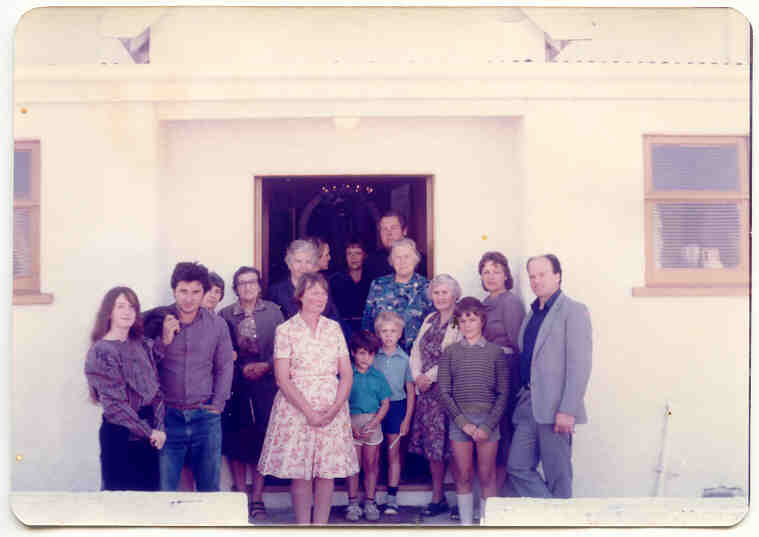
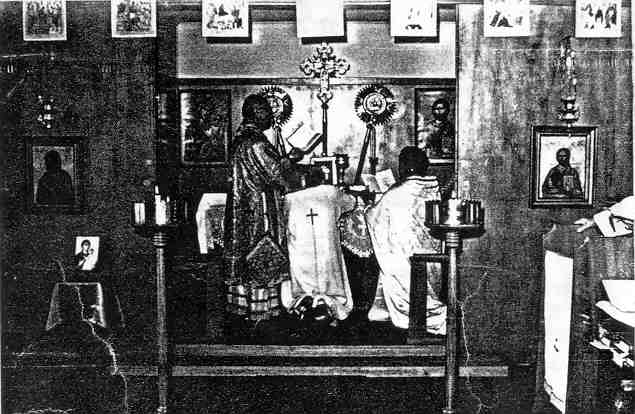
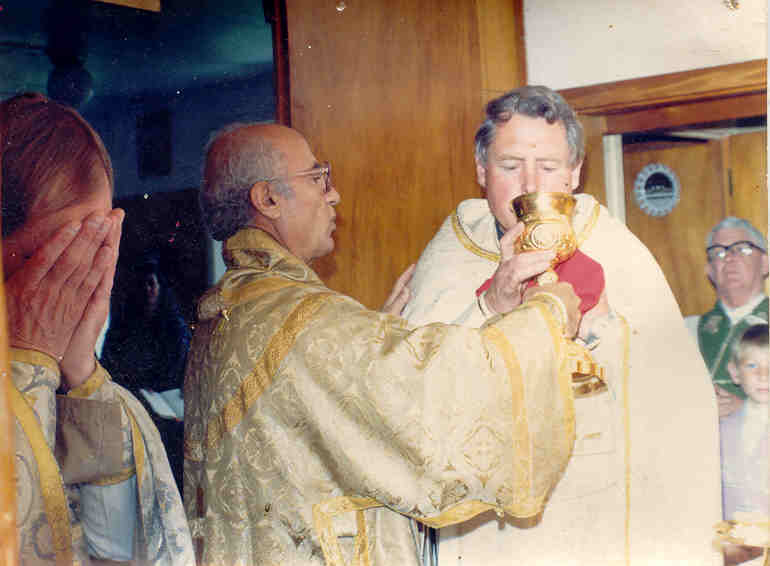
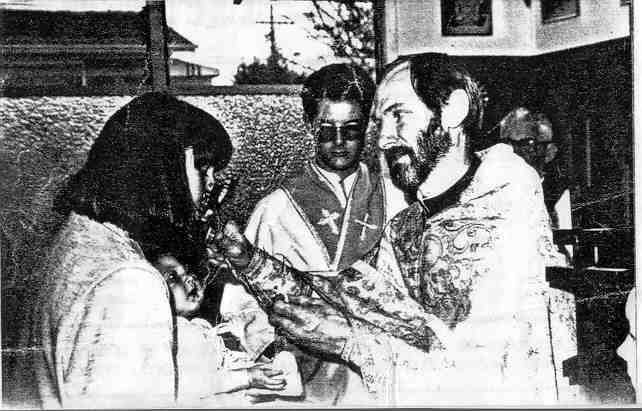
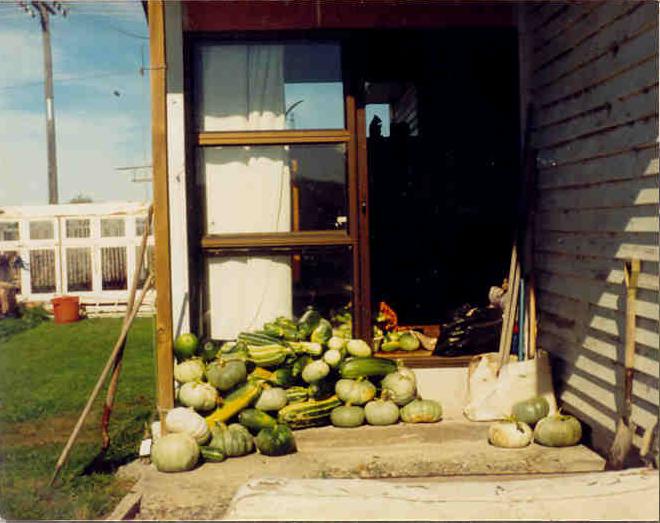
PHOTOS: On the front (p.1) are congregations
at S.Michael's and at Ashley, taken over the last year.
Above: A lamb was roasted in
Greek style at Easter in Dunedin, and later there was some Greek
dancing on the lawn.
Father Jack Witbrock, P.P. of
S.Michael's, with cure of the Church of Antioch in N.Z.:
S.Michael's Church,72 Fingall Street, Dunedin.
Ashley Community Church of
S.Simon and S.Jude.
P.O.Box 2202,South Dunedin.
Orthodox Rectory: KENT
HOUSE,Upper Sefton Road,
21 Eglinton Road,Dunedin.
ASHLEY, No.2 R.D. Rangiora.
Telephone: Dunedin (024): 55 232
Telephone: Rangiora (0502): 5673
CHRISTMAS - EPIPHANY, 1985-6
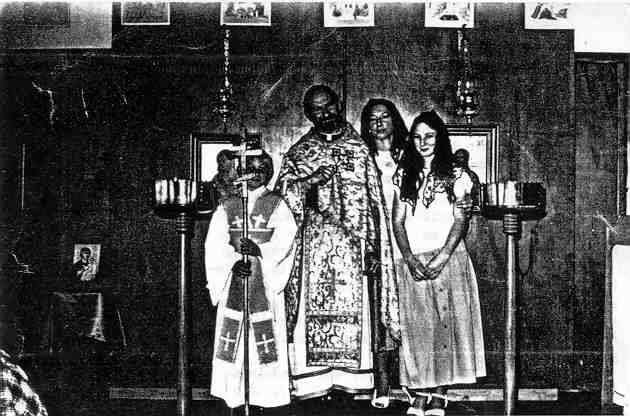
Photo at right: On the Feast of the Epiphany (Theophany
) last year, the waters of the Ashley river were blessed,
and a baptism performed, at the end of the Liturgy
held in the Church. Those present line up for a photo at he end.
Editorial:
Most of this issue is devoted to one article (see inside pages)
which
seems to carry forward the theme of the Orthodox spiritual tradition
which we began in the last issue. Although written in Britain, it not
only informs us of Orthodox life in that country, but touches on many
themes that apply equally to English-speaking Orthodox anywhere. In
particular, it confirms that so much of what is best in the English
religious inheritance is affirmed, not renounced, by becoming Orthodox.
see notes on back page.
DATES
OF SUNDAY LITURGY CONTINUE TO ALTERNATE FORNTNIGHTLY IN OUR TWO CENTRES:
At Ashley, 11
a.m.
In Dunedin. 10 a.m.:
January 5, 19
January 12, 26.
February 2, 16
February 9, 23
March 2,16, 30
March 9, 23
April
13,
27
April 6, 20
May 11, 25
May 4, 18
THIS YEAR (1986) THE EASTERN ORTHODOX
EASTER (May 4) is 5 weeks after the Latin (March 30)
Triodion begins: Feb.
23.
The great
Fast begins Monday, March 17.
PLEASE KEEP THIS LIST FOR REFERENCE; IT
WILL NOT BE CHANGED EXCEPT FOR GREAT URGENCY.
1
Orthodoxy and the
English
by Archimandrite Symeon Lash
ON THE feast of
Pentecost, 6th June
1982, an historic event took place in the Cathedral of the Holy Wisdom
in London, when His Eminence Archbishop Methodios ofThyateira and Great
Britain ordained to the Episcopate Archimandrite Kallistos Ware,
Spalding Lecturer in Eastern Orthodox Studies in the University of
Oxford and a monk of the Brotherhood of St John the Theologian in
Patmos. The historic significance of this event was referred to by
the Bishop-elect in his Address, when he said: 'To the best of my
knowledge this is the first time since the division between the Greek
East and Latin West that a person of British birth has been ordained
to the Orthodox episcopate'.
He went on to draw
attention to the
significance of the event for Orthodoxy in Britain: 'The Archdiocese of
Thyateira and Great Britain remains faithful to its Hellenic heritage -
as the Russian theologian Fr Georges Florovsky used to say,
"Spiritually we are all Greeks" - yet at the same time it is ceasing to
be a church of foreigners or temporary residents, and it is becoming a
local church, with deepening roots in the soil of this land'.
The same point has been
made on a number of occasions by His Eminence
the Archbishop and he repeated it with emphasis in his sermon on that
Sunday: We are no longer mere sojourners, or dwellers within the
diaspora of our Holy Church, but a permanent church established in
Great Britain, where, as genuine citizens of this country, we mix while
at the same time we are spiritually a permanent part of the Church of
the Ecumenical Patriarchate of Constantinople.
Bishop Kallistos saw in the present situ- ation an
opportunity, or
'Kairos', for Orthodoxy. The great Orthodox emigration to the West
which had marked the 20th century was no mere historical accident; it
showed the presence of 'the guiding hand of Providence', 'great numbers
around us in the Western world, far more perhaps than we ourselves
imagine, are thirsty for the distinctive word that Orthodoxy alone can
speak..
Steady and increasing stream
For some years now, particularly
since the end of the second world war, a steady and increasing stream
of native-born English people has come to Orthodoxy from all churches
and from none. They are to be found in all the jurisdictions, men and
women, learned and simple, clerical and lay. There are a dozen or
more English-born Orthodox priests, a number of nuns and monks and, in
some 30 English counties, lay men and women who are ready to help
enquirers into the Orthodox faith. What were these people who have
come to Orthodoxy looking for? What have they found? The second
question is perhaps easier to answer than the former, and is linked
to the question 'how?' 'How did they find Orthodoxy in the first
place?' At the risk of being over-schematic there are probably four (
main ways by which people first encounter Orthodoxy. In no particular
order these are - The Liturgy; voyages abroad; books; the witness
of Orthodox Christians. It would be pleasant if one could mention
television, but it must be admitted that, for a church numbering over
a quarter of a million faithful, the' media show an almost studied
indifference to Orthodoxy, except for the annual broadcasts of
Christmas and Easter offices by the BBC, which are anyway
primarily directed to the Soviet Union. Although it is true that many
people come to the Liturgy through its splendid ceremonial and music -
on almost every occasion upon which I visit non-Orthodox churches or
groups someone will come up afterwards to tell me they have a
record of 'the Russian Creed' - it is not the externals of the
Liturgy but what I can 1 only call its 'rightness', its
orthodoxy, perhaps, which draws people. One English convert put
it to me like this: 'I attended an office in a tiny monastic
church. There were only three monks present and there was no fine music
or ceremonial, but I knew that this was where I ought to be'. How many
people there must be who can say with St Peter on Mount Tabor, 'Lord,
it is good for us to be here' when they assist for the first time at
the public worship of the Church. Even in the most unpromising setting,
even with music and ceremony reduced to their very simplest, even with
the perhaps not very beautiful singing of a small village congregation
of elderly ladies, the transfiguring quality of the
Church's worship shines through. For Orthodox worship is never
disembodied - rather it is the transfiguration of the bodily with the
divine radiance. God meets man as he is and where he is and transforms
him by the Light of His transcendent love.
Surprises and attracts
This is why Orthodox worship
combines to a degree which at first surprises, and then draws the
visitor,
an overwhelming sense of transcendence with great apparent
informality and a genuine popular quality. This is why the Orthodox do
not need to practise or rehearse ceremonies - as Bishop Kallistos
once put it to a young bride who wanted to know when the wedding
rehearsal would be: 'The mysteries of the Orthodox Church are
"happenings" - they cannot be rehearsed', (i) or, as an Anglican
clergyman once put it to me, 'How 1 envy you. lf you forget
something during the Liturgy you can just go and get it'. This same
natural combination of the earthly and transcendent explains the
legendary length of the Orthodox services. Although it is possible to
celebrate the divine Liturgy with dignity in an hour, the Orthodox like
to take their time - or perhaps God's time - over their worship. As a
monk of the Great Lavra said to me during the Agrypnia for St
Athanasios a couple of years ago, 'Ten or twelve hours is very
reasonable for an Agrypnia, fifteen though is somewhat overdoing it'.
At first the newcomer finds it strange that the church may be nearly
empty when an office starts and only gradually fill up as it
progresses, but then he comes to see that the worship of God is
never-ending, that our aim must be to 'pray without ceasing', but
that most of us are prevented in this world from realising this aim.
We do, though, have the privilege from time to time of joining in the
hymn of the angels, of taking our place before the throne of the divine
majesty and joining our praise to that of heaven. Our prayer is never
'private', but always a sharing in the prayer of the Church. That is
why there is no individual obligation on the Orthodox priest to 'say
the office' each day. (ii) The office is said each day by the
Church, as
a whole, which is represented in this respect particularly by the
monasteries. As the Metropolitan of Ierissos said in a sermon at the
Great Lavra: 'For the last twenty-four hours we have been privileged
to join in the worship of God almost without a break. For those of us
who live in the world this is a great privilege and a great joy - a
foretaste of Paradise'.
Great hymn of praise
This idea of sharing in, of taking our own small place in the
great
hymn of praise offered by all creation, both seen and unseen, unto its
Creator, leads to another aspect of Orthodox worship which attracts the
newcomer, strange though it may seem to begin with, and that is the
almost obstinate refusal of the Orthodox Church to update or adapt its
worship to the supposed needs of late 20th-century man. The first time
one hears the monks at a great vigil ceasing to sing intelligible words
and launching into what at first seem interminable 'te-re- rems', one
is taken aback, even shocked; but then one is reminded that the being
of God is beyond all the skill and mastery of human language to
express, that the praise of God must in the end become a song without
words and that all our words are but stumbling steps on the road to
wordless contemplation. And so with the words of the hymns and prayers:
they have been given to us, handed down to us by 'our fathers among the
saints', by men and women who have advanced, and who had advanced while
still on earth, far beyond us in the love and contemplation of God. As
we pray with the Church we are like children listening to the
grown-ups' conversation. We understand perhaps very little, but one day
we shall be able to take part: already there are some words, some
phrases that we can make our own. Not that verbal comprehension is
absolutely necessary. Although there are now more opportunities for
English people to take part in services in their own language, it will
still often be the case that they will have to attend offices in Greek
or old Slavonic. When I say that verbal comprehension is not
absolutely necessary, I am not claiming that it is not in itself
desirable - clearly this would go quite against the ancient tradition
of the church normally to use the language of the people worshipping;
and I know at least one Englishman who had attended services in Greek
with his wife for many years but who had never thought of joining the
Church until he heard the Liturgy in English and realised that he was
quite at home in the Church and that Orthodoxy is simply Evangelical
Christi- anity and not something foreign and exotic. On the other hand
many of us who have become Orthodox through churches whose language we
did not understand, know that it is perfectly possible to pray, and to
pray ecclesially, even when the language is unfamiliar: indeed to
stand silently before God during the long hours of vigil of which one
perhaps understands scarcely a word, armed only with the monastic
weapon - the Komvoschoinio - may be the first step up on the road to
the prayer of the heart. (iii)
Treasure-house of prayer
The great
treasure-house of the
Church's prayer appeals to the English, with their strong sense of
history and con- tinuity. If England has been able to develop and
maintain free and democratic institutions without the violent
revolutions that have often been necessary elsewhere, it is in part due
to
this sense of history: to our ability to crown a constitutional
monarch with all the ancient ceremonial, much of which goes back to
the coronation ritual of the Roman Emperors of Byzantine. Logically the
monarch should become a president in lounge suit, or coat and skirt,
but the outward trappings of ancient monarchy sugar the pill of the
republican reality. Lounge-suited Presidents of France or the United
States enjoy far more power, are in reality far closer to 'Le Roi
Soleil' or 'Good Queen Bess', than the present Queen. But the 'reasons
of the heart' have little time for logic and so it is with the Church.
Perhaps we may think of the Church as an old family house, full
of the
bric-a-brac of generations, heirlooms and reminders of our family's
past, of those who have gone before us, yet left us something of
themselves. The Orthodox, like the English, are not over fond of
'having a good clear out' - we may dust a little here, polish a little
there, but we like to live with the well loved treasures that our
Fathers have handed down to us. We do not easily 'move the marks which
our Fathers have set'. There are probably few Orthodox who could
explain each phrase of the creed, give its historical origin, or the
reason for its inclusion, but all Orthodox are aware when they say it
that they are proclaiming their adherence to the Faith they have
received and which they hope to pass on; that they are proclaiming
their unity with the Church of all the centuries, their fellowship in
the Communion of Saints. This sense of the Communion of Saints is one
of the hallmarks of Orthodoxy. The icons that crowd the walls of the
church, that have the place of honour in the prayer-corner of the home,
are the visible reminders of this 'goodly company' of those 'who have
been pleasing to God in all the ages'. The line between the living and
the dead is a thin one - between those who work and pray on earth and
those who sleep in Christ. For the Orthodox the difference between life
and death is that the living stand on the floor of the church, while
the dead look down from the walls. Hence that sense of familiarity with
the Fathers, the impression that the great figures of the past are well
loved members of the family only recently departed, that newcomers so
often find among the Orthodox. And linked to this is the nearness of
the 'supernatural'. Greek has no special word for 'miracle' - some
'thavmata' may be 'paradoxa' but they are all in an important sense
natural. Two years ago St. Athanasios' body gave off the 'odour of
sanctity' throughout the two days of his feast at the Great Lavra, and
an old monk remarked to me, as we sat under the stars during the Lity
and watched the monks creating the Saint's ikon in coloured sugar for
the Kolytes, 'The old man hasn't done that for years. But I know why
he's
done it this year: it's to show he approves of the fact that we have
gone back to the Coenobitic rule',
'Ordinary miracles'
The average modern man is
at first
ill at ease in a world in which what he would call 'miracles' are in
an important sense ordinary,
but in the end he will perhaps come to
see that if the Saints begin to be transfigured into the glory of the
Resurrection here on earth then there are no rules for what this
may do to the physical body in the manuals of biology. If the Orthodox
take the sayings in the Gospel about 'faith moving
mountains', or doing 'greater things' than the Lord himself quite
literally, it is because they have experience of them. Renan may
exclude all reference to the supernatural in his Life of Jesus but his
reason 'that no one has ever witnessed a miracle' is rejected by the
experience of countless Orthodox Christians, both simple and learned,
devout and lukewarm.
The strong sense of the
present
reality of the transcendent and of the constant interpenetration of the
heavenly with the earthly is the result of the unwavering faith of the
Orthodox in the Incarnation. The Creed proclaimed at Nicaea and
re-affirmed at the subsequent General Councils is the only
Creed used by the Orthodox churches and it asserts without hesitation
that in Jesus God Himself has become man for the sake of man. 'God' as
the Fathers put it 'became man, that man might become God', that man
might come to enjoy the liberty, the freedom of the sons of God. The
word they use is 'parresia', the 'boldness', the 'freedom of speech'
enjoyed by free citizens in a free society.
The English are proud of
their
freedom and jealously defend it. Sometimes, as in 1939, to the shedding
of blood, sometimes, it must be confessed, less seriously. Thus it
has taken the English far longer to introduce a law governing
seat-belts in cars than it did in France, which proclaims the
importance of 'Liberte' on all its public buildings. This spirit of
freedom draws the English to Orthodoxy, for in Orthodoxy they find the
same spirit. It often surprises people when they are told that, despite
appearances, the Orthodox Church is the least clerical of churches. An
Orthodox Bishop was once asked why he had not visited a certain parish
for many years and he replied: 'The Bishop does not go where he is not
wanted'. The late Archbishop Athenagoras told me that what had most
shocked him at the last Lambeth Conference he had attended was not the
theological liberalism or the question of the ordination of women so
much as the fact that the bishops could speak as private individuals.
'An Orthodox Bishop', he said, 'can only proclaim the faith of his
people '. In the last analysis it is the People of God who are the
guardians of the Faith - the People of God baptised in the Spirit,
enlightened by Christ, born again as sons of the Father. The freedom of
the sons of God may not always produce tidy solutions, may, in this
fallen world, produce conflicts and tensions, but the conflicts and
tensions are family conflicts, family tensions, and are lived in the
love of brothers for each other and for their Father in Heaven.
Untidy
things
Families are untidy things
- they are
not, normally, governed by form-filling and bureaucracy - and the
Church is the same. In the course of its long life it has collected
many rules and regulations but all these are subordinate to the rule of
the Gospel of love. The ease with which the Church employs 'economy'
sometimes surprises people, and. there are indeed occasions when it is
abused, but the underlying principle is sound. For love of man, God
became man for his salvation and all the rules must be interpreted and
applied to that end. There is no 'code' of law in the Church, no more
than there is of English law; there is no written constitution of the
Church, no more than there is a written English constitution. That is
not to say that there is no law or no constitution in either case, only
that the Church is a living body: it is Christ's body and it is
animated by the Holy Spirit. This is why the Orthodox Church is
Evangelical without being fundamentalist. The Bible is supreme, but
the Bible lives in the Church. That is why there is no conflict between
the Scripture and the Holy Tradition. Tradition is the Scripture lived
today - because Christ lives today and the Spirit lives today. The tree
in which the birds of the air build their nests grows not according to
a blueprint but as the Spirit moves and animates it and some branches
may take unexpected shapes or directions. It is a tree the English
should find congenial, a tree that should find its natural place on
English soil.
The soil of England, 'England's green and pleasant land',
was called
'Mary's Dowry' in the Middle Ages and England was known for her love
and devotion to the Mother of God. Although the years of the
Reformation tried to trample this down, the seed never died and now the
ancient shrine of Walsingham is held in honour by Orthodox, Catholics
and Anglicans alike. Devotion to the Mother of God is
characteristically English and it is characteristically Orthodox and it
is above all through her prayers and intercessions that the English
will be led to the fullness of the Orthodox faith. The 'Ave Maria',
whether in its Western or Eastern form, is a prayer which expresses
most simply the central truth of the Orthodox Faith: that God became
man for the salvation of man: 'Virgin, Mother of God, hail Mary full
of Grace, the Lord is with you. Blessed are you among women and blessed
is the fruit of your womb, for you have given birth to the Saviour of
our Souls'.
Footnotes:
(i) Which is not to say
that a rehearsal - especially for a wedding where bride or groom is
unfamiliar with what to do - might not be quite suitable. But any
suggestion of amateur theatricals- unfortunately seen in some modern
attempts to revive (or contrive) ceremonial - is quite alien to
the
spirit of Orthodoxy. Converts especially need to beware.
(ii) In point of fact,
theGuidelines for the Priest" issued in New
York for the Antiochian clergy do require him to read at least daily
Vespers and Matins; in the Church if possible, if not, at home. In
this the Antiochian Church is perhaps untypical of Orthodox
jurisdictions; but the further one is from the great centres of
monastic
life, the more one feels, it may be, the need to keep alive a sense of
being part of the prayer of the Church.
(iii) This necessity of
attending services in a foreign language
is even more common in N.Z. The more people of English background wish
to feel "at home" in Orthodoxy and be themselves in language and
culture, the more important it is to be immersed in the worship of the
existing Orthodox nations being "at home" in THEIR language and
culture. The absence of services in English should always be accepted
as an opportunity for learning and growth, never as an excuse; however
desirable it may be that English should be widely used. FrJ.
REVIEW:
ORTHODOX AUSTRALIA (alias Orthodox America, Orthodox New Zealand.)
P.O.
Box 36, Thomastown Victoria, 3074, AUSTRALIA.
We have been receiving for some time now a number of
complimentary
copies of this excellent newspaper. We review it now as, being
uncertain whether the S.Peter' Orthodox Truth Service will have the
money to renew its subscription, we should like to see more of our
readers reading it, and taking out subscriptions themselves. Our
copies are currently being put in the back of the Churches at Ashley
and Dunedin for anyone to take. .
"Orthodox America" was started a few years ago to
disseminate more
widely, as it appears, the articles published in the "Orthodox Word"
and other material designed to make it more popular reading. "Orthodox
Word" is published in the USA by St.Herman Press, Platina, California,
96076 USA, by authority of the Russian Orthodox Church Abroad. The
main guiding spirit behind all these publications was the late
Fr. Seraphim Rose, an American convert who had wanderen from
protestantism through most of the philosophical currents of
contemporary America before becoming deeply committed to
Orthodoxy. As a result perhaps of this long pilgrimage, Fr. Seraphim
took a very pessimistic view of the religious world outside of
Orthodoxy, and had a strong commitment to the view taken by the
Russian Church Abroad towards "Ecumenism" and towards communism. Yet
the articles in the "Orthodox " Word" etc. showed, especially in recent
years, a great care to be fair, give credit where it was due even in
the "Soviet" Church, and avoid extreme, exaggerated censures. The
spititual quality of the publications has justly gained them a wide
readership, and "Orthodox Australia" has a readership not only in the
Serbian Church, which cooperates with the Russian Church in its
production and distribution, but more widely. Especially we should like
to recommend articles by Fr. Seraphim which, in the usual manner of
these publications, are being serialised prior to publication of a
book: "Towards an Orthodox World View". Through the chaos of
contemporary thought, Fr.Seraphim calls us back to Orthodoxy not
as " some sort of exotic sect characterised by elaborate rites..."but
as having ..." a truly harmonious world-view.. we are not afraid to
open our minds; since we have the truth, we are not afraid of what
science or philosophy have to say, or writers, or artists." In these
articles, Fr.Seraphim turns the light of Revelation on our history.
In an article in the
August issue, we can believe that his torch has
been passed to Fr. Alexei Young, who in a similar spitit analyses the
decay of thought in our history leading to the situation where the
Orthodox convert today finds himself almost alone in having the
world-view which all christians had originally. " A Question of
Survival" is a help to 'convert' and 'born' Orthodox in the
West.
-FrJ
1986
Father Jack Witbrock, P.P. of
S.Michael's, with cure of the Church of Antioch in N.Z.:
S.Michael's Church,72 Fingall Street, Dunedin.
Ashley Community Church of
S.Simon and S.Jude.
Telephone: Dunedin (024): 55 232
Orthodox Rectory: KENT
HOUSE,Upper Sefton Road,
ASHLEY, No.2 R.D. Rangiora.
Telephone: Rangiora (0502): 5673
ORTHODOX EASTER AT S. MICHAEL'S,
DUNEDIN
May 1: 6p.m. PASSION GOSPEL service.
2: 3p.m.
Vespers
6p.m. Matins of LAMENTATION
3: 11.3Op.m.
Matins and LITURGY of the RESURRECTION.
(no service in the morning: Easter
FEAST for parishioners and friends at Chingford Stables - lamb barbecue
etc.)
SUNDAY DATES FOR THE NEXT FEW
MONTHS:
Ashley, 11
a.m.
Dunedin, 10 a.m.
May 25 (AUCKLAND on 11 th)
May 4 (midnight), 18
June 8,
22
June 1, 15 (WELLINGTON on 29th)
July 6,
20
July 13, 27
August 3, 17,
31
August 10, 24
September 14,
28
September 7, 21
October 12,
26
October 5, 19
November 9,
23
November 2, 16,
30
1
EASTER IN JERUSALEM
For many centuries now,
every year at
Easter, the Patriarch, dressed in the simplest clothing (nowhere to
hide matches) goes alone into the tomb of Christ in the Church of the
Holy Sepulchre, carrying an unlighted candle. When he emerges, it is
alight,
and the light kindled by divine grace is passed to all as Easter
begins. I first read of this miracle in the book 'with the Russian
pilgrims to Jerusalem' (Graham) which was picked up in a second-hand
display a few years ago. The author, an Englishman, tells how he
travelled round Russia in the last days of the old regime and joined
the shiploads of pilgrims that went to the Holy Land, sailing so as to
avoid being held up by the Turks, and walkng round all the holy
sites, ending in Jerusalom for Holy Week. I refer those interested to
the book which is circulating among our people. This is the source also
of the remarks I recorded for TV for use on a hymn programme to go out
on the after noon of the Orthodox Easter. In advance I apologize for
any distortions inevitably arising in boiling my words down to ¼
of
their length; the true version is in Mr. Graham's book. The miracle, I
was told recently, is known to continue until this day; and perhaps
this is one reason why the Orthodox have not been in a hurry to bring
the Easter date into line with modern astronomy, as has been done by
some with the fixed feasts.
I forget when and how this spontaneous Light began in Jerusalem
(see
Graham); but it must have been very early, as it was surely responsible
for the spread of the ceremony of the Easter Light over the entire
Christian world, both East and West. A story is told of S. Patrick,
that
on his first Easter in Ireland he braved the wrath of the Druids, who
also had a spring-time fire ceremony; and it was death to light any
fire before the Druids had kindled theirs. A film made some ycars
ago showed the Druids on a hilltop, looking across to where Patrick,
on a nearby hill, had lit the Light of Christ's resurrection in the
midst of that pagan land; and he was saved from theDruids only by the
intervention of the King, who listened to him and gave him permission
to preach throughout his kingdom.
Since the Gospels tell us of the finding of the empty tomb at
first
light, christians have always consirered that the actual Resurrection
must have taken place during the night, and universally it has been
celebrated during the night. The service-books of both East and West
contained two Masses: one a 'Vesperal Liturgy' with prophecies
concerning the Passover and Exodus from Egypt, and a second, belonging
to Easter Day itself. Over the centuries the first Mass seems to have
crept back to the Saturday morning, and it is quite recently that
western churches restored it to the night, thus giving meaning again to
the ceremonies of light. But in the East these ceremonies continued as
a popular and living tradition, being attached to the Matins that
precedes the second Mass. This seems to be why we have 1) a Liturgy on
Saturday in which there is a transition from Lenten to Easter
Vestments and the Resurrection is symbolised, a service to which,
however, few people go; 2) No Liturgy for Easter Day itself, but
instead the Vespers service, often 'anticipated' in the morning.
But is it not curious, that every year a miracle occurs in
Jerusalem, well known (says Graham) even among the Muslims, and yet
nothing is published about it, so that even many Orthooox are unaware
of it? It must be well known also to the Israelis, whose ancestors
managed not to be convinced by the original resurrection. It could be
investigated any year with all the apparatus available to a modern
western-style state... Perhaps, like the Shroud of Turin, it is given
us so that we are not deceived by those who want to make religion into
a private (= please- yourself) matter. The Shroud also would have
remained unknown except for the efforts of those Catholics who saw
the point and kept bringing it up; and it was not the public media
that made it known. Perhaps God has sent forward into our
faithless 20th century miracles testifying to Christ's resurrection, so
that we should not forget that our faith is founded, not on
wishful thinking, not on preference for the christian
"value-system," not on the creation by the christian community of a
"Christ of faith" projected over the historical Jesus, but on events
that convince by their simple matter-of-factness. I have
always found S. Thomas an attractive Saint, because he asks the
questions I should have wanted to ask had I been there: can we really
be sure of this? Let's not fool ourselves' Are we sure? And he got his
answers, anticipating, perhaps, by many centuries, the famous
saying of, I think, Mr. Sherlock Holmes: "When you have eliminated
the impossible, what remains, HOWEVER UNLIKELY, must be the truth."
It was in that spirit, not the spirit of a happy dream, that the first
christians referred to the resurrection, and the Church Fathers present
it in the same way: a fact believed, and reported unwaveringly even
in face of death, because unmistakably witnessed.
THE ARTICLE WHICH FOLLOWS
has been in my files for quite some time, since it took my
attention as
a very sensible treatment of the subject; it seems a good time to print
it now that we have almost ready a new printing of LITURGY booklets for
the congregation. These are designed to allow the congregation to join
in with a good deal of the music which our singers have learned over
the
last few years, and which is likely to become our standard setting. It
is based mainly on the "STANDARD BYZANTINE LITURGY" published some
years ago by the Antiochian Publications Dept in New York; but has been
arranged so as to be (we hope) easier to follow. The Liturgies of
S. John Chrysostom and S. Basil have each been printed in separate
booklets; the text as in the "Service Book" for priests is given in
full, including parts sometimes omitted; and such music as is neither
too difficult (as the Cherubimic Hymn) nor too obvious (as the
responses to the little Litanies (Ektenias), is printed exactly where
it comes in the text. We hope this will encourage 1) singers to use
these settings 2) the people
to increase their singing further 3)
everyone to follow mentally the silent prayers, especially in
S. Basil's Liturgy, and those prayers which are often omitted.
It would be wrong if the desire for congregational singing had
the
result of reducing all music in Church to what is simple enough for
even the unmusical to sing; or if we were to dragoon people into taking
part pbysically, when what matters is spiritual participation; but
while a choir, or a reader and cantor, are there so as to free the
people from forced participation in everything, and from worrying
about " what is going to happen next?" ; the choir or cantor are NOT
there to exclude the people from freely taking up those melodies that
they know and love.
CONGREGATIONAL
SINGING IN CHURCH
by
ARCHBISHOP AVERKY OF JORDANVILLE
Congregational [public] singing in church is...a strictly
Orthodox
tradition, for it is of ancient Christian origin. The restoration of
congregational singing in our time must be hailed, for it has the most
profound roots in the very concept of our Divine Services, in which
all the faithful must accept participation "with one mouth and one
heart".
The very structure of our Orthodox Divine Services, which
requires a
constant interchange, like a roll-call, of the exclamations of the
priest and deacon with the reading of the tonsured reader, and the
singing of the people, already presupposes the most active and
conscious participation of all "those standing" in the Divine Service
being celebrated, and not just a passive presence in the church, even
if it is accompanied by private prayer.
Such an active participation of the laity in the
Divine Services is
indicated by those numerous notations in the Typikon and Divine Service
books where the word "1ik". . . is very often replaced by the
pronoun "we", as for example, "we sing in the most attractive voice,
'Lord I have Cried'," or, "and we sing' Joyous Light'," (Typ. Ch.2).
Very often, instead of the word "lik", the expression, "people" is
used: "and the people sing" (e.g. rubrics for Great Saturday at
vespers). From this, the exclamation of the priest in the Divine
Liturgy, in which he calls upon the worshippers to glorify and sing
praises to God not only with "one heart," but also with "one mouth,"
becomes comprehensible.
Thus, according to the concept of our Divine
Services, all the faithful must take part in the singing, if not in
all, then at least in the majority of our Church hymns, rather than
standing in church like only idle spectators and listeners. The church
is not a theatre, where one goes only to see and hear beautiful
singing, but a place of common prayer, in which all must participate in
a fully conscious manner. All the more proper is such participation in
the singing of the Symbol of Faith, which is our common confession of
faith, and in the singing of the Lord's Prayer. "Our Father, " which
is sent up from the person of all of us to God, our common Father.
The intrusion into our Divine Services of western
concert-singing,
accessible only to specially experienced singers with careful and
lengthy preparation, forced out the choir of believers from a living
participation in common liturgical singing and made those who come
into church only listeners, but not living participants in common
Church prayer. In this western theatrical singing, all the attention is
concentrated not on the words, but on the melody, which is more or less
artificial - with bravura or sentimentality - but not at all
churchly. Under the influence of this singing, in which it is often
impossible to even make out the words, and which is deeply alien to the
Orthodox ascetical spirit, many began to come to church not for
prayerful participation in the Divine Services, as in a common action
of all the faithful, but only "to listen to beautiful singing", in
order to experience aesthetic pleasure, which is, unfortunately,
accepted by many in our time as a prayerful feeling. This, in union
with irreligious upbringing and irreligious, often Godless, school
education, penetrated by an atheistic and materialistic spirit, lead to
a greater and greater departure from genuine church mindedness and the
understanding of the Divine Services by the broad majority of the
believers. As a result, there has been a very great weakening of the
immense significance of our Divine Services as a "school of religious
training". Believers often come to church only "to cross the
forehead, " as the expression goes, but everything that takes place
in church is alien and incomprehensible to them. It is, therefore, not
amazing that we now find people who request to receive Holy
Conununion at the all-night vigil, and are sincerely perplexed and even
offended when they are refused. **
The disappearance from our churches of congregational
church singing
and its replacement by a theatrical form of church singing by
special "choirs" has undoubtedly aided the alienation of our society
from churchmindedness. Thus, the surest path for a return of our
irreligious society to the Church is the return to the ancient
practice which is in accord with the Church rubric: the restoration of
congregational singing in our churches.
**
The "All-night Vigil" often held
by the Russians consists of Vespers
and Matins. It is not a Liturgy so there is no Holy Communion.
The
Bishop means to stress the ignorance shown.
AT
HOME AT ASHLEY- GRADUALLY
This issue of SPOTLIGHT is the first to be typed in my workroom
which
has occupied me in buiding and setting-up since mid-December.
Surrounded by my books and ES loudspeakers, I feel at last that perhaps
I am now at home here. This labour has also freed a room in the house
to be a guest room as well as a studio for Julia. With the installation
of the wood-stove, the house is becoming more comfortable, and maybe
it will not be long before the necessary paint and paper outside and in
have been done. The garden was not a great success this year; it will
need to be built up above water-level, and a shelter-belt is
clearly very necessary. but meanwhile quite a lot of vines cane up, no
trees died, and a few chooks, ducks and geese have arrived from various
directions, as well as 2 sheep and 2 goats and a
rabbit.
There have really been quite a number of visitors so far from
other
centres, both from Dunedin and from the North. A small loyal band has
attended services here, and for the meantime we do not have the time
or the wherewithal to take our service into Christchurch or to go
chasing the slackers. The sale of my Dunedin houses has provided a
background income of mortgage payments for the next 5 years, which
together with Julia's earnings is extremely modest, but allows me to be
free to work up the land, and to be available for Church work so far as
money permits. In addition I have been called on rather a lot
to relieve in the High School, which has been a considerable help.
There has been an encouraging response in Dunedin to the changed
arrangements. Not only have some members taken an the burden of my bus
travel each fortnight, which has been a great help, but a desire has
been expressed to activate local organisation so that things can be
decided on and done without waiting for me - a change that I heartily
welcome, and hope all our people will welcome the suggestion of
reviving an active Church
Committee. A meeting has been called for May 18 (the 2nd after Easter)
afterChurch, where all the usual business of a general meeting
(not annual for many years now) will be brought forward.
Since early this year, I have been in Dunedin only overnight
on
the weekend that service is held. So it has been possible to
concentrate on getting things in order here - and on daily prayers in
the Church, which I have found to be entirely satisfactory as a
spiritual home, as I expected. We have had excellent cooperation from
the local Church Committee, and people appear to have accepted us as
neighbours and friends. We appreciate this very much, and hope that
things will gradually build up here to the point that we can make an
acceptable contribution to local life in return.
On May 11, I shall be in Auckland to celebrate a Liturgy. Over
the previous 10 days or I so, we shall have the company of Alan and
Mary Eades, who will also be coming to Dunedin for the Holy Week
and
Easter services. The Bishop has asked me to assist Alan in his
preparation in the hope that he may be ordained as a priest for the
Auckland parish. I ask your prayers for us, for them, and for the
Auckland people at this time.
On the last weekend in June, I am to be in Wellington for the meetings
about the new Ecumenical body. I hope to see some of our people there
and somehow share a service with them. When such events interrupt the
sequence of fortnightly services, I have decided to let it continue as
if there had not been an interruption; this will enable people to
calculate for months ahead if necessary, and will, I hope, be less
confusing.
I had hoped to carry on from the excellent article on ORTHOIOKY AND THE
ENGLISH with an effort of my own to be called ORTHODOKY AND THE NEW
ZEALANDERS. This will have to wait till next time.
May God bless you
all.
-Fr Jack
Father Jack Witbrock, P.P.
of
S.Michael's, with cure of the Church of Antioch in N.Z.:
S.Michael's Church,72 Fingall Street, Dunedin.
Ashley Community Church of
S.Simon and S.Jude.
Telephone: Dunedin (024): 55 232
Orthodox Rectory: KENT
HOUSE,Upper Sefton Road,
ASHLEY, No.2 R.D. Rangiora.
Telephone: Rangiora (0502): 5673
CHRISTMAS, 1986
At Ashley: MIDNIGHT LITURGY, 12.00 December 25 (Thursday)
preceded by Matins (Orthros) at 11 p.m. Christmas Eve.
At S. Michael's: Sunday December 28, as listed below.
Note that Palm Sunday falls
at Ashley (with services until Good Friday) in 1987,
and Easter Day in Dunedin (usual midnight service.) Further details
later.
TABLE OF SUNDAY SERVICES IN
ASHLEY AND DUNEDIN
This, it will be
seen, runs on as before and you can mark it on any calendar for
as far ahead as you like;
if any service is not held for any reason the sequence will
nevertheless not be broken
AT
ASHLEY:
AT S.MICHAEL' S, DUNEDIN:
1986
December 7,
21
December 14, 28
1987
January 4,
18
January 11, 25
February 1,
15
February 8, 22
March 1, 15,
29
March 8, 22
April 12 (Palm Sunday), 26
April 5, 19 (Easter)
May 10, 24
May 3, 17, 31
June 7, 21
June 14, 28
July 5,
19
July 12, 26
August 2, 16, 30
August 9, 23
September 13, 27
September 6, 20
October 11, 25
October 4, 18
November 8, 22
November 1, 15, 29
December 6,
20
December 13, 27
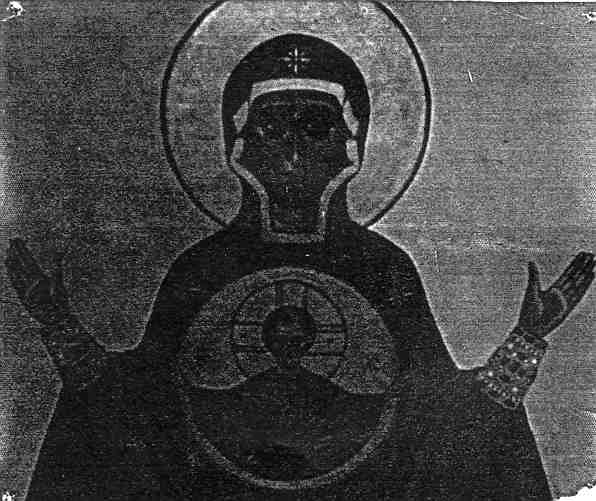
* VIRGO DEI GENETRIX, QUEM TOTUS NON
CAPIT ORBIS, IN TUA SE CLAUSIT VISCERA, FACTUS HOMO
O VIRGIN THEOTOKOS, HE WHOM THE
WHOLE WORLD CANNOT CONTAIN, WAS MADE MAN AND LAY HID IN THY WOMB
1
ORTHODOXY AND THE NEW
ZEALANDERS
Fr Jack.
The "SPOTLIGHT" for last
Christmas carried a long article by Archimamdrite Symeon Lash called
"Orthodoxy and the English", and it seemed to me that it would be worth
looking in the same way at the New Zealanders. That it has taken me a
year to begin it must be a sign of the difficulty of the subject. It could
well be asked whether the two have anything to do with each other.
Orthodoxy is, after all, rather young in this country still. The oldest
Church, S. Michael's, dates from 1911; whereas the main other forms of
Christianity arrived here about a century earlier. And if we are
speaking of the English New Zealanders; - I think, when I became
Orthodox with my family in 1971-72 (we had to wait a year almost) we
were almost the first. And as for those to whan the term "New
Zealanders" was originally applied - the Maori- we are, at present in
this country, going through a realisation of the extent to which they
have been crowded out and pushed aside, and the necessity for the
European society to move aside and make room for this original culture
to live and breathe and be itself; but the Orthodox Church is in no
position to engage in this programme which many other Churches have set
themselves, since it simply has hardly any Maori members - perhaps even
none at all.
So for Orthodoxy the
relationship with this country is with a
number of recent immigrant communities, and with some converts of the
majority, colonial-british, society. And if we are considering the
religious tradition of a nation, it is fair to observe that, so far at
least, both the Maori and European parts of it have experienced
christianity ONLY in its western form - and indeed mainly its British
form: Anglicanism,
Roman Catholicism ,and the various forms of protestantism which are,
in their sheer overwhelming mmber, perhaps the most disti~ctive feature
of English-speaking christianity,
wherever it is found. The article by Archimandrite Symeon was
perhaps too kind to the English tradition in not alluding to this
feature, which surely is the aspect of English religion that
immediately strikes the foreigner. But we must allude to it, for a
nation has not got far in self- knowledge if it doesn't know something
that is obvious to everyone else. Whereas in many parts of Europe there
may
be one, two, or e ven three religious confessions native to the
country, the English and the Americans between them have devised
scores of sects, and exported them even into countries where the
people have been christian longer than the English, and are perfectly
happy with their one or two Churches.
Now whereas in Britain
itself the "denominations", though many,
represent a minority of the population, in New Zealand the percentages
are much more even, and consequently , the divisive effect of
sectarianism on the nation has been much more profound - producing a
certain scepticism and cynicism about religion, which is indeed
characteristic of much of the western world,
but here perhaps even, stronger insomuch as there is no single
expression of religion with which the public at large can identify,
even
in a cultural and emotional manner ; the kindly derision to which the
Church of England is treated in British Television and
radio and novels etc. is seen and perhaps enjoyed here, but not felt to
be appropriate to N.Z. Rather, if there is any public image of
christianity and christians, it is more a composite one of various
expressions of fundamentalism, which enjoy a range of positive and
negative reactions among the
public.
In this situation it is
perhaps not surprising that those few
individuals, who find their way into an Orthodox Church and find
themselves at home there, are usually content to write off and
jettison any former religious history and enter ''as new-born
babes" a new and exotic world which indeed has enough to feed them for
many
lifetimes; and the striking change of cultural milieu is an effective
symbol of leaving behind, with the cultural habits of the past, also
the controversies and distorted teachings that cling to them. Butt I
wonder whether this natural reaction does not, like the present
fashion of denying the English identity of New Zealanders too easily
give a verdict of failure to the best hopes of those who
first came out from Britain to this country. Is it really true
that the English culture and the English religious tradition are
dead amongst us, or, as many seem to be saying nowadays, that they
ought to be?
One of the results
of moving about in a Church almost entirely composed of Greeks,
Russians, Arabs etc., is
to be constantly reminded that one is English. Even those converts who
set out vigorously to make themselves assimilated to
those around them will find that they are regarded as English and
accepted as such. What else could they be? They certainly are not
French, or Dutch, or Maori; they are, to the
ethnic Orthodox, unmistakeably English. They are not in England any
more; but neither are the Greeks, or Slavs, yet they do not thereby
lose their identity; I rather think the
spectacle of the English moving around the world and trying
to pretend they are no longer English must afford a good deal of
amusement to other nations.
In the colonisation of
some parts of New Zealand there was a certain amount of rather
conscious striving to
transplant what were perceived to be the ideal features of the home
country. These attempts were not altogether successful and some
of the perceived ideal aspects may have turned out to be rather
unlovely.
2
So there is
some
understandable cynicism about the colonial goals; and this is
reinforced by realisation of the harm done when colonisation reached
a stage that could hardly avoid putting severe
pressure on the Maori, whose chiefs had perhaps never contemplated
that the Treaty of Waitangi might lead to their being outnumbered in their
own homeland. Yet it does seem that the present increasing
decadence of the Anglo-Saxon culture in New Zealand, far from
assisting the revival of the native culture, only increases the sense
of dispossession among a people who in former times had quite a healthy
respect for things European. To suggest that the majority of New
Zealanders deny their history and try to be white Maoris is no less
absurd than the unfortunate attempt to have the Maori forget his own
genealogy.
England has had a rather uneven religious history, but it has
been christian since the 6th century, and before, when it was not yet
England, but Britain. The mutual nourishment of spiritual and national
life has been going on more or less for some 1500 years.
At present both the
leaders of
secular and social-political thought in this country,
and the vast majority of our small Orthodox Church here, simply have
closed eyes towards this interdepence of faith and nation. It
is therefore encouraging to have seen the foundation in Oxford,
England, of a "Gregorian Club" dedicated to claiming England's
historic religious heritage for the Orthodox Church to which its small
but growing membership belong. Whatever is done by Orthodox
christians in the English-speaking world is bout1d to appear
insignificant in comparison to the currents of thought and action
that gain the attention of the world at large, but, as
Stephen Coombe says in an article in the first number of their journal,
"Every group, every country, every culture has its liturgy. If
silenced, they will be heard in the silence. They cannot be overcome,
because they are from Christ. *
What practical actions issue
from this rather inconclusive discussion? Little enough, perhaps - just
that we should accept that God has made us,
believers in the Orthodox Faith and members of a nation that had a
faith that it is fast forgetting. To stand quietly in faith in the
midst of all this, not putting on acts or masks or attitudes, not
striving anxiously against the half-truths and falsehoods that swirl
around us, but simply believivg in God who made us, asking him to
sift what He made out from the mess we have made, and save us, in
our own nation rather than out of it.
*
The JOURNAL, No.1 of the
GREGORIAN CLUB, III, 41 Essex Street, Oxford, ENGLAND.
THE N.C.C. and the
CONFERENCE OF CHURCHES IN AOTEAROA -NEW ZEALAND
The proposal that
the Roman
Catholics join in the "Ecumencal" Council as full members
has been the occasion for a fundamental rethinking of the
function and structure of the Council, so much so that it
was decided to wind up the N.C.C. and make a new Council
in the hope of making a fresh start. The Orthodox, in the form of the
Greek Church, have been involved in the N.C.C. for many years,
and the Antiochian Church joined in 1982, after S.
Michael's had belonged to the Dunedin Council of Churches for some
years.
To the Orthodox, the idea that the entry of the
Roman Catholics was causing a serious reconsideration of the
Council's aims etc. would seem, on the face of it, very
welcome. The "Ecumenical Movement" began as a fundamentalist
missionary conference, and was enlarged by the entry of the High
Anglicans and Orthodox (causing the departure of some fundamentalists)
but always had a protestant outlook which came to be more and more
that of the liberal protestants who eventually came to occupy centre
stage in the World Council; and this ethos was reflected in National
Councils and their regional branches.
For years the Orthodox have tried
to make some effective input to the N.C.C., and the
leadership of the W.C.C. has made sincere attempts to take account of
the Orthodox expressions of concern. Those few Orthodox in N.Z.
who have had contact with the N.C.C. have felt a similar frustration;
and when I expressed this to N.C.C. staff, I was advised to
read the material that had been published by the W.C.C. as
a result of Orthodox submissions and conferences. There is
quite a lot of this, and it took me a few weeks to get through it all.
There is not space here even to summarise this material; but it is
true that, at world level, progress has been made over the last 10
years in breaking down the total unawareness of Orthodoxy that prevails
widely in the member Churches of the W.C.C. - that is, Heads of
Churches
and theologians have now read some Orthodox theology. After completing
this reading I was encouraged to be " invited" * to a "theological
conversation" in preparation for the new "Conference of
Churches". The
document "Baptism, Eucharist and Ministry" was to be studied ont
the basis of replies received from the Churches.
3
This was welcome as
part of
the material I had studied had been on this document.
The expectation
that Roman Catholic participation would broaden
the vision of the conference was partially fulfilled. The only
session that I could attend (I was away on Sunday) that held any value
for me was that in which a series of people who had represented their
Churches
in dialogue with the Roman Catholics reported on this experience. It
was clear that in all cases there had been a serious attempt to share
in spiritual depth. Each dialogue had
been accompanied by joint prayer out of the resources (breviary,
service and hymn book etc,) of both sides.
This session had
been placed on the agenda by the staff planning the
conversation, but the content was provided entirely by the individuals
who had been
in the dialogues. This may explain the marked newness of atmsophere in
this session alone (that I heard). For the rest I am sorry to say
that on the ground that theological discussion must be "earthed in the
NZ situation" we were treated to what has now become a customary
education in bi-culturalism and feminism. Both of these have been
included as "goals"of the new " Conference". I recorded an abstention
for our Church when these two items were
discussed at an earlier conference because
1). though the "bi-cultural" goal as expressed in the documents is
quite acceptable the
Orthodox are really in no position (see Orthodoxy and the New
Zealanders) to do anything about it AS A CHURCH,
2) some aspects at least of current feminist ideology are perceived by
the Orthodox to involve the rejection of fundamental aspects of
christianity .
The chief difficulty with
these subjects was that they crowded out
all real consideration of the theological documents. The first session
of discussion groups, ostensibly devoted to
sacramental theology, was in my group entirely devoted to
discussing whether we ought to be discussing these matters at all in
view of the
overwhelming importance of the bicultural and feminist agenda..
and when that was over the agenda had reached these matters anyway.
An additional difficulty was the quite advanced sort of feminism that
appears to have become received doctrine in ecumenical circles.
One of the ladies who was brought in to address us spent quite some
time on her grievances against the Churches in which she worshipped;
and it was clear that these already made what we should regard as very
considerable accomodations to her position - far beyond what fidelity
to
the Christian revelation could permit - involving "'inclusive"
language in all scripture readings ( avoiding referring to God as
"He" etc.) Nevertheless any deviation from this (perhaps a slip in
printing a hymn?) was the occasion for intense fury. I was not so
distressed by this address as by the almost universal apparent
acceptance by those present of
the presupposition that underlay it. I was not present
thorughout, and returned to hear the end of a very gentle demur
£rom the Roman Catholic party; but if the goal of "partnership"
of men and womenl in the new Conference of Churches is to be understood
in terms of what was said (and accepted) in that session I feel
our involvemenlt may be a little problematical. Certainly we shall
have to listen to much vehement denunciation of things which we hold
dear as integral parts of the christian tradition, from people who
would be shocked if we even dared to suggest that any of their
doctrines were in error.
SUMMARY:
All canonical Orthodox Churches now belong to the W.C.C.
Expression of concern about the direction of the ecumenical
dialogues does not call in question this involvement. A great deal of
frustration must
be endured by all sides in the search for unity, and although the
Orthodox often feel isolated, they are not the only ones. (The
Baptists have decided NOT to enter the new Conference at present, and
the Churches of Christ have serious reservations). The decision about
the membership of the Antiochian Church has been referred to Bishop
Gibran, and the answer is not yet known. It appears the other
jurisdictions here will mostly join. This, and the general trend
of
the Catholic contribution, may influence the course of the
"Conference of Churches" . But in any case, apart from what
agreements or influence may be achieved, if it is in conscience
POSSIBLE to be involved, mere presence has its value as a testimony of
willingness to seek unity, even if the chances of early success, or
even ultimate success, are not rated very high.
Fr Jack
*
"invited" in most languages means "paid for". Alas, although we are
very short of money, this turned out not to be the case.
If anyone has any
money to spare at present, perhaps we could just mention the deficits
in
our Church accounts which are becoming a bit chronic and are
restricting our activities:
DIOCESE: (-)197-81
S.PETER O.T.S.: (-)176-70
(yes, those are minus signs and
no, the A/c 's are not overdrawn, the
deficit is in the cash balance and Fr Jack is out of pocket. Not
intolerably so, but it can't go much further..)
The rather sad tone of the
report on the not-really-theological-after-all theological
conversation ought to be balanced by reference to the complete delight
of spending Sunday with Fr.George and the Romanians; and a
most fascinating conversation with Professor Niculescu, who has
been attending ecumenical committees for our Antiochian Church,
and also for the Greeks and Romanians. And as a postscript we ought
to mention the simply splendid service held for the Pope with the
leaders of N.C.C. member Churches. The prospect that this might become
the regular character of ecumenical services would be a welcome one
indeed.
4
1987

Father Jack Witbrock, P.P. of
S.Michael's, with cure of the Church of Antioch in N.Z.:
S.Michael's Church,72 Fingall Street, Dunedin.
Ashley Community Church of
S.Simon and S.Jude.
Telephone: Dunedin (024): 55 232
Orthodox Rectory: KENT
HOUSE,Upper Sefton Road,
ASHLEY, No.2 R.D. Rangiora.
Telephone: Rangiora (0502): 5673
Father Allen Eades , P.P. of S. Ignatius' Mission Parish,
Auckland.
S. Christopher's Hall, 5 Alford Street,
S. Joseph's Church, Pirongia
Waterview, Auckland.
Orthodox Presbytery, 17 Sinclair Terrace.
Telephone: Te Awamutu (082) 3065
TE AWAMUTU
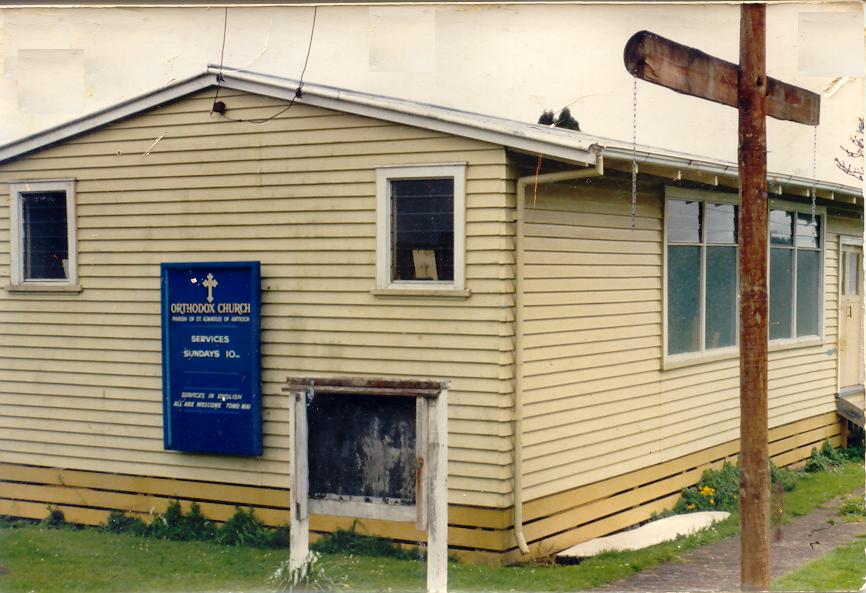
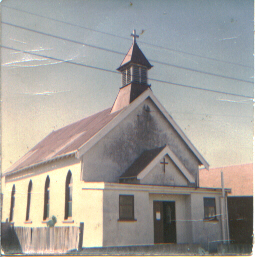
TABLE OF SUNDAY LITURGIES FOR 1988
This continues the
fortnightly alternation as previously. Note that until
further notice, the Auckland parish will alternate similarly:
in
Aucland when service is at Ashley, and at Pirongia when it is in
Dunedin.
ASHLEY
(Auckland)
DUNEDIN (Pirongia)
January 3, 17, 31
January 10, 24
February 14,
28
February 7, 21
March 13, 27
March 6, 20
April 10 (EASTER), 24
April 3, 17
May
8,
22
May 1, 15, 29
June
5,
19
June 12, 26
July
3, 17,
31
July 10, 24
August 14,
28
August 7, 21
September 11, 25
September 4, 18
October 9, 23
October 2, 16, 30
November 6, 20
November 13, 27
December 4,
18
December 11, 25 (CHRISTMAS MIDNIGHT)
KEEP THIS LIST - THE
SEQUENCE OF ALTERNATION WILL NOT BE ALTERED EVEN IF CHANGES OF PLAN
CAUSE CANCELLATIONS OR EXCHANGES OF PARTICULAR SUNDAYS. THESE WILL BE
ANNOUNCED IN CHURCH.
1
ORDINATION IN AUCKLAND
The front cover shows the Church
Hall of S. Christopher, Waterview, which is being used for the services
of S.Ignatius' Parish, by the kindness of Fr. Maurice Venville, Vicar
of S. Jude's, and his people. Here Fr.Allen Eades was erdained Deacon
and Priest on September 26 and 27. These photos show the ordination,
the Communion, and the Blessing.
On the back page Fr. Allen is
seen with his fanily. Fr. Allen will
continue te live in Te Awamutu until he is ahle to move to
Auckland; the table on the front cover therefore applies to the
Auckland parish, for the meantime, as well as to Dunedin and Ashley.
Visitors at the ordinations included not only Mitchell and Colleen
Elder, from the Christchurch community, but also Fr. Gerald Fitzgerald,
of Te Awamutu, who has kindly given
much time to helping Fr. Allen with his theological studies, and is
now lending our people the Church at Pirongia; and Fr. Venville, who
was most willing to help our parish, and even spent much of one
afternoon taking out a door so that the South Door of the Altar could
be used during the ordinations and in our continuing services. We
have asked Fr Allen to write a guest editorial, which fellows on the
next page:
2
Dear Father Jack, Khourieh
Julia and family, parishioners at St.Michael's Dunedin, Mitchell and
Colleen Elder and members ef the Church Community at Ashley, and our
Church people throughout New Zealand,
Greetings in eur L8rd Jesus Christ!
My Ordination to the holy Priesthood by Archbishop Gibran, in September
this year, may now mean that with God's Help, the Parish of St.
Ignatius
can function more fully once more as a Parish Family; and be the
better able te serve the needs of Orthodoxy in this region.
Thanks are due in no small measure to Ingraham and Margaret
Hammond
together with other parishioners whose faith, loyalty and prayerful
support ensured the existence of the Parish in Auckland during the long
period without a priest.
At this stage; Khourieh Mary, our children - Angeline (aged 15),
Nicholas (aged 11), and myself, still live in Te Awanutu, that is until
such time as I can find suitable employment in Auckland and move
up there. We pray that, God willing, this will be very soon.
Currently, I serve a Divine Liturgy every first Sunday of
the fortnight
at nearby Pirongia (approx. 8 miles away) at the small R.C. Church of
St. Joseph. This provides a Liturgy for Orthodox of various
Jurisdictions whe live in this area, plus any visitors who may wish to
attend.
Every second weekend, we travel to Auckland (approx. 110
miles away),
where I serve a Sunday Divine Liturgy at St. Ignatius Parish Church in
Waterview.
With your prayers and support
the Prayer of the Second Antiphon
from the Divine Liturgy express what is in our hearts at this time of a
new beginning for us as
a parish:
O LORD our God, save thy people and bless Thine inheritance: preserve
the fulness ef thy Church: sanctify those whe love the beauty of
Thy house; do Thou glorify them in recompense by Thy divine power, and
forsake not us who put our trust in Thee. For Thine is the majesty, and
Thine is the kingdom and the power and the glory: of the Father, and of
the Son, and of the Holy Spirit: now and ever, and unto ages of ages.
Amen.
Yours sincerely in Christ,
7 Sacraments
- alas, generally speaking, it seems
that few of us regularly participate in the one great sacrament of Holy
Communion offered us in the Divine Liturgy,let alone in some of the
others! What an experience it is to participate in an Ordination.
Colleen and I wished very much to express love and solidarity with the
Eades family on the occasion of (Fr.) Alan's ordination in
September. It was a great joy to take part in the service. To see the
"candidate" firmly held by the arm, being led up to the Royal Doors by
Fr.Jack, thus demonstrating that in the Orthodox tradition
ordination is, in a sense, thrust upon one. In monastic profession, the
one being professed has himself to hand the scissors to the
Hegumen (abbot) for the tonsure, thus signifying his willing consent.
With joyful accord, the Orthodox
family gathered at Saint Ignatius of Antioch, shouted, "AXIOS"(he is
worthy), thus performing part of their Spiritual Priesthood
under the direction and leadership of their Sacerdotal Priest, the
Bishop. That weekend was a
time of great
thanksgiving and rejoicing for God's blessing and gift of another
Orthodox priest in our country, and at last, once more, a pastor for
our
beloved brothers and sisters in Auckland.
It is always a time of renewal
when
we meet our Bishop again. We remembered his visit to us in Christchurch
and how he warmed us with his presence. Sadly that warmth seemed to
have cooled somewhat in many here, for scarcely, if at all, have we
seen
any of you at our services since? Have we forgotten how to "live the
Liturgy" through praying it? St. Isaac of Syria exhorts us: "let your
mind sink deep into the words of the Spirit, till your soul is roused
to
heights of understanding and thereby is moved to glorify God."
Michaël (Mitchell) Eld
MATTERS
ECUMENICAL
<>A few days ago Fr.Jack
represented the Church at a function to mark the closing of the N.C.C.
in favour of the new Conference of Churches in Aotearoa-New
Zealand. Orthodox participation in the new Conference includes at
present the Greek Church, the Romanian Church and our Antiochian
Church. Bishop Gibran gave his approval to our transferring our
membership to the new body earlier this year. One of the Presidents of
the Conference is Professor Niculescu (Romanian Orthodox) who kindly
agreed to represent the Church of Antioch at meetings in Wellington
which Fr. Jack could not afford to attend, and who was at times
representing all
3.
- (cont. over)
<>
<>3
<>
The cost of
participation in this Conference will be a bit of a problem
for our Church; it is to be hoped that the trouble taken to restructure
ecumenism in NZ will result in activities that will convince our people
that the expenditure is worth while. 1988 is designated as a 'year
of ecumenical learning' beginning with suggested united services
at Pentecost (Latin date). Fr. Jack has already written mentioning the
problem of expense of
travelling ; and suggested that as Orthodoxy is the least known
element some of the learning might therefore take place in the form
of visits to the Orthodox. Perhaps this might be followed up locally by
our congregations in making invitations: to local Catholics and
Protestants. It is after all fair to observe that while protestantism
and catholicism are well known in N.Z. (even to the
Orthodox) Orthodoxy is less familiar (even to many Orthodox). This is
surely a point where we could begin.
MESSAGE FROM N.C.C.
The N.C.C. has sent a farewell
message to the memeer Churches,
with a request to pass it on to Church people and then to publish it in
the Church newspaper. As its length would take most of the space in
SPOTLIGHT unless shrunk to illegible size, we have made copies and
posted them in our three Churches in Dunedin, Ashley and
Auckland.
PHOTO:
Fr.Allen and his family after his first Liturgy.
TAILPIECE
- LIFE AT ASHLEY - PROGRESS IN GOAT- AND POULTRY- AND HORTICULTURE....
The
views below give some idea of what we have been accomplishing:
a pile
of pumpkins and marrows that sat here all last winter since the
glasshouse and shed (seen left) were half finished and which therefore
mostly froze and rotted; and Tammy browsing on the pasture, with the
house behind (th